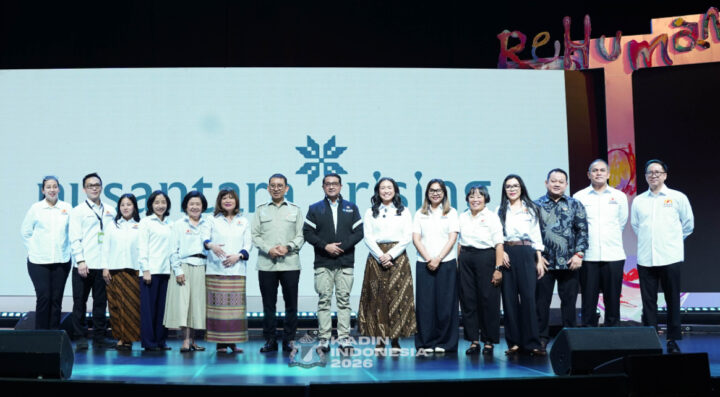
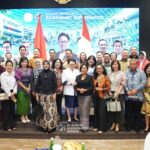
Jakarta – The Indonesian Chamber of Commerce and Industry (Kadin Indonesia) officially launched Nusantara Rising: Indonesia’s Collective Soft Power Movement and the Indonesia Soft Power White Paper as part of IdeaFest 2026, held at the Jakarta International Convention Center (JICC), Senayan, Central Jakarta, on Thursday (September 4, 2026).
The initiative was developed in collaboration with industry players and academics, with support from the Ministry of Culture of the Republic of Indonesia and the Ministry of Creative Economy of the Republic of Indonesia.
Deputy Chairman for Human Development, Culture, and Sustainable Development of Kadin Indonesia, and Chair of the Organizing Committee, Shinta Widjaja Kamdani, opened the event by highlighting the scale of an economic opportunity that has largely gone unnoticed.
Shinta cited China’s short-form drama industry, known as duanju, which has been operating for only three years yet has generated approximately IDR 156 trillion annually, equivalent to Indonesia’s oil and gas export value in 2024. She also highlighted South Korea, where annual government investment of USD 440 million in culture has helped drive a content industry valued at USD 107 billion.
“Indonesia does not lack raw materials. What we lack is the strategic thread that connects them all, moving from a sectoral approach toward a circular cultural economy,” Shinta said.
Furthermore, Kadin Indonesia Deputy Chairman for Culture Rahayu Saraswati Djojohadikusumo emphasized that Indonesia’s rich cultural assets, including more than 1,300 ethnic groups and hundreds of living languages, do not automatically translate into national strength. She identified the “missing middle” as one of the biggest structural challenges facing the sector today: many Indonesian creative works are too large for micro-level financing, yet are not sufficiently bankable to access corporate financing or venture capital.
Rahayu emphasized that Kadin Indonesia’s role in this ecosystem is to serve as a bridge, rather than to replace the responsibilities of government ministries.
“Kadin Indonesia is not here to replace the government’s role. Kadin Indonesia is here to bridge policy with industry, creators with financing, and local intellectual property with global opportunities,” she said.
As one of the initiators of the White Paper, Ivan Chen, a member of the Kadin Indonesia Board in the Culture sector, presented the research underpinning the document. The research draws lessons from South Korea’s reclassification of cultural spending following the 1997 crisis, the commitments established under the 2005 UNESCO Convention, and the role of the state as a policymaker.
Ivan also linked the urgency of strengthening Indonesia’s cultural ecosystem to employment data, noting that the majority of unemployed young Indonesians fall within the same age group that also accounts for the country’s 183 million domestic gamers.
“A young generation that is not rooted in its own culture will not grow into a golden generation. This is not merely a cultural crisis. It is a crisis of sovereignty,” he said.
Minister of Culture Fadli Zon welcomed the launch of Nusantara Rising and emphasized that Indonesia’s cultural wealth holds significant potential as both an economic force and a source of national soft power.
“Indonesia has mega cultural diversity. Our cultural wealth is not merely a heritage that needs to be preserved, but also a source of creativity, economic value, and Indonesia’s influence in the world,” Fadli said.
On the same occasion, the Ministry of Culture also issued a decree establishing the National Soft Power Committee of Indonesia, which will serve as a cross-sectoral platform to strengthen the development of Indonesia’s soft power.
Meanwhile, Minister of Creative Economy Teuku Riefky Harsya outlined the alignment between the initiative and the National Creative Economy Master Plan (Rindekraf), which was officially launched by the President, and affirmed the government’s commitment to fostering synergy between the two initiatives going forward.
The Ministry of Creative Economy, he added, is ready to collaborate with Kadin Indonesia in supporting Nusantara Rising.
“We do not want Indonesia to merely become a market for global content. We also want Indonesia to grow into a content powerhouse capable of bringing Indonesian culture, character, and stories to the world through the creative works of our people, including music, films, animation, and games,” he said.
“Our challenge going forward is how to orchestrate all of this potential so that it becomes not only an economic force, but also Indonesia’s soft power on the global stage,” he added.
Nusantara Rising and the Indonesia Soft Power White Paper are positioned as a foundation for cross-sectoral collaboration within a hexahelix ecosystem involving government, business, academia, communities, media, and financing and technology partners. The initiative aims to bring together strategies and programs that have previously operated across separate sectors.
Kadin Indonesia emphasized that the document is not an end point, but rather the beginning of a collective movement toward achieving Indonesia Emas 2045 (Golden Indonesia 2045).
Also attending the event was Kadin Indonesia Deputy Chairman for Organization Taufan Eko Nugroho Rotorasiko.