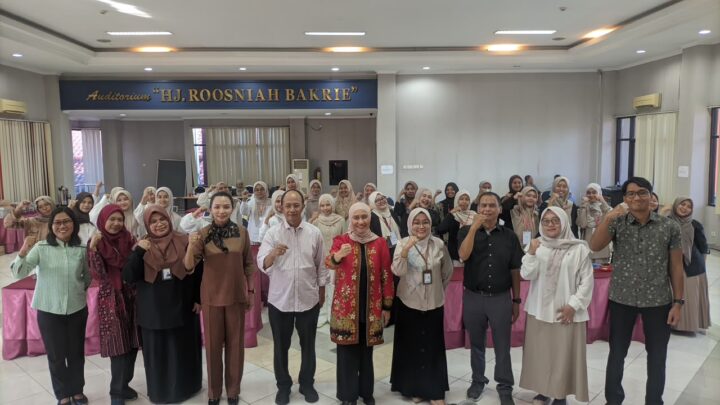
Surabaya – The East Java Provincial Chamber of Commerce and Industry (Kadin East Java), together with Kadin Institute, Save the Children, and the East Java Provincial Manpower Office, held a training program to develop child care professionals as part of efforts to strengthen Indonesia’s care economy. The training took place at the Kadin Institute office in Surabaya from July 27 to August 6, 2026.
The program marks an initial step toward establishing child care as a profession that is no longer underestimated, but instead recognized as a promising career amid growing demand for childcare services.
Chairman of Kadin East Java Adik Dwi Putranto said the training program will be expanded to five locations across East Java, involving a total of 150 participants.
Adik explained that all participants would undergo intensive training covering infant and child care, healthcare, nutritious meal planning, hygiene, and support for children’s growth and development. After completing the training, participants will undertake a one-week internship before taking a competency assessment.
“After completing the training and internship, participants will take a competency assessment through the Nusantara Domestic Workers Professional Certification Institute, which is licensed by the National Professional Certification Agency (BNSP). Those who are declared competent will then be offered opportunities at daycare centers in need of certified child care professionals,” he explained.
Meanwhile, Director of Kadin Institute Nurul Indah Susanti said the training is part of the follow-up development of the care economy concept, namely an economic sector that recognizes caregiving work as a valuable profession that is essential to society.
“The goal is to follow up on the development of the care economy. In the past, jobs such as baby caregivers, child caregivers, and elderly caregivers were often regarded as side jobs. Today, however, they are emerging as highly promising professions,” said Nurul.
Nurul explained that before the participant training began, Kadin Institute had developed training modules and trained 20 instructors. Participants received two weeks of training covering technical childcare competencies as well as teaching methodologies, followed by a one-week internship at a childcare facility before taking the competency assessment.
Once declared competent, the instructors will be deployed to train prospective child care professionals to ensure they meet proper service standards. According to Nurul, demand for professional caregivers will continue to grow, particularly as policies promoting the provision of childcare facilities in industrial areas gain momentum.
“We hope child care will become a new profession for young people. This is a noble profession and one that is greatly needed. In industrial areas, for example, the provision of childcare facilities is increasingly being encouraged so that workers, particularly mothers with young children, can work with peace of mind knowing that their children are receiving proper care,” she said.
She added that the quality of care during children’s formative years is a key focus of the training. Participants receive various types of instruction, covering child growth and development, health, first aid, nutrition, communication, as well as soft skills and public speaking.
Nurul noted that various cases of violence occurring at childcare facilities serve as an important lesson that caregiving must be carried out by professionals with the necessary competencies, empathy, and understanding of children’s psychological development.
“The ages of zero to six are the golden years of a child’s development. Everything children see, hear, and experience will shape their development in the future. Therefore, caregivers cannot rely solely on instinct; they must be equipped with knowledge, skills, and a caring heart,” she stressed.
One of the participants, Aura Puspa Devina, a student at the Faculty of Tarbiyah and Teacher Training at UIN Sunan Ampel Surabaya, said the practical sessions were the most memorable part of the training.
“What left the strongest impression on me were the practical sessions and role-playing exercises on handling children aged three to six. We also learned how to prepare nutritious meals according to children’s needs and practiced first aid for children who sustain injuries. I realized that being a caregiver requires more than just instinct; it must be supported by knowledge,” she said.
Another participant, Lailatul Choiriyah, who works at a daycare center in Surabaya, said the training enriched her knowledge in areas she had never previously learned.
“I have been working at a daycare for quite some time, but I realized there was still a lot I did not know. We learned about balanced nutrition, how to respond when a child is choking, first aid when a child falls, maintaining daycare hygiene, and how to care for children when they vomit or use the toilet. The material was very comprehensive, and the delivery was engaging,” she said.
She expressed hope that similar training programs would continue to be held so that more Indonesian women can develop professional childcare competencies while also gaining valuable knowledge for caring for children within their families.
Through this program, Kadin East Java hopes that child care will gain greater recognition as an important profession in strengthening the quality of Indonesia’s human resources, while also creating new employment opportunities for young people who are passionate about childcare and caregiving.