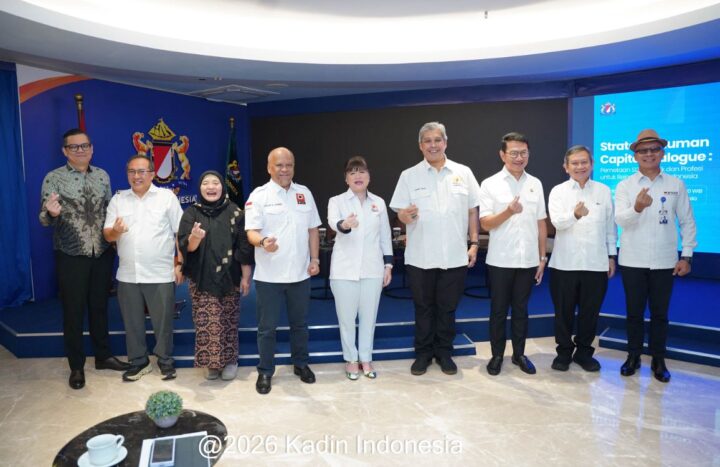
Jakarta – The Indonesian Chamber of Commerce and Industry (Kadin Indonesia) held a Strategic Human Capital Dialogue titled Mapping Technical and Professional Human Resources for Indonesia’s Reindustrialization at Kadin Tower, South Jakarta, on Wednesday (June 24, 2026).
Shinta Widjaja Kamdani, Coordinating Vice Chairwoman for Human Development, Culture, and Sustainable Development at Kadin Indonesia, highlighted the importance of enhancing Indonesia’s competitiveness by learning from the experiences of other countries, particularly Vietnam, which has demonstrated remarkable progress in attracting investment and developing its industrial sector.
According to Shinta, discussions about Vietnam have largely focused on regulatory frameworks, licensing procedures, and investment incentives. However, human capital development and labor productivity should also receive greater attention.
“We see Vietnam as one of the fastest-growing economies in the region. When discussing competitiveness, Vietnam is often used as a benchmark because Indonesia appears to be falling behind,” she said.
Shinta noted that Kadin has encouraged the government to use Vietnam as one of the benchmarks for improving Indonesia’s national competitiveness. In addition to investment policies, Indonesia should also study labor productivity factors. She pointed out that Vietnam’s standard working hours reach 48 hours per week, compared to Indonesia’s average of 40 hours per week. Productivity, she emphasized, is an important factor to consider alongside wage levels.
“This is not merely a matter of wage levels; productivity is equally critical. These are the kinds of lessons we need to learn from countries such as Vietnam, which appear to be moving faster. Vietnam continues to serve as a benchmark for us in identifying ways to strengthen Indonesia’s competitiveness,” Shinta explained.
She further emphasized that successful industrialization depends not only on capital, technology, and infrastructure, but also on the quality of human resources.
According to Shinta, investment in people is the most decisive factor in supporting industrial transformation. Modern factories require competent technicians, digital transformation demands strong technology talent, and the development of green industries requires professionals who understand sustainability standards.
“Even the most advanced technology cannot deliver optimal benefits without the right talent behind it. This is why mapping technical and professional human resources is so important,” she said.
Shinta explained that Indonesia is currently developing a range of strategic sectors as future growth engines, including mineral downstream processing, electric vehicle and battery industries, semiconductors, healthcare, modern agriculture and food systems, renewable energy, and the digital economy. Each of these sectors requires different competencies, making a one-size-fits-all approach to workforce development increasingly ineffective.
“We need a workforce planning system that is data-driven, industry-oriented, and capable of anticipating rapid technological changes,” she said.
She also stressed the importance of collaboration among government institutions, businesses, universities, vocational schools, training centers, and professional organizations in building an integrated talent development ecosystem.
“The government plays a crucial role as a facilitator, ensuring that the entire ecosystem functions in an integrated manner. The link-and-match concept that we have long promoted must evolve into deeper and more strategic partnerships,” she added.
Shinta further noted that the ability to learn and adapt has become just as important as technical expertise. Technological advancements will create entirely new professions over the next five to ten years, while many existing jobs are likely to be transformed or even replaced.
For this reason, she believes that a culture of lifelong learning must become a central pillar of Indonesia’s human capital development strategy. Workers should have opportunities to continuously upgrade their skills and acquire new competencies through reskilling initiatives, while companies should make talent development an integral part of their business strategy.
“Ultimately, success will be measured by our ability to develop Indonesians who are productive, competent, innovative, and capable of competing on a global scale,” she said.
Meanwhile, Insannul Kamil, Vice Chairman for Cooperation in the Development of Technical and Industrial Professional Human Resources at Kadin Indonesia, explained that the dialogue was designed to orchestrate collaboration among all relevant stakeholders. The exponential pace of change requires Indonesia to rapidly develop talent that is aligned with emerging industry needs.
This is particularly important as Indonesia accelerates development across key sectors, including food security, energy transition, reindustrialization, and commodity downstream processing.
“All of these sectors require skilled talent capable of operating and managing them, because ultimately, execution depends on people. Kadin is currently bringing together educational institutions, businesses, industries, professional associations, and Professional Certification Bodies (LSPs) to identify and map existing competency gaps,” Insannul said.
Strong support for the initiative has also come from the National Professional Certification Agency (BNSP). BNSP Board Member Adi Mahfudz stated that Kadin is the most appropriate institution to conduct industry mapping due to its extensive network of Extraordinary Members (ALB) and various sectoral associations under its umbrella.
However, Adi emphasized that the mapping outcomes must be realistic and translated into practical implementation through “Industrial Classes” within vocational education and training programs.
“What do we mean by industrial classes? The needs identified within a particular industry are translated into an industry-based curriculum. As a result, graduates and trainees are developed directly in accordance with industry requirements or specific market demand,” stressed Adi, who also serves as Vice Chairman for Vocational Education and Certification at Kadin Indonesia.