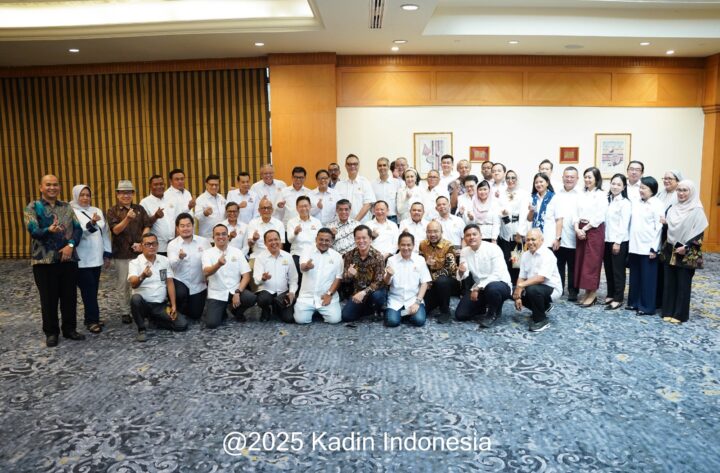
Jakarta - The Indonesian Chamber of Commerce and Industry (Kadin Indonesia) held its latest Monthly Economic Diplomacy Breakfast under the theme "National Productivity Movement" at Hotel Aryaduta, Jakarta, on Friday (September 12, 2025).
The forum featured prominent speakers including James T. Riady, Vice Chairman for International Affairs at Kadin Indonesia; Pahala Mansury, Vice Chairman for Trade and International Agreements; and Indonesia’s Minister of Manpower, Yassierli.
In his presentation, James Riady emphasized that the current global geo-economic landscape offers more optimism than previously expected.
"While many initially predicted a global economic slowdown, the reality is that the world economy has remained stable," James explained.
"Economic conditions that were thought to be problematic have proven resilient. In fact, the global GDP growth forecast has been revised upward twice most recently from 2.8% to 3%. This is a very positive development, largely driven by the services sector and digital services,” he said.
James also underlined the urgent need to embrace the development of artificial intelligence (AI). He warned that global companies are beginning to view AI illiteracy as an unacceptable weakness.
“If we don’t run toward this change, we will fall behind,” he stressed.
James further highlighted the critical role of the services sector in Indonesia’s economy, noting that its contribution is growing at a much faster pace than the national average.
“If our national economy grows by 5%, the services sector could grow by 12-13%, even though it requires significantly less capital investment. This is a major opportunity we must seize,” he said.
Pahala Mansury, Vice Chairman for Trade and International Agreements, also addressed the forum, noting Indonesia’s strategic opportunities amid shifting global supply chains.
According to Pahala, the “China Plus” strategy adopted by many countries is opening significant opportunities for Indonesia, especially in labor-intensive sectors.
“Many countries are exploring options to relocate industries from China or Vietnam to Indonesia. Especially since tariffs in China are still at 75% and in India 50%, Indonesia has a highly competitive position. But the key lies in productivity,” Pahala explained.
Meanwhile, Minister of Manpower Yassierli reaffirmed that boosting productivity is crucial to achieving the Indonesia Emas 2045 vision.
He stated that starting next year, the government will begin direct intervention in businesses, targeting at least 1,000 companies to be assessed and analyzed by productivity experts. The findings will serve as tailored recommendations for each company.
“We’ve trained 700 people so far and aim to reach at least 10,000 by the end of this year. Next year, 1,000 companies will receive direct guidance from productivity experts. We’re also setting up productivity centers involving universities and industrial zones,” Yassierli said.
The government is also preparing to establish productivity centers across industrial areas in collaboration with universities and educational institutions, to ensure a comprehensive and integrated approach to boosting productivity.
“There is a direct correlation between productivity and economic growth. That’s why our focus must be clear: making productivity a national movement,” he concluded.
Other notable attendees at the forum included Thomas Jusman (Vice Chairman for Strategic Infrastructure Development, Rural Development, and Transmigration), Didit Ratam (Chairman of the Russia-Belarus Bilateral Committee), Buchari Bachter (Chairman of Kadin West Sumatra), and M. Armyn Syarif Latuconsina (Chairman of Kadin Maluku).