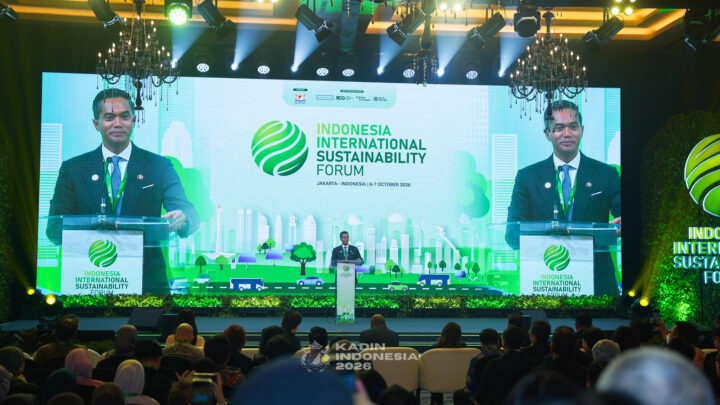
Jakarta – Indonesian Chamber of Commerce and Industry (Kadin Indonesia) Chairman Anindya Novyan Bakrie said energy security has once again become a major global priority amid rising geopolitical uncertainty. The situation also presents an opportunity for Indonesia to accelerate its energy transition and reduce its dependence on imported fuels.
Anindya, popularly known as Anin, made the remarks at the opening of the Indonesia International Sustainability Forum (ISF) 2026, themed “Investing for a Resilient, Sustainable, and Prosperous World,” at the Grand Ballroom of Hotel Indonesia Kempinski, Central Jakarta, on October 6–7, 2026.
Anin said the conflict in the Middle East serves as a reminder that global energy markets remain vulnerable to geopolitical disruptions. The impact has been reflected in rising oil prices, which climbed from around US$65 to US$110 per barrel in 2026.
The situation is particularly significant for Indonesia, Anin added, as national fuel consumption stands at approximately 1.6 million barrels per day, while domestic oil production amounts to only around 600,000 barrels per day. This leaves a gap of approximately 1 million barrels per day that must still be met.
“Indonesia sees this as a serious issue. This dependence makes us vulnerable when global prices fluctuate,” Anin said.
According to Anin, Indonesia has an opportunity to strengthen its energy security by accelerating electrification, increasing the use of renewable energy, and reducing its reliance on imported fuels. He said President Prabowo Subianto had emphasized that strengthening energy self-sufficiency must form an important part of Indonesia’s response to global uncertainty.
In this context, Kadin views the Indonesia Incorporated approach, which encourages the government and business community to work together, as a strategic step toward strengthening Indonesia’s position.
“At Kadin, we believe the President’s vision of Indonesia Incorporated, in which the government and business community work together, is the right approach,” Anin said.
Meanwhile, Anin noted that global investment in the energy transition continues to increase despite geopolitical tensions. Global energy transition investment reached a record US$2.3 trillion in 2025. Global spending on electrified transport also reached nearly US$900 billion in 2025, up from US$741 billion the previous year.
Anin also commended the government, particularly the Ministry of Investment and Downstreaming/Investment Coordinating Board (BKPM), for the increased adoption of electric vehicles in Indonesia. Electric vehicle sales in the country were reported to have nearly doubled over the past year.
According to Anin, these developments demonstrate that the energy transition is not only a necessity but also a source of new economic opportunities for Indonesia.
“This creates both urgency and opportunity,” he said.
Anin added that Kadin had previously estimated Indonesia’s economic potential from its net-zero agenda at US$3.8 trillion through 2050. Realizing this potential will require active private-sector participation in climate initiatives, financing, carbon markets, and skills development.
In closing, Anin outlined five Kadin priorities for advancing climate action and sustainable growth. The first is accelerating the energy transition to strengthen energy security. The second is expanding high-integrity carbon markets. The third is supporting Indonesian companies in achieving their net-zero targets.
“Fourth, promoting the development of the circular economy and energy utilization, and fifth, strengthening sustainable forestry practices,” Anin said.
Meanwhile, Indonesian Presidential Special Envoy for Climate and Energy Hashim S. Djojohadikusumo said Indonesia’s geographic and demographic characteristics, along with its geopolitical position, make the country strategically important and attractive to investors.
He added that the Ministry of Investment and Downstreaming/BKPM continues to receive investment interest from countries around the world.
“Indonesia is always looking for friends. Our President always says that a thousand friends are too few and one enemy is too many. This principle is the main foundation of our foreign policy,” Hashim said.
Investment and Downstreaming Minister and BKPM Head Rosan Roeslani said the energy transition is opening up new investment opportunities in downstream industries and digital infrastructure, as demand for electricity from the digital economy and clean energy for industry continues to rise.
“One of the most important opportunities before us lies at the intersection of the energy transition and the digital economy,” Rosan said.
According to Rosan, advances in artificial intelligence (AI) are increasing electricity demand, while data centers are becoming an increasingly important part of strategic infrastructure.
“The future of AI will depend on electricity, transmission networks, industrial land, connectivity, and investment. In other words, the future of AI is also about infrastructure,” he said.
Separately, Kadin Indonesia Coordinating Deputy Chairman for Human Development, Culture, and Sustainable Development Shinta W. Kamdani said sustainability is increasingly becoming an integral part of business growth strategies and competitiveness.
“Sustainability is increasingly becoming part of how businesses view growth, competitiveness, and future opportunities. For companies, this transition creates room to innovate, generate value, and build long-term competitiveness. ISF 2026 brings together businesses, investors, the government, and various strategic partners to explore these opportunities and promote collaboration that can support sustainable and resilient growth,” Shinta said.
ISF 2026 Organizing Committee Chairman Rachmat Kaimuddin said Indonesia continues to identify opportunities to strengthen its sustainable and resilient growth agenda amid global shifts and uncertainty.
“Amid changing global directions and dynamics, maintaining consistency in the sustainability agenda is becoming increasingly important. For Indonesia, the challenge is to sustain growth momentum while advancing the transition toward a more sustainable economy,” he said.
Rachmat said green growth should be positioned as part of the national development strategy to strengthen economic resilience, create new opportunities, and generate long-term value for society.
“Starting from national interests can actually make the sustainability agenda more relevant and enduring, while opening up opportunities for global collaboration,” he said.
Kadin Indonesia officials attending the event included Coordinating Deputy Chairman for Economic Affairs Franky O. Widjaja; Coordinating Deputy Chairman for Investment, Downstreaming, Energy, and the Environment Bobby Gafur Umar; Coordinating Deputy Chairman for Law and Human Rights, Facilities and Infrastructure M. Azis Syamsuddin; and Deputy Chairman for Export Development Juan Permata Adoe.