Jakarta – Indonesia’s healthcare spending should become a driver of domestic industry and job creation, Health Minister Budi Gunadi Sadikin said. He noted that the country’s growing demand for healthcare services has yet to generate its full economic benefits at home, as many of the products used are still sourced from overseas.
Budi called on the Indonesian Chamber of Commerce and Industry (Kadin Indonesia) and international investors to strengthen domestic production. He said investment is needed to ensure that growing healthcare demand also boosts national industrial capacity, creates jobs, and strengthens the economy.
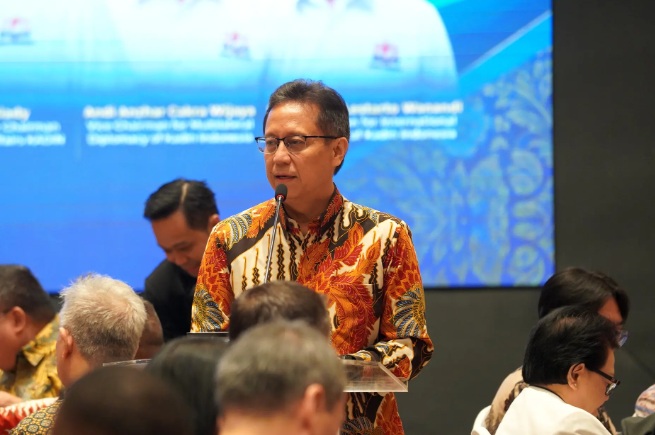
“Economic growth and job creation are not happening in Indonesia because most of the goods we purchase come from abroad,” Budi said at the Kadin Monthly Economic Diplomacy Breakfast, held at Leimena Hall, Adhyatma Building, Ministry of Health of the Republic of Indonesia, Jakarta, on Friday (October 9, 2026).
The forum was attended by Kadin Indonesia Chairman Anindya Novyan Bakrie, Coordinating Deputy Chairman for Foreign Affairs James T. Riady, ambassadors, and business representatives. Foreign Minister Arrmanatha Christiawan Nasir was represented by the Secretary-General of the Ministry of Foreign Affairs.
Budi said Indonesia’s healthcare spending had grown by approximately 9–11% annually over the past decade, based on figures presented during the event. This growth highlights the healthcare sector’s potential to help accelerate national economic growth.
However, he cautioned that higher spending does not automatically translate into increased domestic production and employment. When demand is met through imports, some of the economic benefits flow to the countries where those products are manufactured.
“That is why we are working with Kadin to ensure that foreign investment comes into Indonesia, enabling us to build production capacity, generate domestic economic growth, and create jobs,” he said.
According to Budi, Indonesia’s large population, growing demand for healthcare services, and people’s aspirations to live longer and healthier lives offer substantial investment opportunities. He urged ambassadors to communicate these opportunities to business communities in their respective countries.
Budi also highlighted the relationship between rising life expectancy, service quality, and healthcare spending. In his presentation, he compared Indonesia with Malaysia and Singapore to illustrate the significant potential for further development of the country’s healthcare services.
The comparison was intended to illustrate the size of the potential market as healthcare system capacity and service utilization improve. Budi sees this demand as an opportunity for investors to develop service delivery and production capabilities in Indonesia.
Behind his views on the healthcare industry, Budi shared a personal experience that shaped his priorities as health minister. His mother suffered a stroke at the age of 65 in Bogor. At the time, despite his extensive access through his senior position at a major bank, he struggled to obtain a CT scan for her.
According to Budi, the CT scanner needed in Bogor was not operational when the incident occurred. His family then searched for a hospital in Jakarta. Approximately six hours passed from the onset of his mother’s symptoms before she received the examination.
Budi recounted that his mother lived with severe disabilities for the rest of her life before passing away at the age of 79. She was no longer able to walk, speak, or use her hands as she had before.
The experience left Budi with a profound question: why was access to an essential medical facility still unavailable when someone faced a medical emergency?
Consequently, after being appointed health minister in December 2020 and taking charge during the COVID-19 pandemic, improving the distribution of hospital facilities became one of his priorities. He wanted people across different regions to have better access to medical examinations and healthcare services.
Budi explained that the government had secured financing from several multilateral development institutions to strengthen medical equipment at hospitals serving 514 regencies and cities. The equipment includes CT scanners, cardiac catheterization facilities, mammography machines, and hemodialysis services.
He said his banking experience had helped him secure financing for these transformation needs. International support was subsequently directed toward strengthening domestic healthcare capacity.
Budi also described how his conversations with businesspeople who had once been his banking clients had changed. When he was leading a bank, their discussions typically focused on investment, risk, returns, corporate restructuring, and additional financing.
After he became health minister, their questions shifted toward access to doctors, the latest medical technologies, and the possibility of living longer and healthier lives. From this experience, Budi came to appreciate how highly people value their health, including those who have already accumulated substantial wealth.
“I then realized that the greatest wealth is life itself, because everyone wants to live a long and healthy life,” he said.
This perspective has further deepened Budi’s interest in developments in medical science. He highlighted advances in biotechnology, computer science, and artificial intelligence, which have the potential to improve understanding of the human body and support better healthcare delivery.
Budi expects these technological developments to bring significant changes to healthcare over the next five to ten years. For Indonesia, these changes reinforce the need to build technological and industrial capabilities to participate in this progress.
While emphasizing the growth opportunities presented by healthcare spending, Budi also stressed the importance of efficiency. He pointed to differences in healthcare expenditure across countries that do not always correspond to differences in life expectancy. In his view, these comparisons demonstrate the need for greater transparency and better system management.
Toward the end of his remarks, Budi addressed the need to reform the WHO and other international organizations. In the context of his candidacy for WHO Director-General, he emphasized the importance of leaders with experience implementing change within large organizations.
Budi said his experience leading transformation at Bank Mandiri and in Indonesia’s healthcare sector had prepared him to face these challenges. He argued that reform requires the ability to overcome bureaucracy and accelerate implementation.
“If we want to reform a major global organization, we need a leader with a track record of carrying out major reforms within large organizations,” he said.