Jakarta – Indonesia’s business sector in the first quarter of 2026 has tended to adopt defensive strategies in response to increasingly uncertain global pressures. Amid the impact of geopolitical conflicts, surging energy prices, exchange rate fluctuations, and supply chain disruptions, the majority of businesses are focusing more on maintaining internal efficiency, while others are still taking a wait-and-see approach as they assess the most appropriate strategic direction.
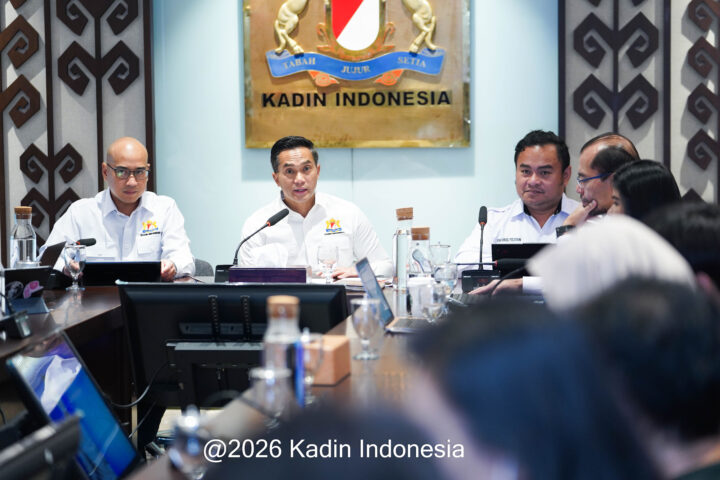
This is reflected in the Indonesian Chamber of Commerce and Industry (Kadin) Business Pulse Q1-2026, released by the Kadin Indonesia Institute on Friday (April 24, 2026), based on a survey of Indonesian business perceptions regarding business conditions, challenges, and the impact of global uncertainty. Chief of the Kadin Indonesia Institute, Mulya Amri, said the survey was conducted from March 17 to April 5, 2026, involving 210 Kadin members across 27 provinces using random sampling through WhatsApp and online survey forms.
The survey results show that companies’ anticipatory measures against the impact of geopolitical conflicts are still dominated by internal strategies. Operational cost efficiency is the main measure chosen by 33.9% of respondents, indicating that businesses are more focused on maintaining profit margins by reducing production, distribution, and operational costs amid rising input prices and high global uncertainty. This strategy suggests that companies’ main priority at present is not expansion, but maintaining healthy cash flow and business stability.
However, the survey also shows that 29.3% of businesses have not taken or are not taking any specific measures. This significant proportion indicates that many businesses are still adopting a wait-and-see stance, either due to limited capacity to adapt quickly or uncertainty about the most appropriate mitigation strategy amid continuously evolving conditions. This attitude reflects a high level of caution, but also indicates that parts of the business sector remain vulnerable if global pressures persist for a longer period.
Adaptive measures have begun to emerge, but their scale remains limited. Around 9.9% of respondents have chosen to diversify trading partners, 9.5% are reviewing business contracts and supply chains, and 7.1% are diversifying sources of raw materials or supply. These figures indicate a growing awareness among businesses to reduce dependence on specific markets, suppliers, or distribution channels in order to minimize the impact of global disruptions. Meanwhile, 6.4% of respondents are shifting focus to domestic demand as a way to sustain sales continuity, while only 3.9% are engaging in asset or currency hedging, indicating that financial risk management practices are not yet widespread among businesses.
This defensive stance is inseparable from the business pressures currently being felt. In Q1-2026, perceptions of current business conditions compared to the previous quarter tend to be negative.
A total of 40.5% of respondents disagreed that current business conditions are better than the previous quarter, while 25.2% agreed and 34.3% considered them unchanged. These findings suggest that businesses are still burdened by cost pressures, weak demand, and geopolitical uncertainty.
Similar pressures are also reflected in perceptions of conditions within their respective industries. As many as 44.3% of respondents stated that conditions in their industry are not better than the previous quarter, while 22.9% said they are better and 32.9% considered them unchanged. This confirms that the slowdown is being felt across sectors, and that recovery at the industry level remains uneven.
The impact has also extended to investment decisions. The survey shows that investment plans for the next six months tend to weaken. About 39.0% of respondents said they do not plan to invest in the next six months, slightly higher than the 38.6% who said they do, while 22.4% remained neutral. This indicates that investment interest remains restrained due to high caution regarding short-term economic prospects.
In terms of business challenges, the survey results indicate that the greatest pressures currently come from government policies and programs. Around 16.7% of respondents cited government policies and programs as the main challenge, followed by bureaucracy (14.3%), demand (11.4%), access to financing (9.5%), and legal uncertainty (9.3%). External pressures are also increasingly felt through supply chain disruptions (3.4%), weather/climate/natural disasters (3.6%), and technological changes (3.0%). This suggests that businesses are not only facing market-related issues but must also adapt to rapid changes in policies, standards, and global dynamics.
In the geopolitical context, businesses are experiencing tangible impacts. Surging energy or commodity prices are the most significant impact, cited by 20.9% of respondents, followed by declining market demand (16.2%), depreciation of the rupiah (16.2%), increased operational risks (11.8%), global policy or market uncertainty (11.5%), and global supply chain disruptions (10.9%). Meanwhile, 12.5% of respondents reported no significant impact, indicating that geopolitical effects are not uniformly felt across all sectors.
In terms of preparedness, 36.7% of respondents said they are ready to face the impact of geopolitical conflicts, 32.4% said they are neutral, 25.8% admitted they are unprepared, and 5.2% did not know or did not respond. These findings show that while some businesses have basic capabilities to respond to geopolitical pressures, a substantial number are still not fully prepared. Among those who consider themselves unprepared, 81.8% also perceive business conditions as worsening, while only 18.2% see improvement. Conversely, among those who feel prepared, perceptions are more balanced, with 52.6% seeing improvement and 47.4% seeing deterioration.
The survey also captures positive developments that continue to support business optimism. Market developments remain the main positive factor at 24.1%, although declining compared to the previous quarter. Meanwhile, technological developments have increased significantly to 22.0%, indicating that digitalization and innovation are becoming new sources of efficiency and optimism. Other positive factors include policy improvements (13.6%), better regulations (11.9%), a more conducive competitive environment (10.6%), access to financing (7.0%), and improved access to international markets (4.3%).
Looking ahead to Q2-2026, business confidence that conditions will improve still largely depends on central government policies. Around 39.5% of respondents cited central government policy as the main factor supporting optimism for business and economic improvement in Q2-2026. This shows that the direction and consistency of national policy remain the primary anchor of business expectations, particularly regarding energy price stability, the increase in biodiesel mandates from B40 to B50, and higher government spending as fiscal stimulus.
In addition, sources of optimism are beginning to shift toward external factors and financing. Global market trends are cited by 16.2% of respondents, indicating expectations of improved global conditions and increased demand. Easier access to financing is mentioned by 11.9%, highlighting the importance of liquidity support for business expansion. Meanwhile, improved legal certainty accounts for 14.3%, regional government policies 8.1%, and appropriate fiscal incentives 5.2%. However, 1.9% of respondents said there is no factor, and another 1.9% cited geopolitical stability, reflecting that some businesses still lack strong confidence in near-term improvement.
In line with this, businesses have also expressed their most urgent policy needs from the government. Temporary subsidies or fiscal incentives are chosen by 19.8% of respondents, followed by easier access to financing (19.5%), exchange rate stability and responsive monetary policy (16.7%), diversification and stabilization of energy supply (15.1%), and logistics support and security guarantees (15.1%). Meanwhile, trade tariff reductions (6.0%) and the development of hedging instruments and financial diversification (5.7%) remain lower priorities. This indicates that businesses currently prioritize liquidity buffers and macroeconomic stability over more technical instruments.
Overall, the Kadin Indonesia Business Pulse Q1-2026 highlights that Indonesia’s business sector remains in a highly cautious phase. Rather than taking aggressive steps, businesses tend to focus on maintaining efficiency, holding back investment, and monitoring developments before making further moves. Amid geopolitical and global economic uncertainty, a defensive strategy remains the dominant choice, while optimism persists but is highly dependent on government policy, improvements in global market conditions, and access to financing.