Surabaya – Unemployment in East Java remains a major challenge, particularly among university graduates. Amid growing industry demand for workers with relevant skills and qualifications, the open unemployment rate (TPT) among bachelor's degree holders has continued to rise. The National Apprenticeship Program is expected to serve as one solution to bridge the gap between business needs and the capabilities of fresh graduates.
According to data from the East Java Provincial Government through its Regional Organization Bureau, the unemployment rate among bachelor's degree holders reached 6.04% in February 2026. This marked an increase from 5.60% in February 2025 and 4.07% in February 2024.
The unemployment rate among university graduates was even the highest compared with other educational levels. High school graduates ranked second, with an unemployment rate of 5.75%, followed by vocational high school graduates at 5.73%.
A similar pattern can be observed at the national level. Based on data from the National Labour Force Survey (Sakernas), the proportion of university graduates among Indonesia's total unemployed population has shown an upward trend in recent years.
In August 2022, approximately 674,000 university graduates were unemployed, accounting for 7.98% of the total unemployed population. This figure rose to around 843,000, or 11.28%, in August 2024. The trend continued in May 2026, when Sakernas data recorded 1,033,182 unemployed people with tertiary education qualifications, ranging from Diploma IV and bachelor's degrees (S1) to master's (S2) and doctoral degrees (S3). This represented 14.31% of Indonesia's total 7.22 million unemployed people.
According to Chairman of the East Java Provincial Chamber of Commerce and Industry (Kadin), Adik Dwi Putranto, the increase indicates that unemployment is not solely a matter of educational attainment, but also reflects the labour market's ability to absorb graduates based on their qualifications and competencies. The high unemployment rate among bachelor's degree holders is a shared challenge that requires the involvement of businesses, the government, and educational institutions.
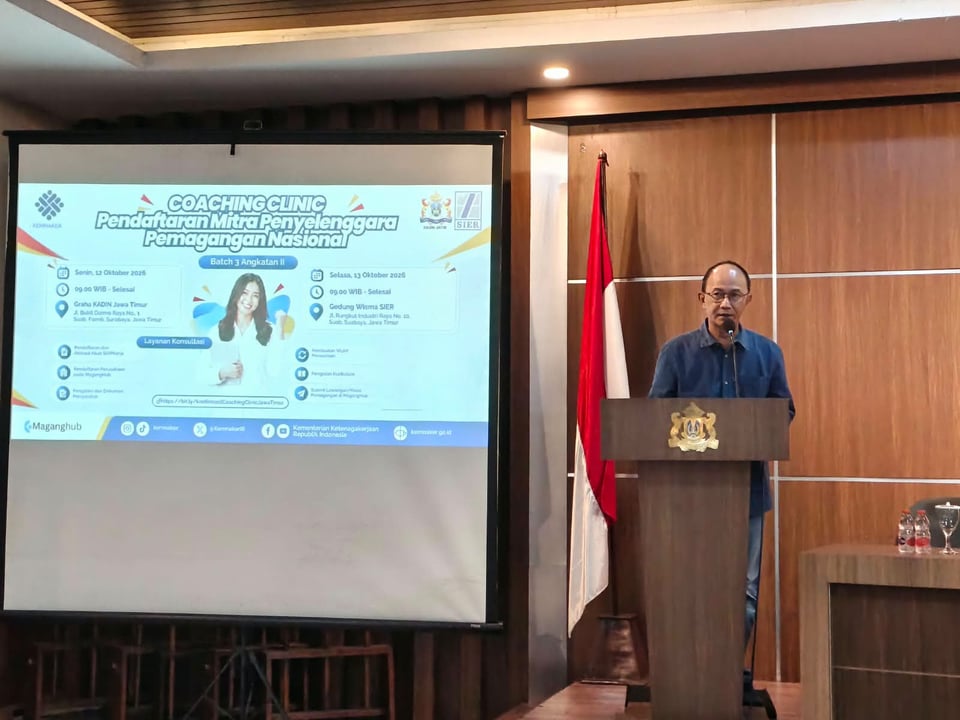
"This is a challenge for all of us. Currently, bachelor's degree graduates account for the largest share of unemployment in East Java. The figure is quite high," he said during a coaching clinic on registration for companies seeking to become partners in the National Apprenticeship Program, organized by the Sidoarjo Vocational Training Center (BLK Sidoarjo) under the Ministry of Manpower at the East Java Kadin headquarters on Monday (October 12, 2026).
According to Adik, the large number of university graduates entering the labour market each year presents its own challenges for employment absorption. Concrete measures are therefore needed to ensure that graduates possess not only academic qualifications but also practical experience and skills that match companies' needs.
Adik expressed hope that the National Apprenticeship Program could help reduce unemployment in East Java. The East Java Provincial Kadin has encouraged district and city Kadin chapters, particularly in industrial areas such as Surabaya, Pasuruan, Gresik, Sidoarjo, and Mojokerto, to help promote the program.
"Alhamdulillah, today the East Java Provincial Kadin has been given the opportunity to host an outreach session on the apprenticeship program. We hope this initiative can help reduce the unemployment rate in East Java," he said.
He added that apprenticeships should be conducted through a structured six-month program. Companies are expected to appoint supervisors or mentors to guide participants from the beginning to the end of the program, ensuring that they gain meaningful work experience in an industrial environment.
"We hope that after completing their apprenticeships, our industry partners will be able to employ them," Adik said.
He further noted that workforce regeneration in the industrial sector also presents opportunities for fresh graduates. According to Adik, some industries replace or regenerate their workforce by as many as 300 employees annually. This is expected to encourage companies to accept apprenticeship participants while preparing a new pool of potential employees.
Head of the Sidoarjo Vocational Training Center (BLK Sidoarjo) under the Ministry of Manpower, Muhammad Aiza Akbar, said the National Apprenticeship Program was designed to bridge the gap between university graduates' competencies and labour market requirements. The program is open to diploma and bachelor's degree graduates who completed their studies no more than one year prior to registration.
"This apprenticeship program is one of the most appropriate breakthroughs to address the mismatch between industry's needs and graduates' competencies," he said.
In 2026, the government is targeting 150,000 apprenticeship participants nationwide, up from the previous year's target of 100,000. The program does not allocate specific quotas for individual provinces. Therefore, companies and prospective participants are encouraged to make use of the available opportunities in accordance with the program's requirements.
Aiza explained that companies participating as apprenticeship partners could benefit from hosting participants who bring strong enthusiasm and a willingness to learn. Throughout the program, participants receive a stipend equivalent to the applicable regency or city minimum wage, funded through the state budget (APBN), as well as employment social security coverage through BPJS Ketenagakerjaan. Companies are also required to provide mentorship throughout the apprenticeship period.
To participate, companies must meet administrative requirements, including registration under the Mandatory Company Employment Reporting System (WLKP), and register through the platform provided by the government. Through the coaching clinic, companies are expected to gain a better understanding of the registration process and prepare apprenticeship positions according to their respective needs.
He emphasized that the program's benefits should not be measured solely by whether participants are recruited after completing their apprenticeships. Six months of work experience can also provide fresh graduates with valuable practical knowledge, from understanding workplace practices and building teamwork to solving problems in a corporate environment.
"At the very least, our young people will gain real experience of what it is like to work in a company. These are things that they may not necessarily have learned in university," he said.
On the other hand, companies can directly assess the capabilities of fresh graduates. The results can provide valuable input for improving recruitment processes and training requirements, while universities can gain insights into the evolving competencies demanded by industry.
According to Aiza, the rising unemployment rate among university graduates does not necessarily indicate that university curricula are misaligned with industry needs. The rapid pace of change in the business sector also presents challenges for educational and training institutions in adapting their programs.
Ultimately, the success of the National Apprenticeship Program should not be measured solely by the number of participants enrolled. The quality of mentorship, relevance of apprenticeship placements, work experience gained, and employment opportunities after completion are all essential factors in ensuring that the program truly serves as a bridge from university to the world of work.