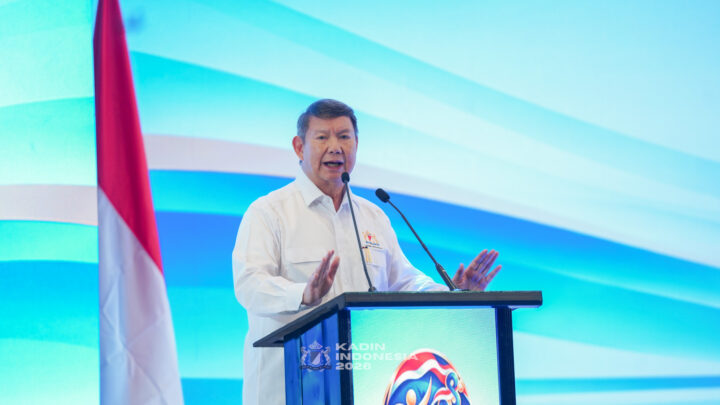
Jakarta - Indonesian Chamber of Commerce and Industry (Kadin Indonesia) Advisory Council Chair Hashim Djojohadikusumo has warned that the rupiah exchange rate risks depreciating to Rp21,000 per US dollar if investor confidence in the Indonesian capital market continues to deteriorate. This risk could escalate further if the issues highlighted by MSCI are not promptly addressed and Indonesia is downgraded to a standalone market.
Speaking at the opening of the Kadin Indonesia National Leadership Meeting (Rapimnas) at Hotel Borobudur, Jakarta, on Thursday (October 29, 2026), Hashim urged the business community to view this matter as a serious threat. The impact could range from declining stock prices to downward pressure on the rupiah, increased foreign currency debt servicing burdens, and disruptions to overall economic activity.
"Because if foreign investment exits our stock market, the rupiah could weaken even further. I have calculated that it could reach Rp20,000 to Rp21,000. Some even say Rp22,000," said Hashim, who also serves as the Presidential Special Envoy for Energy and Environment.
This figure was presented as a warning regarding a risk scenario should foreign capital outflows persist. In his speech, Hashim did not elaborate on the calculation method or the timeframe in which such an exchange rate might be reached.
He cautioned that an excessive depreciation of the rupiah would increase the rupiah requirements needed to service foreign currency liabilities. Companies generating revenues primarily in rupiah while holding US dollar-denominated loans face the risk of surging debt-servicing burdens if these liabilities are not adequately hedged. "Our foreign loans will have to be paid at a much higher cost. This could become a disaster and a catastrophe for the Indonesian economy," he stated.
Illustratively, a liability of US$1 million requires Rp18 billion at an exchange rate of Rp18,000 per US dollar. If the exchange rate weakens to Rp21,000, the rupiah requirement increases to Rp21 billion. This represents an additional requirement of Rp3 billion, or approximately 16.7%, even though the amount of the dollar liability remains unchanged. The actual impact on each company depends on its hedging position, foreign exchange earnings, and the maturity schedule of its liabilities.
Consequently, Hashim's warning encompasses interests far broader than those of equity investors. Exchange rate pressure can spill over into the costs of imported raw materials, capital goods, corporate cash flows, and the ability of business actors to sustain expansion.
Hashim stated that President Prabowo Subianto had asked him to assist Rosan Roeslani and the government ranks in mitigating the challenges faced by Indonesia regarding MSCI, with the aim of preventing capital market pressures from spiraling out of control. "I was asked by the President to assist Mr. Rosan and our colleagues in the government," he noted.
According to Hashim, one of the greatest risks is the shrinking pool of funding sources for the Indonesian capital market if the market status is downgraded. Certain foreign investors may face mandates requiring them to adjust their portfolios in alignment with their investment guidelines and benchmark indices. "If we do not mitigate MSCI, it means the funding sources for our capital market will eventually dry up. Many will be forced to exit if we are downgraded to a standalone market," he said.
This warning comes as MSCI is conducting a consultation regarding a proposed reclassification of Indonesia from an emerging market to a standalone market. In an announcement on October 15, 2026, MSCI highlighted a lack of transparency in share ownership structures, allegations of coordinated trading, and the need for consistent enforcement and governance reform. The consultation runs until April 30, 2027, with a final decision expected no later than June 30, 2027. Consequently, the downgrade is not yet a final decision.
In the scenario warned of by Hashim, equity sell-offs by foreign investors could be followed by the conversion of sale proceeds from rupiah into foreign currency to be repatriated abroad. If executed on a large scale and not offset by adequate capital inflows or foreign exchange supplies, this process could intensify pressure on the rupiah. However, the magnitude of exchange rate fluctuations is not determined solely by equity capital flows.
Hashim specifically highlighted unhealthy practices in stock trading. He pointed to shares with a limited public float yet featuring price-to-earnings ratios that he deemed unreasonable.
"There are indications that unhealthy practices are indeed taking place in our stock market. I will not name anyone, but there are stocks that are, so to speak, 'cooked' [manipulated]," he stated. He did not mention specific stock tickers, companies, or parties accused of involvement, directing his focus instead toward trading behaviors that undermine market credibility and cause losses to other investors.
Limited public share ownership and high valuations do not in themselves constitute proof of manipulation. However, in his speech, Hashim emphasized the necessity of halting coordinated trading practices that strip prices of their fairness and erode investor confidence. "I appeal to my colleagues at Kadin, this is a very, very serious matter," he said.
Hashim subsequently urged Kadin members not to participate in such practices. According to him, the imperative to maintain economic stability and protect investors must be a shared concern of the business community. "Please stop these market manipulation activities. I earnestly ask that manipulation practices be halted immediately," he stressed.
He also mentioned that the government intends to take firm action, drawing a parallel to regulatory crackdowns on market players in Turkey as a cautionary tale. He expressed hope that similar issues would not drag down Indonesian business actors.
The vast number of retail investors participating in the market serves as another reason for the government to address capital market issues seriously. Citing information he attributed to the Financial Services Authority (OJK), Hashim mentioned that 32.7 million Indonesian citizens hold investment or brokerage accounts. In his address, he did not detail the statistical scope utilized.
Hashim assessed that the decline in investment value has generated dissatisfaction among the public, including business actors affiliated with Kadin. He acknowledged that he himself has felt the impact of falling stock prices. "I also own shares in public companies. I am dissatisfied. Therefore, the government must pay attention to this issue," he remarked.
According to Hashim, the government and the business community must be willing to discuss bad news openly so that corrective measures can be implemented swiftly. Optimism regarding economic prospects must be accompanied by the courage to confront ongoing challenges. "Good news, I think, will come next year. But bad news we must face right now," he said.
Amid warnings regarding the capital market, Hashim maintained his confidence in Indonesia's economic potential. He asserted that the country's capacity to finance development can be bolstered through improved revenue collection, technological utilization, and broader public access to financial services.
Hashim argued that the sheer scale of economic activity is not yet fully reflected in state revenues. He cited various small business and service transactions conducted in cash, linking this to the need to improve administrative record-keeping and expand transaction tracking.
He referenced an estimate that approximately 35% to 40% of economic activity remains unrecorded, which he attributed to World Bank sources. However, in his speech, he did not cite the specific study title or its timeframe; the figure served as a reference cited by Hashim rather than a newly presented calculation.
In his fiscal simulation, Hashim utilized a GDP figure of approximately Rp25,000 trillion and a state revenue ratio of roughly 12%. He argued that if the revenue ratio could be raised by six percentage points to 18%, the additional revenue would arithmetically reach Rp1,500 trillion annually.
According to Hashim, an addition of that magnitude would expand the government's capacity to finance development programs and alleviate deficit pressures. Nonetheless, this figure represents an illustrative potential based on his assumptions rather than realized revenues or guaranteed budgetary additions.
Hashim stated that the government will strengthen the use of information technology and artificial intelligence in tax administration. He mentioned plans to implement what he termed digital taxation on November 9, 2026, involving banking institutions and digital platforms in the collection and remittance of taxes in accordance with regulations.
Statements regarding the timeline and scope of implementation were delivered as Hashim's explanation of government plans, without detailing the underlying regulatory framework or technical mechanisms during the forum.
Beyond state revenue, Hashim underscored the importance of financial inclusion. He stated that the government has decided to provide free bank accounts for citizens reaching the age of 17, an initiative expected to facilitate the direct disbursement of social assistance to eligible recipients.
Hashim explicitly clarified that his reference was to free bank accounts, not free mobile phones, asking the media not to distort his statements.
Through more targeted assistance distribution, Hashim hopes to boost public purchasing power and stimulate regional economic activity. He assessed that business opportunities will multiply if state revenues improve and the government secures greater fiscal space to finance development. "Indonesia's future is not dark. Indonesia is not dark; Indonesia is bright," he stated.
Nevertheless, this optimism was coupled with an urgent call for investor confidence issues to be resolved promptly. Hashim warned that ignoring unhealthy market practices could trigger extensive economic and political consequences. "Let us not allow the rupiah to reach Rp21,000 or Rp22,000. This carries an extraordinarily negative political impact," he concluded.
For Hashim, halting stock manipulation practices is part of safeguarding national interests: preserving investor confidence, sustaining corporate financing sources, and preventing capital market pressures from escalating into a broader crisis for the Indonesian economy.