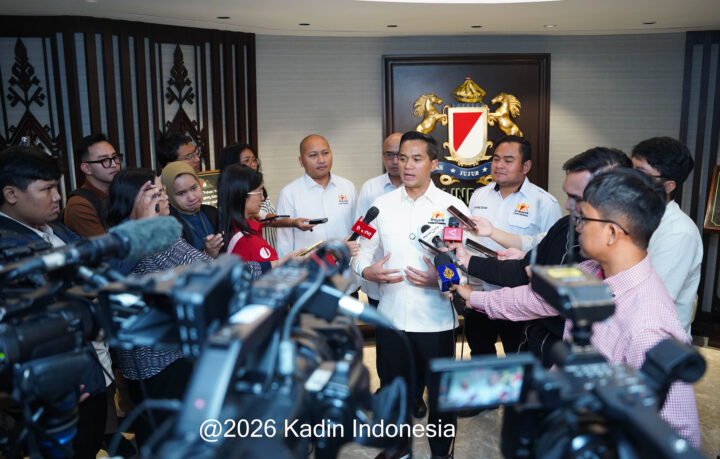
Jakarta – Chairman of the Indonesian Chamber of Commerce and Industry (Kadin), Anindya Novyan Bakrie, highlighted the impact of global uncertainty on the national business sector. This was conveyed by Anin, as he is commonly known, during the Press Conference of Kadin Business Pulse Q1 2026: Navigating Uncertainty - From Business Sentiment to Policy Action held at Menara Kadin Indonesia, Kuningan, South Jakarta, on Friday (April 24, 2026).
Anin stated that the dynamics and conflicts in the Middle East have had a significant impact on many countries, including Indonesia.
“The most noticeable impact is the increase in fuel prices, which then spills over into higher operational costs. However, this condition is not accompanied by an increase in purchasing power, as liquidity is currently also very tight,” said Anin.
According to Anin, this situation has encouraged Kadin Indonesia to regularly conduct the Kadin Business Pulse survey every quarter. The survey is considered important because it is based on corporate input rather than individuals, thus reflecting the real conditions of the business world.
“The responses we receive come from companies that directly manage profit and loss. So this is not an assumption, but evidence-based,” Anin explained.
Anin added that amid technological developments and the use of digital data and artificial intelligence, information gathering has become more comprehensive. Nevertheless, direct interaction with business players remains crucial, which is why Kadin continues to actively reach out to regions to understand economic challenges firsthand.
Furthermore, Anin reminded that the business sector has gone through various crises, such as the 1998 financial crisis, the 2008 global crisis, and the COVID-19 pandemic in 2021–2022. Therefore, businesses need to prepare more resilient business models, not only to survive but also to be ready for future crises.
“The challenge now is how to respond to this situation. Whether to focus solely on efficiency by tightening our belts, or to quickly return to the path of growth,” Anin said.
He explained that based on the results of the Kadin Business Pulse Q1 2026 survey, most business players choose to implement gradual efficiency measures while striving to return to a growth strategy as quickly as possible.
“From what I see, the business sector is choosing efficiency in order to quickly return to growth. Because growth is what enables job creation and maintains economic circulation,” Anin noted.
Anin also warned that the impact of the Middle East conflict is not temporary. The changes occurring have the potential to shift the structure of global supply chains in the long term.
“Of course, we cannot say or deny that what is happening in the Middle East will only last one or two months or quarters it could be longer. This is because it is altering the structure of supply chains,” he explained.
Anin emphasized that Business Pulse is not only a reflection of business conditions but also functions as an early warning system and a bridge between policy and on-the-ground implementation. The survey also captures business perspectives on current economic conditions, responses to geopolitical and geo-economic shocks, and concrete needs from the government.
“Kadin is a strategic partner of the government, but not a policymaker. Our role is to convey what businesses on the ground are experiencing and need, so it can serve as a reference in understanding economic conditions while also expanding the space for dialogue between the business sector and the state,” Anin said.
Meanwhile, Executive Director of Kadin Indonesia Institute, Mulya Amri, explained that the beginning of 2026 has been marked by rising global economic uncertainty due to geopolitical dynamics and policy changes among countries.
“This condition has affected supply chains, commodity price fluctuations, and pressure on exchange rates, including increased operational costs for businesses,” he said.
Therefore, Mulya continued, the Kadin Business Pulse Q1 2026 survey includes more specific questions related to business conditions, challenges, and the impact of global uncertainty and geopolitical dynamics on businesses.
“We hope the results of this survey can serve as an up-to-date reference to understand what businesses are currently experiencing,” he said.
Furthermore, Director of Insights at Kadin Indonesia Institute, Fakhrul Fulvian, explained that the survey results show that companies’ anticipatory measures in response to geopolitical conflict impacts are still dominated by internal strategies.
“Operational cost efficiency is the main step chosen by 33.9% of respondents, indicating that businesses are more focused on maintaining profit margins by reducing production, distribution, and operational costs amid rising input prices and high global uncertainty. This strategy shows that the main priority for companies right now is not expansion, but maintaining cash flow health and business stability,” he explained.
However, Fakhrul added, the survey also shows that 29.3% of businesses have not taken or are not taking any specific measures.
“This large proportion indicates that many businesses are still taking a wait-and-see approach, either due to limited capacity to adapt quickly or due to uncertainty about the most appropriate mitigation strategy amid continuously changing conditions. This stance reflects a high level of caution, but also shows that part of the business sector remains vulnerable if global pressures persist longer,” he concluded.