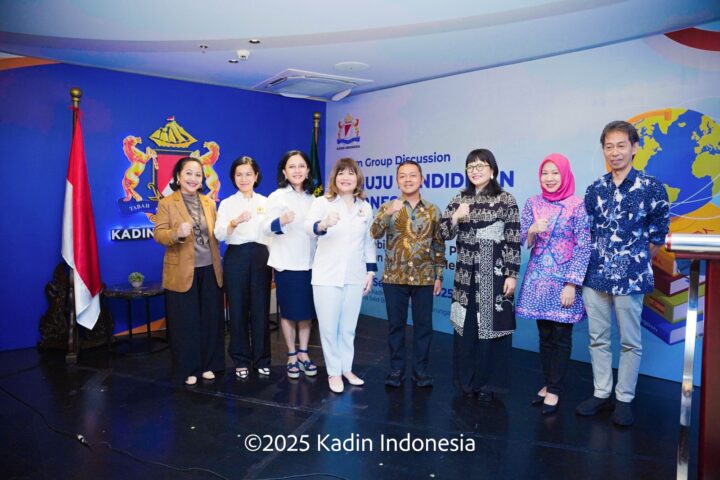
Jakarta - The Indonesian Chamber of Commerce and Industry (Kadin Indonesia) held a Focus Group Discussion (FGD) titled “Towards Globally Standardized Education in Indonesia: Policy Proposals to Strengthen Primary and Secondary Education” at the Kadin Indonesia Tower in South Jakarta on Wednesday (September 24, 2025).
During the event, Kadin emphasized the critical importance of educational transformation as a key driver of national competitiveness in the face of global change.
Shinta Widjaja Kamdani, Vice Chairwoman for Human Development, Culture, and Sustainable Development at Kadin Indonesia, underscored the urgent need to bridge the gap between job-ready graduates and industry demands.
“There are several challenges we must address together. First, there remains a significant mismatch between education outcomes and labor market needs. Educated unemployment continues to persist. In 2023, more than 842,000 diploma and university graduates were unemployed. This highlights a serious competency gap,” said Shinta.
She also addressed a common misconception in society regarding globally standardized schools. According to her, educational quality is not solely determined by the use of foreign curricula, but rather by teacher competence, relevant curriculum design, and credible assessment systems.
“In reality, it doesn’t have to be that way. Education quality is defined by the competence of teachers, a relevant curriculum, and a credible assessment system not merely by using an international curriculum,” she added.
Shinta went on to highlight that Indonesia’s workforce productivity still lags behind that of other Southeast Asian countries.
She noted that according to the Organisation for Economic Co-operation and Development (OECD), Indonesia’s labor productivity is only about one-third of the OECD average.
“In addition to having a large workforce, we must also ensure their quality and productivity to remain globally competitive,” she stated.
She further explained that global challenges such as the Fourth Industrial Revolution and rapid digitalization are driving an urgent demand for new skill sets.
“The McKinsey Global Institute estimates that by 2030, up to 23 million jobs in Indonesia could be automated if the workforce is not equipped with new skills. Education is a shared responsibility not only of the government, but also of the business sector, academia, and the broader community,” Shinta asserted.
Meanwhile, Stella Christie, Indonesia’s Deputy Minister of Higher Education, Science, and Technology, stressed the importance of transitioning universities toward the research university model.
“We need to understand the data that clearly shows a direct link between higher education and economic growth. Research-based universities are the ones generating innovation. For example, Stanford University contributes up to USD 3 trillion in economic value annually,” Stella explained.
She revealed that the ministry has mapped out centers of research excellence across universities in Indonesia. This mapping is expected to facilitate collaboration between the business sector and researchers.
“We’ve built a system that allows anyone to search for specific research topics and instantly identify the relevant researchers and universities. This will accelerate collaboration among industry, government, and academia,” she added.
Fajar Riza Ul Haq, Indonesia’s Deputy Minister for Primary and Secondary Education, emphasized that educational transformation does not always require curriculum changes.
“People often celebrate when a new minister brings a new curriculum. But we want to focus on strengthening how teachers deliver the curriculum. 21st-century competencies are not about how much content is taught, but how and why it is taught,” Fajar explained.
He stressed the importance of cultivating mindsets, mental resilience, and a culture of learning from an early age.
“Curricula may change, but if teachers who are the primary drivers do not understand how to teach it effectively, it becomes meaningless,” he concluded.
The event was also attended by several Kadin Indonesia board members, including Taufan Eko Nugroho Rotorasiko Vice Chairman for Organizational Affairs, Arini Subianto Vice Chairwoman for Higher Education and Science, Antarina Sulaiman Vice Chairwoman for Primary and Secondary Education, Akhmad Ma'ruf Maulana Vice Chairman for Special Economic Zones, Industrial Zones, and National Strategic Projects, Widiyanto Saputro Vice Chairman for Membership, Titi Khoiriah Head of the Islamic Economic Development Agency, Muhammad Iqbal Piyeung Chairman of Kadin Aceh Province, Faurani Chairwoman of Kadin West Nusa Tenggara Province.