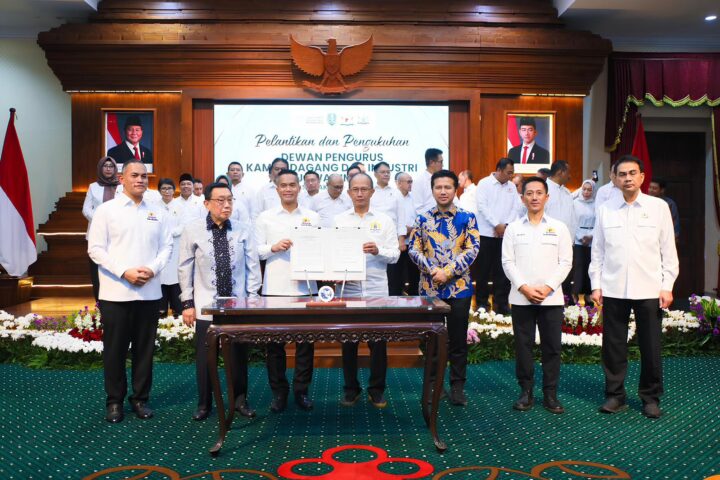
Surabaya – The East Java Provincial Chamber of Commerce and Industry (Kadin East Java) held the inauguration and formal induction of its board of directors for the 2025–2030 term at the Grahadi State Building in Surabaya on Sunday (1 February 2026).
A total of 400 board members across 32 business sectors were officially sworn in. The event marked an important moment of consolidation for East Java’s business community in accelerating regional economic growth.
Chairman of Kadin Indonesia Anindya Novyan Bakrie emphasized the importance of implementing the Indonesia Incorporated concept initiated by President Prabowo Subianto, which promotes mutual cooperation and collaboration among national business actors.
“Not only moving forward, but moving forward together. Not only allowing large companies to grow bigger, but enabling medium-sized enterprises to move up a level, small businesses to become medium-sized, and MSMEs to continue developing,” said Anindya, commonly known as Anin.
According to Anin, the implementation of Indonesia Incorporated is most clearly reflected in East Java, which has long served as a national hub for manufacturing and agro-industry. He stressed that industrialization is the key driver of higher economic value creation.
“When we talk about value-added, industrialization is the answer,” Anin said.
He further highlighted East Java’s strategic role as a national food production center as well as a base for non-oil and gas manufacturing. Approximately 30 percent of East Java’s Gross Regional Domestic Product (GRDP) is supported by the manufacturing sector, with strong contributions from large-scale trade and agriculture.
In addition, Anin noted that East Java’s MSMEs—accounting for around 99 percent of all business units—represent a major asset for regional economic growth. These enterprises operate across various sectors, including food and beverages, textiles, footwear, and fisheries.
Seven Priorities to Support Regional Economic Growth
Meanwhile, Chairman of Kadin East Java Adik Dwi Putranto stated that the newly inaugurated leadership has set seven main priorities to be implemented over the next five years, all aimed at driving East Java’s economic growth to reach 8 percent.
“We are targeting East Java’s economic growth to reach 8 percent, in line with the direction set by President Prabowo Subianto,” Adik said.
The first priority is investment, by fostering a conducive business climate through ease of doing business, legal certainty, and the availability of competent, job-ready human resources.
The second priority focuses on trade, both domestic and international. This year, the East Java Provincial Government, together with Kadin, has planned trade missions to nine domestic provinces and four international destinations.
The third and most crucial priority is human resource development. According to Adik, the quality of human capital contributes approximately 60–70 percent to economic growth.
“Therefore, human resource development is our top priority, especially with the establishment of the Regional Vocational Coordination Team by the Governor,” Adik explained.
The fourth priority is technology adoption and digitalization, which he said is no longer an option but a necessity—particularly for MSMEs—to enhance competitiveness and move up the value chain.
The fifth priority is the development of green industries and green jobs. Kadin East Java, in collaboration with Kadin Indonesia, has prepared green soft skills competency standards that will be proposed as a national benchmark.
The sixth priority is infrastructure strengthening, which has long been a key pillar of East Java’s economic growth. The seventh priority focuses on MSME empowerment as the backbone of the regional economy.
Further emphasizing collaboration, East Java Vice Governor Emil Elestianto Dardak underscored the importance of sustained cooperation between the regional government and the business community amid global uncertainty.
“This partnership has been well established, and we will continue it. Hopefully, it will grow even stronger in the future,” Emil said.
He warned that global geopolitical conflicts have had a direct impact on the world economy. According to him, regional governments cannot work alone but must act as facilitators for business actors.
“At a minimum, the government should not create obstacles, while still ensuring that the economic ecosystem is orderly and sustainable. I am confident that Kadin East Java has left tangible contributions to many of these achievements,” he concluded.
Also attending the event were M. Aziz Syamsuddin, Vice Chair Coordinator for Legal Affairs, Human Rights, and Infrastructure at Kadin Indonesia; Taufan Eko Nugroho Rotorasiko, Vice Chair for Organization at Kadin Indonesia; and Widiyanto Saputro, Vice Chair for Membership at Kadin Indonesia.