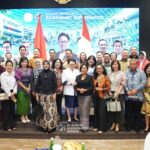
Jakarta – Economic relations between Indonesia and Bulgaria have significant potential for further development through increased trade, investment, technology transfer, as well as industrial and agricultural cooperation.
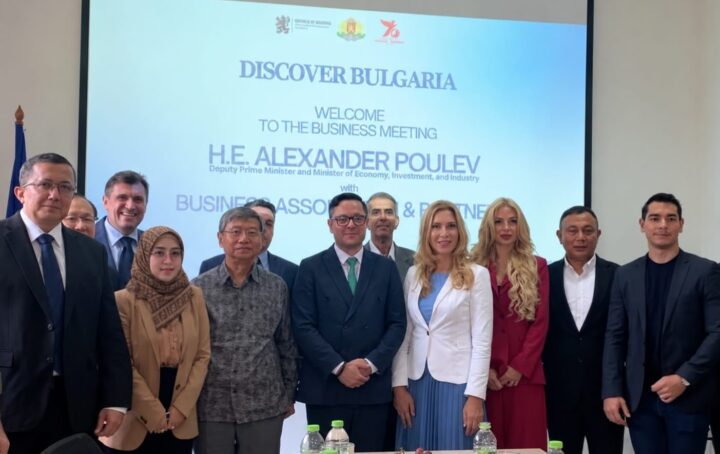
The issue was highlighted during the Indonesia–Bulgaria Business Meeting, which brought together Alexander Poulev, Deputy Prime Minister and Minister of Economy, Investments and Industry of the Republic of Bulgaria, and Tanya Dimitrova, Ambassador of the Republic of Bulgaria, with representatives of the Indonesian business community, including Devi Erna Rachmawati, Deputy Chairperson for Agriculture of the Indonesian Chamber of Commerce and Industry (Kadin Indonesia), on Saturday, September 12, 2026.
The meeting served as a strategic momentum to strengthen economic relations between the two countries and open up new, more concrete opportunities for cooperation, particularly in agriculture, food processing, agritech, investment, industrial cooperation, and technology transfer.
Indonesia–Bulgaria Trade in 2025
Data from Bulgaria’s Ministry of Economy, Investments and Industry showed that total bilateral trade between Indonesia and Bulgaria in 2025 reached US$215.5 million, comprising Bulgarian exports of US$77.8 million and Bulgarian imports from Indonesia of US$137.7 million. Accordingly, based on Bulgarian statistics, Indonesia recorded a trade surplus of approximately US$59.9 million.
The figure declined from US$638.7 million in 2024, indicating significant room to increase bilateral trade once again.
For comparison, UN Comtrade data compiled by Trading Economics recorded Indonesia’s exports to Bulgaria at approximately US$147.43 million in 2025. Key commodities included cereals at around US$22.69 million, animal/vegetable fats and oils at approximately US$9.87 million, and coffee, tea, mate and spices at around US$1.88 million.
Agriculture Sector Holds Strategic Potential
Agriculture is one of the areas where the two countries have complementary advantages.
Bulgaria is part of the European Union market and has a strong agricultural base. Approximately 41% of Bulgaria’s territory is agricultural land, while the agricultural sector accounts for around 4% of Gross Value Added and more than 6% of employment. Key Bulgarian commodities include cereals, oilseeds, protein crops, tobacco, as well as products such as rose oil, lavender oil, honey, pork, and poultry.
Meanwhile, Indonesia has a large domestic market and growing food demand, while also possessing competitive advantages in tropical commodities such as coffee, cocoa, spices, vegetable oils, horticultural products, plantation commodities, and processed food products.
Therefore, cooperation between the two countries can go beyond commodity trade and extend to the development of joint agricultural value chains.
Agricultural Commodity Trade Statistics in 2025
| Commodity |
2025 Trade |
| Cereals, Indonesia → Bulgaria |
US$22.69 million |
| Animal/vegetable fats & oils, Indonesia → Bulgaria |
US$9.87 million |
| Coffee, tea, mate & spices, Indonesia → Bulgaria |
US$1.88 million |
| Cocoa & cocoa preparations, Indonesia → Bulgaria |
US$1.12 million |
| Meat/fish/seafood preparations, Indonesia → Bulgaria |
US$0.91 million |
| Bulgarian agricultural exports globally – cereals |
US$1.71 billion |
| Bulgarian agricultural exports globally – oilseeds |
US$881.39 million |
| Bulgarian agricultural exports globally – animal/vegetable fats & oils |
US$826.92 million |
The commodity trade data indicate that cereals, vegetable oils, seeds, coffee, spices, and processed food are relevant areas for the development of bilateral trade.
Opportunities for Indonesia–Bulgaria Agricultural Cooperation
During the meeting, several strategic opportunities for cooperation were identified, including:
- Food Security Partnership
Developing cooperation to strengthen food security through trade and investment in rice and cereals, corn, soybeans and plant-based proteins, wheat and its derivatives, vegetable oils, livestock and poultry, dairy products, and processed food.
- Agritech & Smart Farming
Bulgaria’s technological and industrial engineering capabilities could be combined with Indonesia’s agricultural land and market through smart farming, precision agriculture, IoT, AI, agricultural machinery, and digital supply chains. Cooperation could include the development of pilot smart farming projects in Indonesia.
- Seed & Agricultural Biotechnology
There are also opportunities for cooperation in research and development of seeds, improved varieties, seed technology, biotechnology, climate-resilient crops, soil improvement, biological fertilizers, and biological pest control. These areas are relevant to Indonesia’s agenda of increasing agricultural productivity and modernizing the sector.
- Joint Ventures in the Food Industry
Bulgarian companies could establish production bases in Indonesia to access the ASEAN market. Potential models include Bulgarian Technology + Indonesian Resources + Indonesian Market + ASEAN Market, particularly in food processing, agricultural inputs, biotechnology, and machinery.
- Exports of Indonesian Agricultural Products to Bulgaria and the European Union
Indonesia has opportunities to expand exports of coffee, cocoa, spices, coconut products, palm-based products, tropical fruits, processed food, herbal products, and agricultural-based consumer products. Bulgaria could serve as one of the gateways to the European Union market, while taking into account SPS requirements, food safety, traceability, and EU standards.
- Bringing Bulgarian Agricultural Technology to Indonesia
Indonesia could become a market for agricultural machinery, irrigation technology, greenhouse technology, post-harvest technology, food processing equipment, agricultural biotechnology, and cold-chain technology. One important indicator is Indonesia’s investment presence in Bulgaria.
According to the Bulgarian National Bank, Indonesian FDI in Bulgaria stood at only around US$0.47 million at the end of 2025.
This figure indicates that investment relations between the two countries remain at an early stage and have significant untapped potential.
This is in line with Deputy Prime Minister Alexander Poulev’s statement in August 2026 that there is “enormous untapped potential” in Bulgaria–Indonesia trade and investment relations. The Bulgarian government has also identified opportunities in technology transfer, investment, and joint production.
For Indonesia, opportunities for Bulgarian investment could be directed toward agriculture, food processing, agritech, biotechnology, logistics, manufacturing, and green industries.
Meanwhile, for Indonesian investors, Bulgaria could serve as a strategic gateway to the EU market, particularly through the development of production, distribution, and partnerships with local Bulgarian companies.
Strategic Agenda that Kadin Indonesia Could Promote
As a follow-up to the Business Meeting, Kadin Indonesia could encourage the establishment of an Indonesia–Bulgaria Agriculture & Investment Working Group, with a focus on:
- Trade Expansion
Increasing bilateral trade and diversifying commodities.
- Agriculture Investment
Encouraging Bulgarian investment in Indonesia’s agriculture and food processing sectors.
- Agritech Transfer
Promoting agricultural technology transfer and digital farming.
- Joint Ventures
Establishing Indonesia–Bulgaria joint ventures.
- Research & Development
Encouraging collaboration among universities, research centers, and agritech companies.
- Market Access
Expanding market access for Indonesian products in Bulgaria and the European Union.
- Food Security
Promoting cooperation in food security and sustainable agriculture.
Key Statement
“Indonesia and Bulgaria have a strong opportunity to transform bilateral relations from conventional trade into a strategic partnership based on agriculture, investment, technology transfer and joint production.”
Going forward, Indonesia–Bulgaria cooperation is expected to go beyond business meetings and generate concrete projects, investment commitments, technology partnerships, and new market access opportunities for businesses in both countries.
The meeting also reinforced the position of the agriculture sector as one of the strategic bridges in Indonesia–Bulgaria economic relations.