Surabaya – The Chairman of the East Java Chamber of Commerce and Industry (Kadin), Adik Dwi Putranto, emphasized that the adoption of research by industry remains very limited, despite the fact that driving economic transformation in East Java requires strong synergy between the research community and industry.
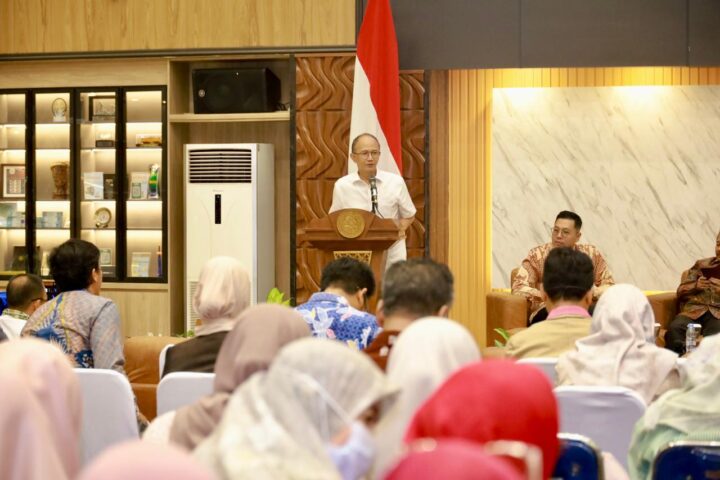
Adik made the statement during the Directorate of Research and Innovation (DRI) Week Strategic Dialogue at Airlangga University, titled “From Research to Impact: Innovation and Industry Synergy for East Java Transformation,” held at the Airlangga University campus in Surabaya on Tuesday (April 14, 2026).
Adik explained that, from a macroeconomic perspective, East Java holds a highly strategic position in the national economy. In 2025, the province’s Gross Regional Domestic Product (GRDP) reached approximately IDR 3,403 trillion, with economic growth of 5.33 percent. East Java is also one of the main contributors to Indonesia’s Gross Domestic Product (GDP).
In terms of economic structure, Adik noted that the manufacturing sector contributes around 31 percent, while household consumption dominates at 60 percent. Meanwhile, the transportation and logistics sector has recorded strong growth of over 9 percent, reflecting East Java’s increasingly important role as a distribution hub.
“The strategic role of East Java is becoming more evident as a manufacturing and logistics hub in Eastern Indonesia, as well as a key base for national exports. With this foundation, East Java has a solid economic scale,” Adik said.
However, he pointed out that a key challenge remains: upgrading the economic structure through innovation that drives efficiency across sectors. Even a 1 percent increase in efficiency, he noted, could generate economic impact worth tens of trillions of rupiah.
“There are still fundamental issues hindering the optimization of this potential, namely the gap between research and industry. Although research capacity continues to grow, many research outputs stop at publication and are not widely implemented. The involvement of research in industrial processes is also still limited, resulting in low adoption of research outcomes,” Adik explained.
He added that the absence of a strong downstreaming mechanism makes it difficult to translate research into commercially viable products or solutions. This has created an imbalance where Indonesia, including East Java, is strong in producing research output but weak in generating tangible economic impact.
“Therefore, closer collaboration among academics, researchers, industry players, and the government is essential to ensure that innovation truly drives sustainable economic growth,” he said.
Adik stressed that research transformation in East Java must shift toward a paradigm that is more aligned with industry needs. The traditional supply-driven approach where academics determine research topicsis no longer sufficient to address current economic challenges.
“A shift toward demand-driven research is needed, where research is based on real industry needs,” he said.
Under this new paradigm, industry players will play a greater role in determining research direction and priorities. In this context, Kadin takes on a strategic position as an aggregator of industry needs and a bridge between academia and the industrial sector.
“Kadin also acts as a facilitator in ensuring that research outputs are effectively implemented and adopted,” Adik added.
In line with this shift, Adik outlined a strategic research agenda focusing on seven key priorities. These include product innovation to enhance value-added in manufacturing; process innovation to improve efficiency and productivity; and marketing innovation focused on digitalization and global market penetration.
He further highlighted the importance of technology and artificial intelligence (AI) in enabling data-driven decision-making. Sustainability and Environmental, Social, and Governance (ESG) principles are also key priorities, particularly for accessing global markets. Strengthening governance and regulatory frameworks is expected to serve as an enabler of economic growth, while human capital development is focused on aligning education with industry needs.
To ensure effective implementation, Adik said a concrete framework has been prepared. The first step is the establishment of an Industrial Problem Bank a structured database capturing industry needs and challenges. The second is the formation of a Joint Research Task Force involving collaboration between Kadin, universities such as Airlangga University, and research institutions including regional and national research agencies.
The third step involves pilot projects for research downstreaming, covering commercialization, incubation programs, and industry adoption. These initiatives will be supported by government-funded applied research grants to ensure that research delivers tangible economic impact rather than remaining purely academic.
“With this approach, Kadin aims to create a more integrated innovation ecosystem, where research not only produces publications but also delivers concrete solutions that drive industrial growth and enhance East Java’s economic competitiveness,” Adik concluded.