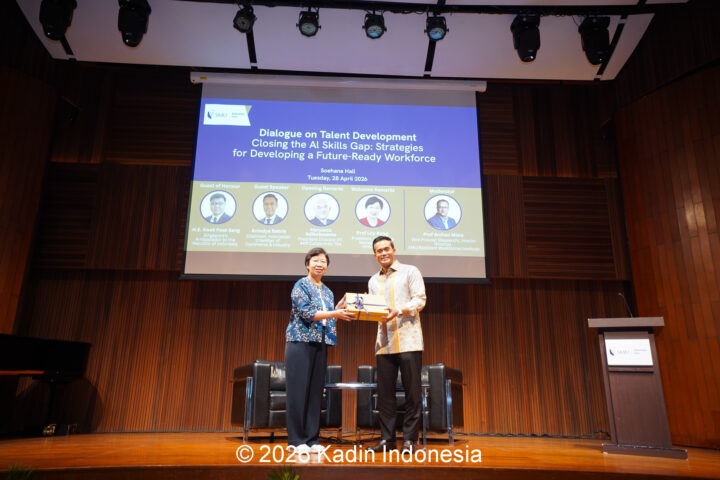
Jakarta - Chairman of the Indonesian Chamber of Commerce and Industry (Kadin), Anindya Novyan Bakrie, attended the Dialogue on Talent Development Fireside Chat titled “Closing the AI Skills Gap: Strategies for Developing a Future-Ready Workforce,” organized by Singapore Management University (SMU) International Indonesia at the Energy Building SCBD, Central Jakarta, on Tuesday (April 28, 2026).
In the forum, Anindya commonly known as Anin emphasized that Indonesia’s large population is a significant asset that has not yet been fully optimized. He noted that Indonesia accounts for around 4 percent of the world’s population, yet contributes only about 1.3–1.4 percent to global GDP.
“This means we are still punching below our weight. This can be seen as a challenge, but also an opportunity,” said Anin.
He further highlighted the role of Artificial Intelligence (AI) in driving economic growth. However, Anin stressed that AI development in Indonesia should focus on practical applications.
“AI is something new, so we need to focus on its applications. Indonesia has unique challenges, and we must develop tailor-made solutions that match the opportunities and issues we face,” he explained.
Anin also underscored that the success of AI adoption in Indonesia will largely depend on the involvement of Micro, Small, and Medium Enterprises (MSMEs), noting that around 97 percent of the national workforce comes from this sector.
“AI will only succeed to the extent that we can mobilize MSMEs,” he asserted.
Moreover, Anin revealed that investment realization in the first quarter of 2026 reached IDR 500 trillion. However, this investment was not dominated by large-scale projects, but rather by smaller-scale investments averaging around IDR 1.5 billion per project.
“Many assume that major investments come from large-scale projects, whereas most are actually incremental such as adding machinery, vehicles, or other small-scale expansions,” he said.
Looking ahead, Anin believes that AI implementation holds significant potential to drive industrial growth, particularly in the financial, healthcare, and education sectors. These sectors are seen as the fastest to adopt innovation while also generating broad societal impact.
“In the AI era, we are not just surviving we must return to a growth story. Service sectors such as finance, healthcare, and education are the quickest to adapt and to generate innovation,” Anin concluded.