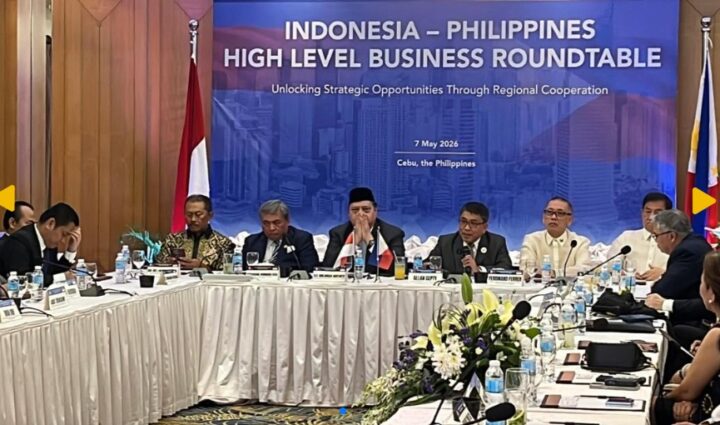
Amid the series of The 27th Meeting of the ASEAN Economic Community (AEC) Council and Related Meetings in Cebu, the Philippines, Coordinating Minister for Economic Affairs of the Republic of Indonesia Airlangga Hartarto, together with Philippine Secretary of Trade and Industry Maria Cristina A. Roque, directly witnessed the signing of a Memorandum of Understanding (MoU) on Strategic Nickel Industry Development Cooperation between the Asosiasi Penambang Nikel Indonesia and the Philippine Nickel Industry Association.
The signing ceremony took place during the Indonesia–Philippines High Level Business Roundtable at Jpark Island Resort on Thursday (7/5). The high-level business forum was held alongside the official visit of Indonesian President Prabowo Subianto to the Philippines to attend the 48th ASEAN Summit, and served as a concrete follow-up to regional economic cooperation discussions during the AECC Summit held on May 6–7, 2026.
Indonesia and the Philippines: An Inseparable Axis in the Global Nickel Industry
Based on 2026 data from the United States Geological Survey, Indonesia and the Philippines jointly accounted for 73.6% of global nickel production in 2025. Indonesia alone contributed approximately 66.7%, or 2.6 million tons, while the Philippines contributed 6.9%, or 270,000 tons. In terms of reserves, Indonesia holds 44.5% of the world’s nickel reserves, totaling 62 million tons, while the Philippines possesses 3.4%, or 4.8 million tons.
Trade relations between the two countries have also grown increasingly robust. Throughout 2025, Indonesia’s total exports to the Philippines reached USD10.22 billion, equivalent to 8.4% of the Philippines’ total imports, making Indonesia the Philippines’ third-largest trading partner after China and Japan. Overall, the Philippines remains a crucial strategic trade partner for Indonesia in Southeast Asia, particularly in the energy and automotive sectors.
“This collaboration is not merely an ordinary partnership. It is the foundation for the Indonesia–Philippines Nickel Corridor, a structured platform connecting Indonesia’s downstream and smelting capabilities with upstream nickel ore supplies from the Philippines. It will become an inseparable reserve and production axis for the world’s nickel industry,” said Minister Airlangga.
Comprehensive Scope of Cooperation
The MoU between APNI and PNIA encompasses strategic and long-term areas of cooperation, including:
(i) information exchange to support the stabilization of regional and global nickel trade;
(ii) joint development of nickel downstream technologies and value-added utilization of side products from the processing industry; and
(iii) joint human resource development to support a sustainable nickel industry ecosystem.
Minister Airlangga explained that Indonesia currently possesses a massive nickel downstream ecosystem, with exports of processed nickel products reaching USD9.73 billion in 2025. Investments projected to reach USD47.36 billion and the creation of 180,600 jobs are targeted by 2030. These smelters require a stable ore supply with an appropriate silicon-to-magnesium (Si:Mg) ratio, which can be fulfilled through blending processes using Philippine nickel ore.
“Through this corridor, the Philippines will no longer merely serve as an exporter of raw ore. The country will be integrated into a higher regional value chain, while Indonesia secures feedstock security for our battery precursor and stainless steel industries. This aligns with the directive of the 27th AECC Summit to strengthen critical supply chains across ASEAN,” Minister Airlangga added.
Nickel for Energy Security and the Role of Special Economic Zones
Furthermore, Minister Airlangga emphasized that nickel is a critical mineral playing a central role in the energy transition. Nickel-derived products can be integrated into both national and regional energy security strategies through enhanced energy storage systems, including electric vehicle (EV) batteries and solar energy storage batteries. As such, nickel downstreaming not only supports industrial development but also directly contributes to a cleaner and more sustainable energy mix.
To accelerate downstream industrialization and strengthen the competitiveness of the nickel industry, the Indonesian Government continues to promote the development of integrated Special Economic Zones (SEZs) linked to critical mineral supply chains. These SEZs are expected to serve as key drivers for investments in smelters, battery raw material processing, and internationally standardized downstream technology innovation hubs. (ekon/rep)