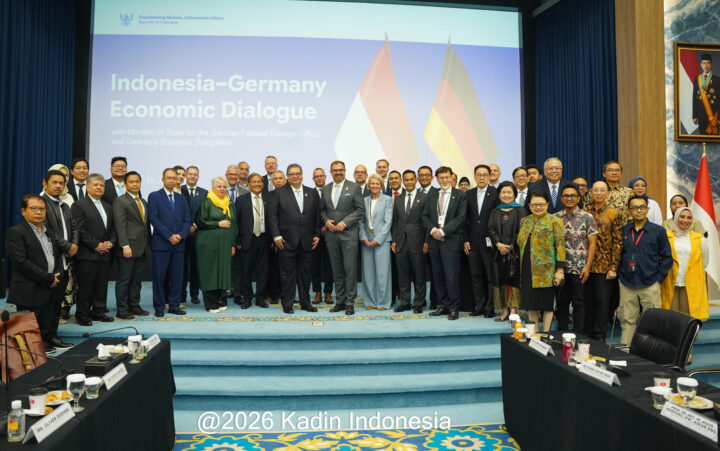
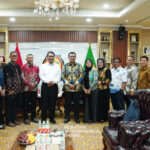
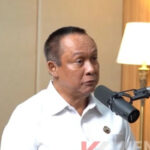
Jakarta – Chairman of the Indonesian Chamber of Commerce and Industry (Kadin Indonesia), Anindya Novyan Bakrie, expressed optimism regarding the strengthening of economic relations between Indonesia and Germany after attending the Indonesia-Germany Economic Dialogue with the Minister of State for the German Federal Foreign Office and Germany Business Dialogue, held as part of the state visit of President of the Federal Republic of Germany H.E. Frank-Walter Steinmeier to Indonesia.
The event took place at the Office of the Coordinating Ministry for Economic Affairs of the Republic of Indonesia in Central Jakarta on Monday (June 15, 2026).
Anindya, popularly known as Anin, said the German business community had demonstrated strong enthusiasm for expanding economic cooperation with Indonesia, particularly by capitalizing on opportunities that will emerge through the Indonesia-European Union Comprehensive Economic Partnership Agreement (IEU-CEPA).
“There is tremendous enthusiasm and interest in, first, expanding trade and taking advantage of the IEU-CEPA. They are very enthusiastic, and of course we are equally enthusiastic,” Anin said.
Beyond trade, Anin noted that the discussions also covered cooperation in industrialization, ranging from the development of critical minerals and energy transition initiatives to more advanced manufacturing technologies.
“And secondly, regarding industrialization, discussions covered critical minerals, energy transition, and advancements in manufacturing,” he said.
Anin added that Germany is also seeking to increase foreign direct investment (FDI) in Indonesia. In addition, broader cooperation opportunities exist in the labor sector through worker exchange programs between the two countries.
“We would like to thank Coordinating Minister Airlangga Hartarto for advocating greater opportunities for Indonesian workers in Germany. In fact, the German side is also interested in worker exchange programs so that we can build not only strong people-to-people relations but also create opportunities for mutual learning and skills enhancement in this era of industrialization and the government’s ongoing initiatives,” Anin said.
Meanwhile, Coordinating Minister for Economic Affairs Airlangga Hartarto explained that the meeting followed discussions between Indonesian President Prabowo Subianto and President of the Federal Republic of Germany H.E. Frank-Walter Steinmeier at Merdeka Palace.
According to Airlangga, the German business delegation was particularly interested in exploring economic cooperation opportunities that could be developed following the implementation of the IEU-CEPA.
“Germany brought a business delegation, and during the meeting they were particularly interested in learning about the opportunities that will be available for Indonesia once the IEU-CEPA comes into effect,” Airlangga said.
He added that Germany also expressed appreciation for the readiness and quality of Indonesia’s human resources. Amid a declining youth population in Germany, the country sees opportunities to strengthen cooperation in workforce development and skills enhancement.
“Germany is one of the countries experiencing a decline in its young population. Therefore, they are looking to address this challenge, and I proposed discussing it through a joint commission on industry and the economy,” he said.
Airlangga stated that both countries plan to further discuss labor placement cooperation and training programs through the Joint Commission on Industry and Economy, which is scheduled to convene in September.
“By September, we can prepare a joint plan for workforce placement and training programs for both Indonesians and Germans. I have also directly requested the Chairman of Kadin Indonesia to help organize these initiatives,” he said.
In addition to labor-related issues, the German delegation also expressed interest in investment opportunities in Indonesia’s strategic mineral sector, including rare earth elements and nickel.
“Third, there are several investment-related matters. They asked which sectors could further strengthen cooperation between Indonesia and Germany. They are particularly interested in rare earth elements as well as nickel,” Airlangga said.
However, Airlangga emphasized that future industrial cooperation should take global market conditions into account, including excess steel production capacity in Europe.
“I also conveyed that Europe currently faces excess steel production capacity. They are planning to reduce steel output in Europe from 80 million tons to 40 million tons. Therefore, in pursuing cooperation, we hope not to add to this excess capacity but instead focus on other sectors where opportunities remain wide open,” he concluded.
Also attending the event were Deputy Chairman for Investment, Downstream Industries, Energy, and Environment Bobby Gafur Umar; Deputy Chairman for Migrant Worker Protection Nofel Saleh Hilabi; and Chairman of Kadin Indonesia’s Russia-Belarus Bilateral Committee Didit Ratam.