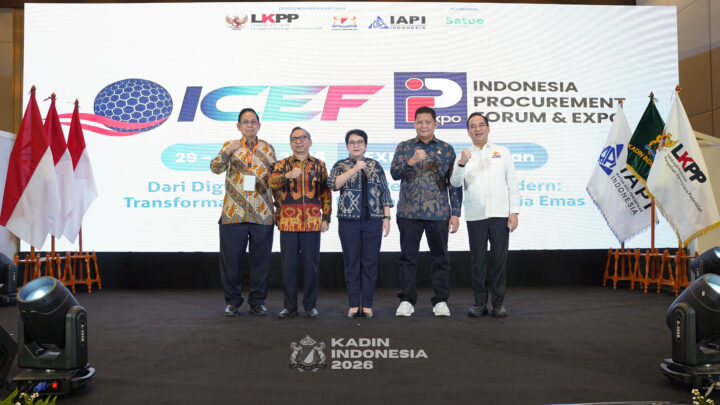
Jakarta - The Indonesian Chamber of Commerce and Industry (Kadin Indonesia), in collaboration with the National Public Procurement Agency (LKPP), officially opened the 2026 Indonesia Catalogue Expo and Forum (ICEF) – Indonesia Procurement Forum Expo (IPFE), themed “From Digitalization to Modern Procurement: Data-Driven Transformation for Golden Indonesia,” at the Grand Ballroom of JIEXPO Kemayoran, North Jakarta, from July 29–31, 2026.
Juan Permata Adoe, Coordinating Vice Chairman for Export Development of Kadin Indonesia, who represented Kadin Indonesia Chairman Anindya Novyan Bakrie at the event, stated that the organization of ICEF-IPFE 2026 represents a strategic collaboration between Kadin Indonesia, LKPP, and the Indonesian Association of Procurement Experts (IAPI) to strengthen synergy between the government and the business community in building a modern, transparent, and competitive national procurement system.
According to Juan, the forum serves as a strategic platform that brings together government institutions, business actors, investors, suppliers of goods and services, and the entire national procurement ecosystem through exhibitions, business matching sessions, seminars, talk shows, and professional certification programs.
“Amid a global environment still facing economic slowdown, rising production costs, uncertainty, and intensifying competition, we need new growth engines capable of driving the economy rapidly, inclusively, and sustainably. One of those growth engines is government spending,” Juan said.
Juan emphasized that government expenditure should not merely be viewed as budget absorption but as a strategic instrument capable of creating jobs, strengthening national industries, empowering micro, small, and medium enterprises (MSMEs), fostering innovation, and providing market certainty for businesses.
“Therefore, public procurement must evolve from being merely an administrative process into a strategic instrument for Indonesia’s economic development,” he said.
Juan also stressed that national procurement should serve as a vehicle to enhance the capacity and competitiveness of Indonesian businesses. Companies that grow through the domestic market, he noted, should be encouraged to improve quality, capacity, standardization, and efficiency so they can compete internationally.
He further explained that Indonesia possesses tremendous potential through government spending exceeding Rp3,000 trillion annually. Meanwhile, infrastructure investment requirements to achieve the vision of Golden Indonesia 2045 are estimated to surpass Rp30,000 trillion.
“This potential will only generate maximum impact if it is supported by a procurement system that is fast, transparent, data-driven, and capable of matching government needs with the capacities of the business sector,” Juan said.
For this reason, Kadin Indonesia welcomes the transformation undertaken by LKPP through procurement system modernization and the strengthening of the electronic catalog. These initiatives are expected to provide greater process certainty, expand market access, enhance transparency, and create broader opportunities for domestic products, MSMEs, cooperatives, and regional businesses.
Nevertheless, Juan noted that several challenges remain, including difficulties faced by MSMEs and regional enterprises in entering the electronic catalog due to certification requirements, limited working capital, low digital literacy, and uneven digital procurement infrastructure readiness between central and regional governments.
“These are the issues we must solve together. They should not merely be celebrated as achievements but must truly deliver the outcomes envisioned by the government,” he said.
Juan added that strengthening the domestic market should serve as the foundation for Indonesian businesses to expand into export markets. In his view, digitalization is only the first step toward a modern, data-driven procurement system capable of improving government spending efficiency, strengthening national supply chains, reducing logistics costs, and delivering development that provides tangible benefits to society.
Furthermore, he emphasized that data-driven transformation must go hand in hand with stronger integrity and governance that are clean, fair, transparent, and accountable in order to increase business confidence in the government procurement system.
Juan described ICEF-IPFE 2026 as more than just an exhibition, calling it a national collaboration marketplace that connects government with businesses, investors with projects, and innovation with development needs.
“This is where government meets business, where investors meet projects, where innovation meets demand, and where both business-to-government and business-to-business collaboration are built in a tangible way,” he said.
Through this year’s event, which involves approximately 15,000 participants and 39 suppliers of goods and services, Kadin Indonesia hopes to generate more investment partnerships, business matching outcomes, supply chain collaborations, and new business opportunities that directly benefit enterprises across Indonesia.
Juan also expressed hope that within six months after ICEF-IPFE 2026, measurable results would be visible, including increased realization of business matching agreements, a higher number of MSMEs and cooperatives successfully joining the electronic catalog, and the growth of mentoring programs by provincial and district/city Kadin chapters to help regional businesses enter government procurement supply chains.
On the occasion, Juan reaffirmed Kadin Indonesia’s three key commitments to supporting the transformation of national procurement.
First, strengthening strategic partnerships with the government through LKPP to create a healthy, competitive, and transparent procurement environment.
Second, expanding the participation of national businesses—including MSMEs, cooperatives, regional industries, and national companies—in government procurement supply chains while enhancing their capabilities and competitiveness.
Third, positioning procurement as an instrument to strengthen investment, improve industrial competitiveness, prepare businesses for global markets, and accelerate regional economic growth.
“We believe that when the government, business community, financial institutions, investors, and professional associations work together, procurement ceases to be a development cost and instead becomes a driver of development. Golden Indonesia 2045 will be built through collaboration between central and regional governments, regulators and businesses, industries and MSMEs, and through the combination of sound policies and professional execution,” Juan explained.
Meanwhile, LKPP Head Sarah Sadiqa reported that throughout 2026, transactions conducted through the electronic catalog reached Rp135.4 trillion, generated from more than one million transactions. These transactions involved 104,000 suppliers and 1.83 million products.
“This achievement demonstrates that the digital procurement ecosystem is becoming more mature and increasingly trusted by ministries, agencies, regional governments, and, of course, business actors,” she said.
She further stated that within Indonesia’s broader transformation agenda, procurement must also serve as an instrument to strengthen the government’s support for national industry. As of July 24, 2026, transactions involving domestic products had reached Rp244.5 trillion, accounting for 91.1 percent of total supplier transactions. Meanwhile, transactions involving micro, small enterprises and cooperatives reached Rp128.4 trillion, or 47.9 percent of total transactions, with 236,000 business actors participating.
“These figures are more than mere statistics. Behind them are factories that continue operating, workers earning incomes, MSMEs gaining market access, local innovators receiving opportunities, and communities benefiting from development. This is the face of inclusive, productive procurement that directly impacts the people’s economy,” she concluded.
Also attending the event was Kukrit Suryo Wicaksono, Vice Chairman for Regional Empowerment of Kadin Indonesia and Chairman of the Organizing Committee for ICEF-IPFE 2026.