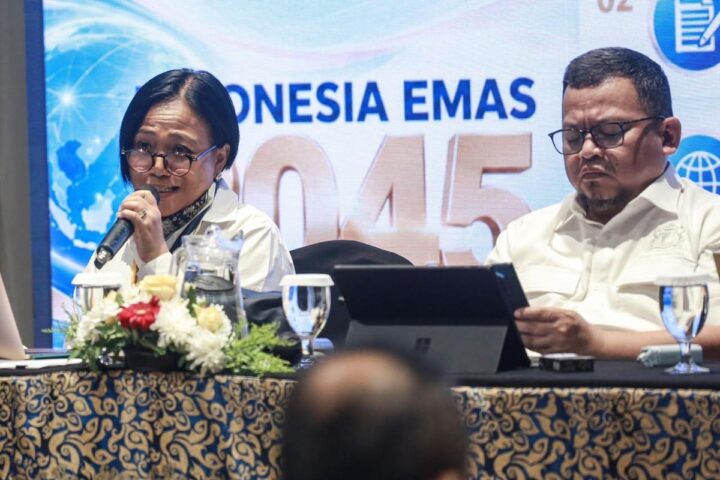
Jakarta - Indonesian Chamber of Commerce and Industry (Kadin) Indonesia is gathering various issues faced by regional business actors. This feedback will serve as material for regulatory reform recommendations in Indonesia's accession process to the Organisation for Economic Co-operation and Development (OECD). This effort is carried out by involving Regional Kadins and Extraordinary Members (ALB), including sectoral associations, to identify business obstacles, adjustment needs to OECD standards, as well as the support required by the business community.
Chairperson of the Standing Committee for BIAC–OECD at Kadin Indonesia, Rinawati Prihatiningsih, said that the experience of business actors in various regions needs to be taken into consideration in formulating policy recommendations.
According to her, the OECD accession process is not enough to just be oriented towards meeting international standards.
Reforms also need to provide tangible benefits for companies through clearer regulations, more efficient business processes, as well as expanded investment and market opportunities. "We want to produce real benefits for members, clearer regulations, more efficient business processes, as well as broader investment and market opportunities," said Rinawati in the Executive Directors Forum of Kadin throughout Indonesia, Friday (30/10/2026).
Rinawati assessed that socialisation regarding the OECD needs to help business actors understand the relevance of the accession process to their business activities, including opportunities, adjustment challenges, and required support.
She described the OECD accession process as a reform marathon that requires consistency and collaboration. The government leads the process, while the business community plays a role in conveying experience and evidence regarding the implementation of policies on the ground.
The involvement of business actors from various regions is necessary so that differences in company conditions and capacities can be considered in reform discussions. Indonesia has submitted its Initial Memorandum to the OECD on June 3, 2025. The self-assessment document marked the start of the technical phase which includes reviewing the alignment of Indonesia's policies and practices with OECD standards.
For the business community, these reforms are expected to be felt in daily business activities. Simplifying licensing, for example, needs to result in shorter service times, clearer requirements, and reduced repetition of administrative processes.
Standard adjustments also need to consider differences in company capacity. Micro, small, and medium enterprises (MSMEs), for example, require easy-to-understand guidance, mentoring, and adequate transition periods to be able to adapt and take advantage of opportunities.
Six mapped problem areas
To identify these various issues, Kadin prepared a questionnaire covering six subject groups. The six areas are manpower and skills, integrity and responsible business conduct, regulatory governance, digital and data, green transition and trade, as well as investment, tax, and finance.
This mapping is intended to determine member readiness, main obstacles faced, and support needed in facing adjustments to OECD standards.
Questionnaire answers will serve as initial material for case deepening together with Regional Kadin (Kadinda) and ALB.
Rinawati asked each organisation to gather two to three priority cases equipped with information regarding related rules or procedures, location of occurrence, impact on business activities, and proposed improvements.
For example, the issue of lengthy licensing processes needs to be accompanied by information regarding the type of permit, related agency, processing chronology, process duration, to its impact on production or investment.
Estimated figures can also be submitted by including the source and basis of calculation.
"We need concrete and verifiable input. Two to three priority cases from each Regional Kadin or ALB will greatly help Central Kadin formulate targeted recommendations," she said.
Through this deepening, Kadin wants to identify issues that require regulatory changes and distinguish them from obstacles that can be resolved through coordination, procedural alignment, or clarity of implementation guidelines.
Entrepreneurs' input expected to lead to policy improvements
Collecting input from business actors also raised questions regarding the follow-up that Regional Kadins will receive after filling out the questionnaire. In the forum, participants highlighted the importance of obtaining feedback so that the issues presented do not stop at the data collection stage. Responding to this, Rinawati proposed that Regional Kadins and ALBs obtain a summary of the mapping results, the opportunity to validate priority cases, as well as information regarding follow-up progress.
The mapping results are expected to strengthen Regional Kadin's dialogue with regional governments while supporting coordination with Kadin Indonesia. To maintain continuity of communication, each Regional Kadin and ALB is expected to propose one person in charge (PIC) through the support of their respective leaders. The PIC will serve as a liaison for member consultation, answer consolidation, and evidence clarification.
The collected input will subsequently be proposed through stages of consolidation, validation and analysis, alignment of recommendations into Kadin's position, to advocacy and monitoring. Dialogue with the government will be conducted according to its authority. Kadin will also utilize the Business at OECD (BIAC) channel to convey issues relevant to the business community's interests in discussions at the OECD level. Member involvement is expected to cover various business scales, including MSMEs and women entrepreneurs, so that the needs and challenges of different business groups can be identified.
Rinawati also assessed the need for further online socialisation with regions using simpler language and examples close to daily business activities.
"Kadin's strength lies in the network and experience of its members across various sectors and regions. By gathering these experiences, we can bring real issues on the ground into concrete and actionable policy recommendations," she said.
This collaboration is expected to strengthen Kadin's contribution in driving reforms that increase productivity, create jobs, and expand economic opportunities in various regions.