Jakarta – Chairman of the Indonesian Chamber of Commerce and Industry (Kadin Indonesia), Anindya Novyan Bakrie, emphasized that green growth is not a standalone agenda, but an integral part of Indonesia’s broader national growth narrative.
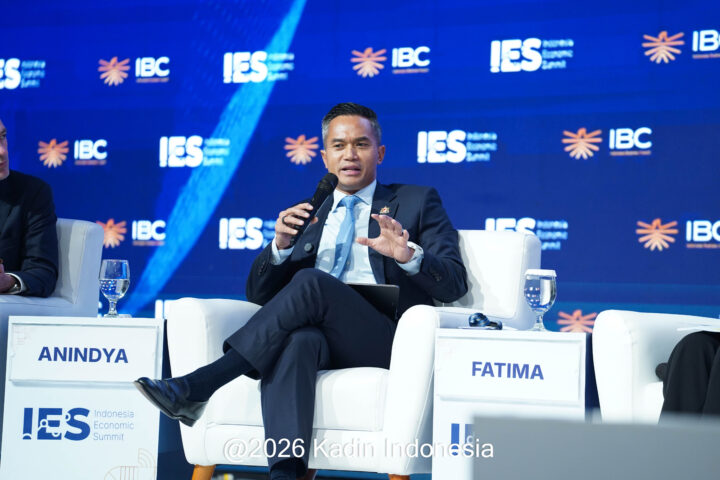
Anindya, who is widely known as Anin, made the remarks during a panel session at the Indonesia Economic Summit (IES) Thought Leadership forum titled “How Can Indonesia Leverage the Green Sectors to Boost Growth”, held at the Shangri-La Hotel Jakarta on Wednesday (February 4, 2026).
According to Anin, green growth should be understood as a unified concept encompassing economic growth, energy transition, and evolving global geopolitical dynamics. Such an approach, he said, is essential for Indonesia to position itself strategically amid shifts in the global economic landscape.
“Green growth is essentially not something that runs in parallel—it is part and parcel of the national growth story,” Anin said.
Anin explained that green growth consists of at least three key dimensions. First, it is fundamentally a story of economic growth that drives investment, trade, industrialization, and ultimately job creation. Second, green growth is closely linked to the energy transition agenda. Third, it carries an increasingly strong geopolitical dimension at the global level.
From an economic growth perspective, Anin stressed the importance of Indonesia clearly defining its position within major global supply chains and ecosystems. He identified electrification and downstream mineral processing as two core sectors with significant potential to drive national green growth.
Anin noted that electrification accounts for approximately 40 percent of opportunities within the green growth narrative. Currently, around 1.5 percent of new vehicles sold in Indonesia are electric vehicles (EVs). While this figure still lags behind China, where EV penetration has reached about 90 percent, and Europe at around 60 percent, the trend, he said, presents opportunities for the development of new industries and ecosystems domestically.
“This creates an entirely new chain of industries and ecosystems. Many businesses, particularly from China, have already established production facilities in Indonesia,” Anin said.
Beyond electrification, critical mineral downstreaming is another major focus. Anin highlighted that Indonesia is not only known as the world’s largest nickel producer—accounting for around 60 percent of global production—but also holds substantial potential in other commodities such as cobalt, copper, and bauxite.
“Approximately 10 percent of global production of these commodities comes from Indonesia, with much of the activity concentrated in eastern Indonesia, which has the potential to promote more balanced national economic growth,” Anin explained.
Anin further emphasized that green growth is inseparable from the broader energy transition narrative. He pointed to the rising demand for energy driven by the expansion of artificial intelligence (AI) and data centers.
“Over the next 25 to 35 years, as Indonesia moves toward its net-zero target, the country is expected to require around **100 gigawatts of electricity solely to support data center operations,” Anin said.
In this context, Anin expressed support for PT PLN (Persero), which is currently developing up to 75 gigawatts of power generation capacity, with approximately 75 percent sourced from renewable energy.
“To support critical mineral downstreaming, Indonesia is estimated to need around 500 gigawatts of solar energy over the next 25 to 35 years. Given Indonesia’s silica reserves and natural resource base, this presents a significant opportunity,” he added.
From a geopolitical standpoint, Anin underlined that green growth and energy transition have become arenas of global strategic competition. He observed that in international forums such as Davos, APEC, and the G20, energy transition issues are increasingly dominating discussions among major economies. At present, China is seen as more proactive than the United States in advancing this agenda.
“Indonesia must be very strategic in playing its role, while continuing to keep cooperation open—including with Middle Eastern countries that can provide support from the financing side,” Anin concluded.
Other panelists at the session included Presidential Special Envoy for Climate and Energy Hashim S. Djojohadikusumo, Chief Sustainability Officer of APP Group Elim Sritaba, Partner at Systemiq Mattia Romani, Head of Development & Investment Asia Pacific at Masdar Fatima Alsuwaidi, Deputy Speaker of the People’s Consultative Assembly (MPR RI) Eddy Soeparno, with the discussion moderated by Secretary-General of the Global Alliance for a Sustainable Planet (GASP), Satya Tripathi.