Surabaya – The concept of the care economy is becoming increasingly important as more women enter the workforce and more married couples both work. The availability of childcare facilities (daycare) in industrial areas is also being encouraged as part of efforts to create a more supportive work environment while maintaining worker productivity.
Chairman of the East Java Chamber of Commerce and Industry (Kadin East Java) Adik Dwi Putranto said the need for childcare services could no longer be viewed solely as a household matter. According to him, companies and the government also need to help build an ecosystem that enables workers, particularly parents, to work with peace of mind.
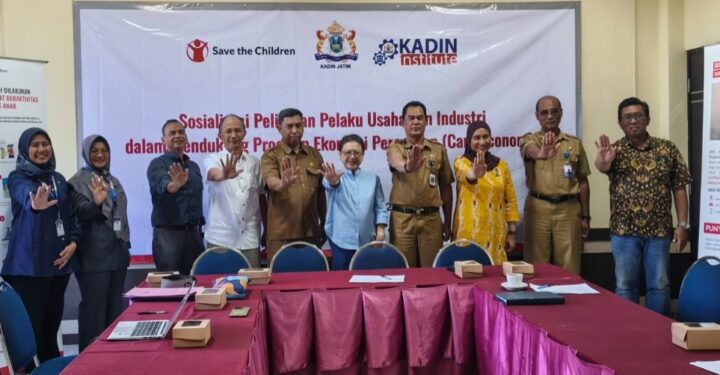
“When both husband and wife work, they certainly want to feel comfortable and at ease while working. Therefore, we must ensure that their children continue to be properly cared for,” Adik said at the Socialization of Business and Industry Involvement in Supporting the Care Economy Program, held at the Kadin Institute Office in Surabaya on Tuesday (September 15, 2026).
Adik said the availability of daycare facilities in industrial areas could be one solution. Workers would not have to constantly worry about the condition of their children while they are at work, allowing them to focus more on their responsibilities.
The East Java Provincial Kadin, together with Kadin Institute and Save the Children, has begun conducting socialization and training on the care economy for the industrial sector. The program has also been introduced in several areas across East Java, including Gresik, which is considered to have significant attention to the need for childcare services for workers.
Adik said the government’s response to the concept had been fairly positive. However, from the industry’s perspective, further discussions are still needed regarding the direct benefits companies could gain, including potential government support and incentives.
“For the industry, the question is certainly, what are the benefits for the industry? Are there any incentives from the government related to this? That is what we are currently discussing with our colleagues in the industry,” Adik said.
The East Java Provincial Kadin is targeting at least five industrial areas in East Java to have daycare facilities this year. The target includes industrial areas in Surabaya, Sidoarjo, and Gresik, including the Surabaya Industrial Estate Rungkut (SIER) and Java Integrated Industrial and Port Estate (JIIPE).
“Our target is that, at the very least, this year there will be daycare facilities in five industrial areas, including Surabaya, Sidoarjo, and Gresik,” Adik emphasized.
Meanwhile, Director of Kadin Institute East Java Nurul Indah Susanti added that her organization had prepared several acceleration measures to support the implementation of the care economy program in East Java. These measures began with the preparation of a Training Needs Analysis (TNA), followed by the development of modules, curriculum, and syllabi that have been harmonized with the needs of the daycare industry.
The curriculum has also been aligned with professional certification schemes in the childcare sector, so that the competencies provided to participants are expected to be relevant to workplace requirements. “We have prepared modules, curriculum, and syllabi that have been harmonized with the needs of the daycare industry and are relevant to the childcare professional certification scheme,” Nurul said.
As part of a pilot project in East Java, Kadin Institute has conducted training and technical competency assessments for prospective instructors. These instructors will later provide training to prospective workers in the care economy sector. To date, 17 instructors have received training. Meanwhile, training for 150 participants has been conducted in several areas, namely Surabaya, Malang, Ponorogo, and Gresik.
Nurul said these efforts represented Kadin Institute’s support for accelerating the availability of workers with competencies in childcare, while also supporting the development of the care economy ecosystem in East Java.
Furthermore, Acting Head of the East Java Provincial Manpower and Transmigration Office Agus Gunawan said the protection of children and workers was a shared responsibility that required the attention of the government, business sector, and all stakeholders.
According to Agus, the need for childcare facilities has also become increasingly evident as work patterns in society change. He said regulations concerning the protection of workers and workers’ children, as well as the strengthening of daycare services, were still under discussion and were expected to become part of East Java’s policies in 2027.
“It is indeed time for daycare to become part of the government’s priorities. It is not only about caring for children, but also about preparing their competencies,” he said.
He appreciated the efforts by the East Java Provincial Kadin and Kadin Institute East Java in pioneering discussions on the care economy with the industrial sector. The results of the discussions, he added, are expected to be conveyed to the government and subsequently aligned with industry needs.
Furthermore, Save the Children representative Evi Woro Yulianti said the development of the care economy was also closely linked to efforts to ensure that children remain safe and well cared for when their parents return to work. According to her, changes in women’s work patterns require an adequate childcare support ecosystem.
“The care economy is intended to become decent and professional work. Therefore, we need to look at the ecosystem and what is needed beyond the government. Today, we are conducting socialization with the workplace to gain insights into what the industry actually needs,” Evi explained.
Save the Children, she added, is currently promoting the development of workforce competencies in childcare. The program has entered the training and certification stage, with a target of around 150 job seekers gaining competencies in the care economy sector.
The program is also serving as a pilot project in East Java. Evi said there had been considerable enthusiasm from local governments, including the Gresik Regency Government. In fact, she said the need for daycare services had also emerged in the assessment of civil servant staffing requirements.
“Every worker or laborer, when they leave home, has a child waiting for them who very much wants to be accompanied by their parents. But because of work circumstances, they cannot always be there. This is what we want to ensure: that every child remains safe and protected,” she concluded.