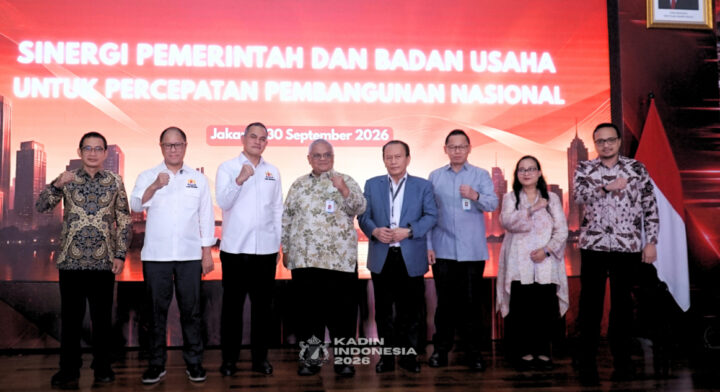
Jakarta – The Indonesian Chamber of Commerce and Industry (Kadin Indonesia) and the Ministry of National Development Planning/National Development Planning Agency (Bappenas) strengthened government-business collaboration to accelerate national development through the “Government-Business Synergy for Accelerating National Development” forum held at the Bappenas Building in Jakarta on Wednesday (September 30, 2026).
Kadin Indonesia Deputy Chairman for Organization Taufan Eko Nugroho Rotorasiko said Indonesia’s development needs are expected to grow increasingly substantial, requiring closer collaboration between the government and the business community. The government has a broad and strategic development agenda, while businesses have capital, technology, innovation, networks, and execution capabilities that can support its realization.
“The question is how we can build an ecosystem that enables both sides to move together more quickly, with greater certainty and productivity. This is the spirit that we at Kadin Indonesia seek to continuously promote,” Taufan said.
According to Taufan, project quality and readiness are among the key factors in attracting investment. The business community needs projects with clearly defined development needs, strong policy direction, and certainty regarding regulations, licensing, financing structures, risks, and investment models.
“Kadin Indonesia is ready to serve as a bridge between the government’s development needs and the perspectives and capabilities of the business community. We believe that a good project is not merely one that is ready to offer, but one that is truly ready to invest, ready to execute, and capable of delivering an economic impact,” he said.
Taufan said Kadin can also strengthen connectivity between projects and investors by bringing together the central government, regional governments, businesses, investors, and various sources of financing.
“Kadin is not only a platform for business communication, but can also serve as a marketplace of opportunities that brings together the government, regional governments, businesses, investors, and various sources of financing,” Taufan said.
As a follow-up, Kadin Indonesia and the Ministry of National Development Planning/Bappenas will establish a Task Force on Public-Private Partnerships (PPP) and Strategic and Innovative Financing. The task force is expected to serve as a joint working platform to strengthen project development, financing schemes, and investment opportunities that support accelerated national development.
“Through this Task Force, we want to strengthen the process from identifying development needs and priorities, preparing projects and developing financing schemes, to matching projects with the right businesses, investors, and sources of financing,” Taufan said.
Meanwhile, Kadin Indonesia Deputy Chairman for National Development Planning Bayu Priawan Djokosoetono said limited government financing capacity makes collaboration with businesses an important instrument for accelerating development.
“Therefore, government-business collaboration is no longer an additional option, but has become one of the key instruments for accelerating development,” Bayu said.
According to Bayu, PPPs and strategic and innovative financing need to be developed as an “ecosystem of collaboration” that brings together the government, businesses, financial institutions, and communities.
“PPPs and strategic and innovative financing must be developed into an ecosystem of collaboration—an ecosystem that brings together the government as the holder of the development mandate, businesses as implementers and innovators, financial institutions as financing providers, and communities as the beneficiaries of development,” he said.
Bayu identified three aspects that need to be strengthened: project readiness, innovative financing, and business-government alignment. Investors, he said, need projects with clarity on regulations, institutional arrangements, risks, land readiness, revenue schemes, and investment processes.
“Therefore, the quality of project preparation is crucial,” Bayu said.
On the financing side, Bayu encouraged the use of various innovative instruments, including de-risking mechanisms and blended financing, to match projects with appropriate sources of capital, both from domestic and international investors.
Meanwhile, business-government alignment is needed to enable the government and business community to exchange input on development priorities, conditions on the ground, investment risks, market needs, and obstacles faced by investors.
Bayu emphasized that Kadin Indonesia is ready to strengthen its role as a bridge between the government and business community, including through the Kadin Task Force on PPP and Strategic and Innovative Financing, established jointly with the Directorate of Strategic Innovative Financing.
The task force will serve as a platform for collaboration and business facilitation by providing market input, improving project bankability, connecting projects with prospective investors and financing sources, and identifying commercial and financing barriers.
“Project pipelines must become investment pipelines, and investment pipelines must become development projects that deliver tangible benefits to the people,” he said.
Meanwhile, Deputy for Development Financing and Investment (PIP) at the Ministry of National Development Planning/Bappenas Putut Hari Satyaka emphasized that growing infrastructure development needs must be accompanied by an expansion of financing sources beyond the state and regional budgets.
Government-business collaboration is needed to develop projects that are high-quality, viable, sustainable, and capable of delivering tangible benefits to the public, in line with the direction of the 2025–2029 National Medium-Term Development Plan (RPJMN).
“The success of national development is not measured merely by how many projects can be planned or offered to investors, but by how many projects can be realized as investments and deliver tangible benefits to the public,” the Deputy for PIP said.
At the forum, the Deputy for PIP also emphasized three areas that need to be strengthened: the quality of planning and project preparation, strengthening the investment ecosystem, and strengthening dialogue between the government and businesses.
Also attending the event were Kadin Indonesia Deputy Chairman for the Kalimantan Region Andi Yuslim Patawari and Chairman of Kadin West Sumatra Province Buchari Bachter.