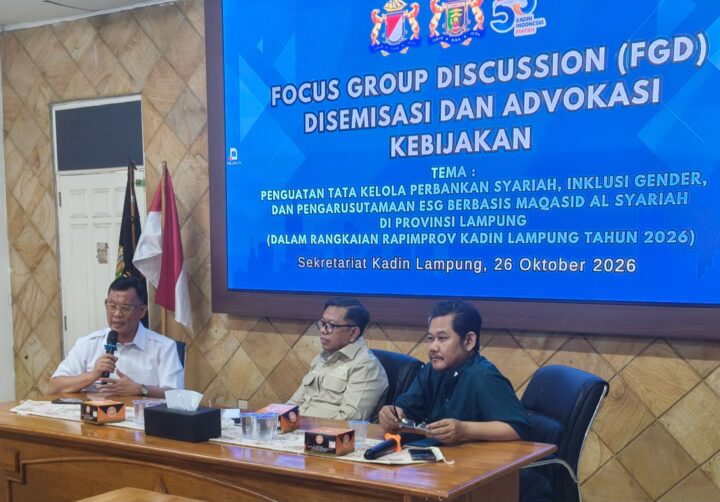
Bandar Lampung – The Lampung Provincial Chamber of Commerce and Industry (Kadin Lampung), in collaboration with the Regional Committee for Islamic Economy and Finance (KDEKS), held a Focus Group Discussion (FGD) on Policy Dissemination and Advocacy themed “Strengthening Islamic Banking Governance, Gender Inclusion, and Maqasid al-Sharia-Based ESG Mainstreaming in Lampung Province.” The event took place at the Kadin Lampung Secretariat Office in Bandar Lampung on Monday (October 26, 2026).
Romi Junanto Utama, Coordinating Deputy Chairman for Organization and Legal Affairs at Kadin Lampung, said the establishment of a regional regulation (Perda) was one of the initiatives the business community sought to advance to accelerate the development of the Islamic economy and finance sector in Lampung.
According to Romi, developing the sector requires more than initiatives from banks and businesses. Support from the regional government through well-directed policies is also necessary to enable Islamic banks to grow and compete with conventional banks.
“As representatives of the business community, we strongly hope that Lampung Province will have a regional regulation on Islamic Finance and Economy,” Romi said.
Romi noted that regional regulations could strengthen existing programs while accelerating the expansion of Islamic financial inclusion. He added that Kadin hoped the proposal would receive the attention of Lampung Governor Rahmat Mirzani Djausal.
Romi said the FGD's outcomes would be developed into a set of recommendations by a dedicated team before being submitted to the governor.
“We hope this discussion will not stop at an exchange of ideas but will lead to policy recommendations,” Romi said.
Meanwhile, Ardiansyah, a member of the Advisory Council of Kadin Lampung and Executive Director of KDEKS Lampung Province, said government intervention through regulation was necessary to strengthen the position of Islamic banking.
He highlighted that the market share and assets of Islamic banking, according to his presentation, remained at around 6–8%. This indicated considerable room for growth in the Islamic financial sector amid the dominance of conventional banking.
“This cannot be left entirely to business-to-business mechanisms alone,” he said.
Ardiansyah explained that the development of the regional Islamic economy needed to be supported by regulations, improved public literacy, and a stronger role for businesses and the banking industry.
He noted that public understanding of Islamic banking also needed improvement. While some people were familiar with Islamic banks, they did not yet fully understand the underlying principles, contractual arrangements (akad), and fundamental differences between Islamic and conventional banking practices.
Therefore, expanding the market share of Islamic banking requires more than introducing additional products and services. Educational initiatives that explain the substance of Islamic principles are also essential to help the public understand the available financial service options.
Ardiansyah also outlined three indicators used to assess the development of the Islamic economy and finance sector at the regional level: halal certification, zakat and social fund management, and the asset value of Islamic banking.
“These three indicators need to be incorporated into efforts to strengthen Lampung's Islamic economic ecosystem,” he said.
Furthermore, Muslimin, a lecturer at the Faculty of Economics and Business at the University of Lampung, presented research on gender diversity, blockholder structures, and the environmental, social, and governance (ESG) performance of global Islamic banks.
One of the research findings showed that women's representation in executive management had a positive and statistically significant effect on the ESG performance of Islamic banks, with a beta coefficient of 0.214 and a statistical significance level of p less than 0.01.
Meanwhile, gender diversity on the board of directors also showed a positive effect, although weaker, with a beta coefficient of 0.065 and a significance level of p less than 0.10.
These findings indicate that women's participation in executive positions may contribute more substantially to the implementation of environmental, social, and governance principles than gender diversity at the board level within the research model.
Executive leadership is considered important because it is directly linked to operational decision-making, the implementation of ESG frameworks, and the execution of corporate sustainability strategies.
In the context of Islamic banking, strengthening ESG practices must also be framed within maqasid al-sharia, the objectives of Islamic law that emphasize the public good and the realization of societal benefits.
“This approach is expected to strengthen governance while ensuring that business activities deliver broader benefits,” he said.