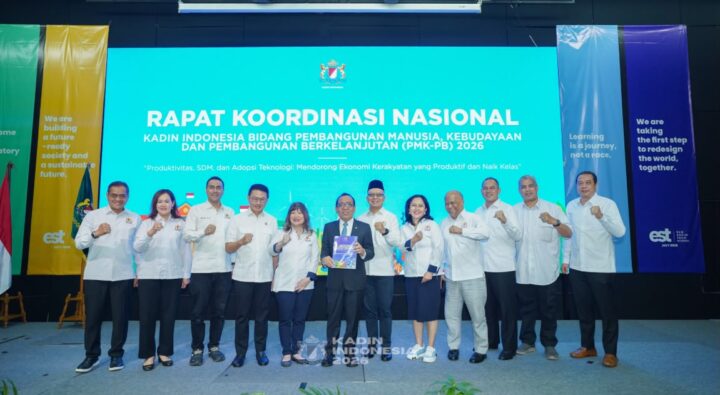
Jakarta – The Indonesian Chamber of Commerce and Industry (Kadin Indonesia), through its Human Development, Culture and Sustainable Development Division, held a National Coordination Meeting (Rakornas) themed “Productivity, Human Resources and Technology Adoption: Driving a Productive and Upgraded People’s Economy” at the Blackbox Theater, EcoSocioTech (EST) School (formerly HighScope Indonesia), on Thursday (October 1, 2026).
Kadin Indonesia Chairman Anindya Novyan Bakrie said strengthening the quality and productivity of human resources (HR) is one of the key factors in gradually achieving the national economic growth target of 8 percent.
“And of course, how healthy, how skilled, and how productive the workforce is will be one of the determining factors,” said Anin, as he is commonly known.
According to Anin, the business sector faces challenges in strengthening micro, small, and medium enterprises (MSMEs) amid rapid technological developments. Therefore, transformation and adaptation are needed to enable MSMEs and informal workers to improve their productivity and competitiveness.
Anin emphasized the importance of strengthening MSMEs, given that they constitute the largest segment of Indonesia’s business sector. This can be pursued through broader access to financing, digitalization, and partnerships with larger businesses to increase business value-added.
At the same time, technological developments require businesses and workers to continuously adapt. Anin said improving competencies is key to ensuring that workers remain capable of responding to changing demands in the labor market.
“In an era of very rapid technological development, we must continue to adapt in order to maintain our competitiveness globally. Therefore, the key is to keep learning,” Anin said.
Meanwhile, Kadin Indonesia Coordinating Deputy Chairman for Human Development, Culture and Sustainable Development Shinta Widjaja Kamdani said Indonesia needs increasingly higher, inclusive, and sustainable economic growth to achieve the Indonesia Emas 2045 vision.
Under the 2025–2029 National Medium-Term Development Plan (RPJMN), the government has set a target for national economic growth to reach 8 percent by 2029. Meanwhile, Indonesia’s economy grew by 5.61 percent in the first quarter of 2026. According to Shinta, this growth momentum needs to be strengthened through higher productivity, the development of value-added industries, and improvements in human capital quality.
“Indonesia has a very large workforce. In February 2026, the labor force reached 154.91 million people, with around 147.67 million employed. However, this large workforce must be matched by the quality, competencies, and productivity needed to respond to changing industrial requirements,” Shinta said.
She said technological changes are making workforce requirements increasingly dynamic. Technology, automation, digitalization, and changing business models are also transforming the competencies required by businesses. Therefore, human capital development needs to be increasingly aligned with the direction of economic growth.
Kadin is encouraging the mapping of growth-driving sectors, the types and number of talents required, industry competencies, available human resource capacity, and remaining gaps that need to be addressed.
“This mapping can begin pragmatically with several priority and future-oriented sectors, such as downstream processing, healthcare, energy, sustainable industries, and the creative economy,” she said.
The Rakornas also gathered input from Kadin regional offices and divisions under the coordination of the Human Development, Culture and Sustainable Development Division. The input covered priority issues, challenges, policy needs, and program directions.
Shinta said regional input is important because workforce needs, education and training, industrial conditions, access to healthcare, and readiness for technological transformation vary across regions.
“Through this Rakornas, we want to bring together these two perspectives: the sectoral needs brought forward by each division and the realities and needs of businesses in the regions,” she said.
The Rakornas discussions were consolidated around four main pillars: workforce productivity and competitiveness; education and training; strengthening the national healthcare industry; and sustainable industry and innovation.
These four pillars are aimed at building a human capital development ecosystem that is connected to economic growth needs, ranging from improving workforce productivity and competencies to developing the healthcare industry, green economy, creative industries, research, innovation, and technology.
Shinta added that Kadin has a strategic role as a bridge between business needs, government policies, the education and training ecosystem, professional associations, and regional needs.
“This enables Kadin to strengthen the connection between the demand and supply of human resources, education and the world of work, as well as between policy and implementation,” she said.
Through the Rakornas, Kadin is targeting several concrete outcomes, including an initial mapping of priority sectors and talent requirements, identification of human resource and competency gaps, policy bottlenecks, as well as follow-up agendas and quick wins that can begin to be implemented in 2027. The results of the Rakornas will subsequently become part of the substance consolidation process leading up to the 2026 Kadin Indonesia National Leadership Meeting (Rapimnas).
Coordinating Minister for Human Development and Cultural Affairs Pratikno welcomed the collaboration between Kadin and the government in preparing a skilled workforce that is relevant to the needs of the labor market.
According to Pratikno, climate change, geopolitical dynamics, and technological developments such as automation and artificial intelligence (AI) have transformed work patterns across various sectors.
“All of this is causing many types of jobs to disappear. Although new types of jobs are also emerging, what is clear is that the way work is done is changing across all sectors,” Pratikno said.
Therefore, educational institutions need to respond to these changes by aligning learning with labor market needs. In addition to vocational education, the government is also encouraging stronger training and apprenticeship programs as part of workforce competency development.
“Thank you to Kadin for helping the government make education more relevant, make our students more competent, and contribute to economic development. It is not only about achieving economic growth, but also ensuring that growth is inclusive and sustainable,” he said.
Also attending the event was Kadin Indonesia Deputy Chairman for Organization Taufan Eko Nugroho Rotorasiko.