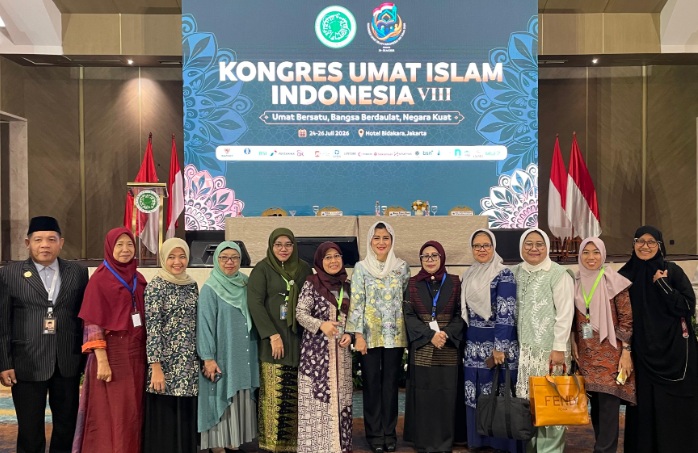
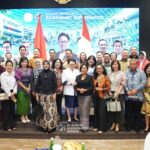
Jakarta – The Indonesian Chamber of Commerce and Industry (Kadin Indonesia) reaffirmed its commitment to strengthening the people's economy (ekonomi umat) as part of a broader strategy to enhance Indonesia's national economic resilience. The commitment was conveyed by Head of Kadin Indonesia's Sharia Economy and Finance Development Agency, Titi Khoiriah, during her address at the 12th Plenary Session of the 8th Indonesian Muslim Congress (Kongres Umat Islam Indonesia/KUII VIII), held at Hotel Bidakara, Jakarta, on Saturday (July 25, 2026).
Speaking under the theme "Strengthening Sustainable Economic Development and Enhancing International Business Competitiveness," Titi emphasized that the strength of the Muslim community's economy will play a decisive role in determining Indonesia's position amid intensifying global economic competition.
In her presentation, Titi identified three fundamental challenges that continue to hinder Indonesia's economic independence: the concentration of capital ownership among a limited number of players, which has prevented the country from achieving full economic sovereignty; policies that have yet to sufficiently support micro, small, and medium-sized enterprises (MSMEs) and the Islamic economy; and the relatively low adoption of digital technologies among Muslim entrepreneurs.
Despite these challenges, she highlighted several encouraging macroeconomic indicators recorded throughout 2026. Indonesia's economy expanded by 5.61 percent in the first quarter, inflation remained under control at 2.42 percent, and the Consumer Confidence Index stood at 122.9, reflecting strong public optimism regarding the country's economic outlook.
However, Titi cautioned that these achievements have not yet translated into stronger global competitiveness. Referring to the IMD World Competitiveness Ranking 2026, she noted that Indonesia ranked 48th out of 70 economies, with business efficiency and infrastructure quality remaining among the country's principal weaknesses.
Titi also underscored Indonesia's significant potential in the Islamic economy, citing the continued growth of Islamic financial assets, expanding exports of halal products, and the increasing number of halal-certified products. She noted that the government has set an ambitious target of positioning Indonesia as a global hub for the Islamic economy by strengthening three key pillars: the halal industry, Islamic finance, and an integrated business ecosystem.
She added that global demand for halal products continues to rise, while Indonesia already possesses strong competitive advantages in sectors such as modest fashion, Muslim-friendly tourism, halal pharmaceuticals and cosmetics, and the halal food industry. According to Titi, these industries should be further developed to enable Indonesia to become a leading player in the global halal value chain.
As the backbone of Indonesia's economy, MSMEs employ more than 120 million people across approximately 65 million business entities and contribute around 62 percent of the country's Gross Domestic Product (GDP). Given their significant contribution, Titi urged policymakers to prioritize easier access to financing, accelerated digital transformation, halal certification support, and human capital development within MSME empowerment programs.
She also emphasized the critical role of digital transformation in improving business efficiency and competitiveness. The adoption of artificial intelligence (AI), the strengthening of Indonesia's national data center infrastructure, and the expansion of digital literacy programs, she said, would enable MSMEs to reach broader markets while increasing productivity.
Beyond digitalization, Titi called for accelerating the transition toward a green economy through the development of renewable energy, carbon trading mechanisms, sustainable financing, and downstream industrialization of natural resources. In her view, downstreaming should not only strengthen Indonesia's domestic industrial base but also enhance the country's export competitiveness in international markets.
On international trade, Titi expressed optimism about Indonesia's expanding opportunities through various cross-border economic cooperation frameworks, including the country's accession process to the Organisation for Economic Co-operation and Development (OECD) and the completion of several international trade agreements. Nevertheless, she stressed that limited access to formal financing for millions of MSMEs, along with the need to strengthen institutional credibility, remains a major challenge.
Titi further highlighted the strategic role of Zakat, Infaq, Sadaqah, and Waqf (ZISWAF) in reinforcing the foundation of the Muslim community's economy. According to her, optimizing zakat management, expanding productive waqf, issuing Green Sukuk, developing Cash Waqf Linked Sukuk (CWLS), strengthening Islamic cooperatives, and professionally managing Islamic social funds could significantly broaden public access to financing while helping reduce economic inequality.
Concluding her presentation, Titi Khoiriah outlined five strategic recommendations for consideration by the 8th Indonesian Muslim Congress:
- Strengthen regulations that support MSMEs.
- Accelerate the development of an integrated Islamic economic ecosystem.
- Increase infrastructure investment alongside bureaucratic reform.
- Accelerate industrial downstreaming and the transition toward a green economy.
- Expand digital literacy and improve access to formal financing for millions of MSMEs that remain underserved by the banking sector.
Her presentation concluded with a statement that received strong appreciation from participants at the plenary session:
"When the Muslim community is strong and prosperous, Indonesia will also become a stronger, more advanced, and globally competitive nation."
Through this forum, Kadin Indonesia expressed its hope that the ideas presented would contribute to shaping policies that strengthen the economic empowerment of the Muslim community, in line with the vision of building an independent, equitable, sustainable, and globally competitive Indonesia.