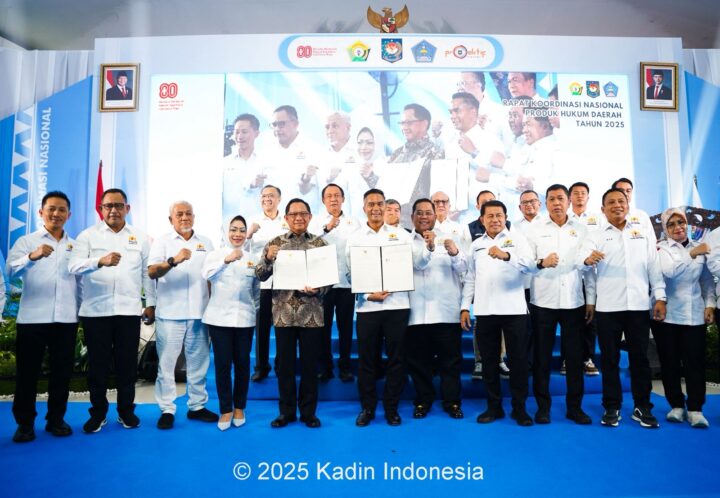
Kendari - Chairman of the Indonesian Chamber of Commerce and Industry (Kadin), Anindya Novyan Bakrie, attended the 2025 National Coordination Meeting (Rakornas) on Regional Legal Products, themed “Regional Legal Products for Investment Facilitation and Strengthening Asta Cita”, held at the Governor’s Office of Southeast Sulawesi in Kendari on Wednesday (August 27, 2025).
On the occasion, Anindya familiarly known as Anin emphasized Kadin’s strategic role as both a government partner and an umbrella for the business community, including state-owned enterprises (SOEs), MSMEs, and cooperatives.
Anin underlined the importance of collaboration with regional governments to drive economic growth and improve public welfare.
“We're thinking creatively about how to collaborate with local governments. There are many national programs that can empower the regions, such as the Free Nutritious Meals (MBG) initiative, the Merah Putih Village Cooperative Program, and the KUR for Livable Housing,” Anin said.
He added that early synergy between local governments and the private sector can generate positive impacts, including increased local revenue (PAD) and support for the creative economy.
“Going forward, Kadin will unify MSME initiatives with the creative industry, as we see this as a high-value intangible asset. Kadin remains focused on three key areas: investment, trade, and job creation,” Anin continued.
He expressed optimism about Indonesia’s economic momentum, noting that the national economy grew by 5.12% in the second quarter and that this trend could continue, supported by increasing investment.
“With events like this, I believe the momentum in Q3 and Q4 will be even stronger. What matters most is that investment continues to grow, and this will become evident in the upcoming quarters,” he concluded.
Meanwhile, Minister of Home Affairs Tito Karnavian reminded attendees of the need for caution in formulating regional legal products.
“When creating policies that affect the public, we must consider social, economic, and cultural conditions. If the community supports it, implement it. If not, don’t force it,” said Tito.
He also emphasized a bottom-up approach in resolving inter-regional disputes, encouraging direct communication and consensus-building before involving the national government.
“If the people support it, go ahead. If they don’t, don’t push it,” Tito reiterated.
In the same forum, Minister of Creative Economy and Head of the Creative Economy Agency Teuku Riefky Harsya stated that his ministry, in cooperation with the Ministry of Home Affairs, had issued a Joint Decree (SKB) as a guideline for strengthening creative economy institutions at the regional level.
“The creative economy can serve as a driver for job creation, attract investment, and contribute to Gross Regional Domestic Product (GRDP). Therefore, regional heads may establish dedicated creative economy departments or integrate them with tourism and culture, depending on their capacity,” he explained.
Support for national programs was also expressed by regional leaders attending the event. One program that drew attention was the Free Nutritious Meals (MBG) initiative.
Governor of North Maluku, Sherly Tjoanda Laos, said that MBG implementation in her province has reached only about 20%.
“Currently, MBG kitchens in North Maluku cover only around 20%. Our target is to reach 100% by optimizing existing infrastructure, such as restaurants, school canteens, and unused buildings that can be repurposed as community kitchens (SPPG),” Sherly stated.
Kadin and Ministry of Home Affairs Sign MoU
At the event, KADIN Indonesia signed a Memorandum of Understanding (MoU) with the Ministry of Home Affairs (Kemendagri) to support the development of regional policies that promote investment and business activity.
This agreement marks a strategic step to strengthen cooperation among the central government, regional governments, and the business sector to foster inclusive and competitive national economic growth.
The MoU covers various areas, including:
-
Empowerment of MSMEs and cooperatives through partnerships with the business sector,
-
Organization of dialogue forums and investment promotion activities,
-
Exchange of data and information on trade and investment potential,
-
Capacity building for local governments and business actors through training and technical assistance,
-
Use of demographic data, border region development,
-
Recognition for regional governments that excel in supporting the Asta Cita national agenda.
At the regional level, Kadin Southeast Sulawesi and the Southeast Sulawesi Provincial Government also signed a Joint Agreement on Economic Development Synergy and Strengthening the Business Sector in Support of the Asta Cita Program.
Through this partnership, Kadin Sultra is committed to enhancing the role of the private sector in regional development, expanding investment opportunities, and supporting the development of the local economy in line with national priority programs.