Surabaya – The Surabaya State Polytechnic of Electronics (Politeknik Elektronika Negeri Surabaya/PENS) has partnered with the East Java Chamber of Commerce and Industry (Kadin Jawa Timur), Kadin Institute, and Swisscontact to align the vocational education curriculum with the needs of industry.
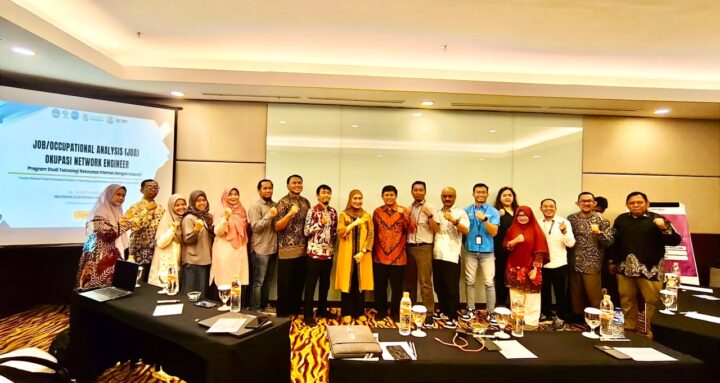
The collaboration was carried out through a Focus Group Discussion (FGD) on Job/Occupation Analysis (JOA) for the Network Engineer occupation, held in Surabaya over two days, from Friday (Sept. 4, 2026) to Saturday (Sept. 5, 2026).
The activity is part of efforts to establish a more concrete link and match between higher vocational education and industry. Through the JOA, higher education institutions do not merely seek industry input on existing curricula, but directly examine the jobs, tasks, responsibilities, and competencies required of Network Engineers in the workplace.
Director of Kadin Institute Nurul Indah Susanti said the collaboration among universities, industry, Kadin East Java, Kadin Institute, and Swisscontact is an important step toward realizing the link and match concept, which has remained a challenge. She said that cooperation between education and industry should go beyond formal partnerships and result in curricula that genuinely meet the needs of the labor market.
“Until now, when we talk about link and match, we have had the link, but not yet the match. We hope that through this collaboration, industry, universities, and the facilities provided by Swisscontact can create a new platform to jointly develop curricula that meet industry needs,” she said.
She added that the outcome of the activity is expected to be an Industry-Based Curriculum (IBC) that can be implemented not only at PENS, but also replicated by other universities and vocational education institutions. PENS is considered one of the pioneers in implementing this approach in East Java.
PENS Deputy Director Zen Samsono Hadi said the activity marks an important moment for PENS as the institution is currently revising the curriculum across all of its study programs. Curriculum revisions, which are generally conducted every four to five years, provide an appropriate opportunity to obtain direct input from industry.
“Ultimately, the curriculum we develop will truly reflect what industry needs. We want to receive input on the competencies required, the certifications needed, including the soft skills that should be provided to students,” he said.
According to Zen, collaboration with industry will not stop with the two-day FGD. PENS is also preparing a number of follow-up programs, including downstreaming initiatives, so that cooperation with industry can provide broader benefits for both students and the institution.
He said he hoped industry involvement in curriculum development would equip students with both technical capabilities and the character required in the workplace. Students are expected not only to master technology but also to adapt to rapidly changing industry trends.
“Our hope is that industry representatives will remain enthusiastic throughout these two days of working together with the university to formulate what is appropriate and what should be provided to students, who will eventually become Indonesia’s Golden Generation 2045,” he said.
Senior Program Officer SS4C at Swisscontact, Benaya Jaya, explained that aligning curricula with industry needs is essential to narrowing the gap between education and the world of work. Through the IBC approach, industry is directly involved in curriculum development, including through JOA to identify competency requirements based on actual jobs.
“The outcome of this activity is for schools and higher education institutions, particularly vocational education institutions, to have curricula that are aligned with industry. With an aligned curriculum, graduates can subsequently be directly absorbed by industry, increasing their employment opportunities,” he explained.
During the JOA process, six panelists from six different companies, all representing the same occupation—Network Engineer—provided information on job tasks and responsibilities, required competencies, and developments in the occupation. The panelists each have at least five years of experience and are still working as Network Engineers, ensuring that the information provided is relevant to current industry needs.
Senior Program Officer for VET Development at Swisscontact, Ilham Hasbiullah, said the approach encourages a paradigm shift in curriculum development, from supply-driven to demand-driven. Whereas curricula were previously developed by educational institutions and subsequently verified by industry, this approach first analyzes industry job requirements before translating them into a curriculum.
“We want to shift from a supply-driven curriculum to a demand-driven curriculum. The first step is to analyze the jobs in industry, and only then transfer or translate those requirements into the existing curriculum,” he said.
Ilham emphasized that under this approach, industry is not merely a partner but serves as a key reference in curriculum development. The results of the JOA are then translated into tasks and duties, which are subsequently developed into course designs and teaching materials that are once again verified by industry.
“Industry serves as one of the references—the real curriculum reference that reflects the latest developments and current conditions,” he said.
The approach is expected to make the PENS curriculum more adaptive to technological developments while enhancing graduates’ readiness to enter the workforce.