Surabaya – East Java Province (Jawa Timur) is strengthening its strategy for preparing Indonesian migrant workers by shifting its approach from simply sending workers overseas to developing human resources with the skills, certifications, and adaptability required by the global labor market.
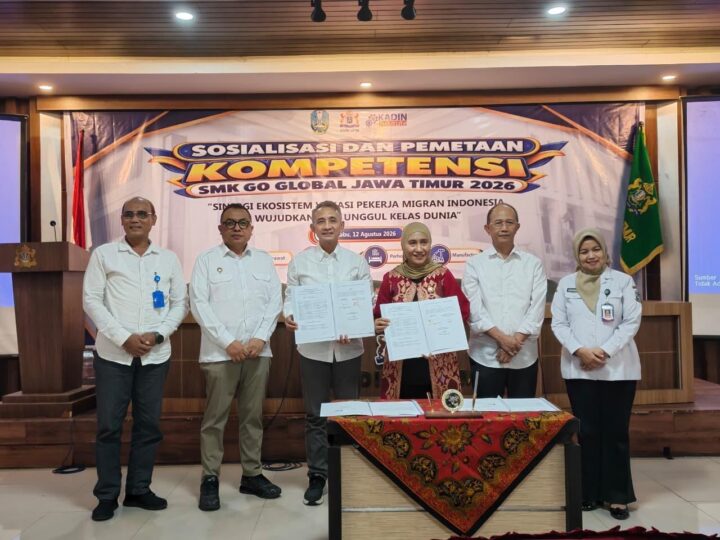
The strategy was discussed at the 2026 East Java SMK Go Global Competency Socialization and Mapping event, themed “Synergizing the Vocational Ecosystem for Indonesian Migrant Workers to Build World-Class Human Resources,” held at Graha Kadin East Java in Surabaya, East Java, on Wednesday (12/08/2026).
The event, a collaboration between the East Java Provincial Chamber of Commerce and Industry (Kadin), Kadin Institute, and the Ministry of Migrant Worker Protection of the Republic of Indonesia (KP2MI), brought together various stakeholders from the vocational education and training ecosystem, including Vocational Training Institutions (LPK), Course and Training Institutions (LKP), Professional Certification Institutions (LSP), Vocational Training Centers (BLK), vocational associations, and representatives of vocational high schools (SMK).
Chairman of Kadin East Java Adik Dwi Putranto said legal compliance must go hand in hand with competency development. Prospective migrant workers must follow official channels and be equipped with the necessary skills before being deployed overseas.
“The most important thing now is that workers must be legal, registered with the Manpower Office, and go through official channels, not illegal ones. They must then be equipped with competencies, both technical and non-technical,” Adik emphasized.
He said the ability to adapt to the culture of the destination country is equally important. Workers who do not understand the characteristics and culture of their destination country may experience culture shock, which can affect their behavior and ability to sustain their employment.
“If they do not understand the culture, they can experience culture shock. There are cultural differences there that can affect their behavior. If they cannot adapt, they may eventually feel uncomfortable and problems can arise,” he said.
In addition to adaptation, competency gaps can also cause workers to encounter problems in the workplace. Therefore, the government is encouraging migrant workers to obtain competency certifications before being deployed.
“If they do not have the skills and are not equipped with the necessary training, they will not be able to perform their jobs there and could be sent home. This is now being minimized. The government is encouraging everyone who goes abroad to have a competency certificate to minimize undesirable incidents,” Adik said.
Meanwhile, Director of Kadin Institute East Java Nurul Indah Susanti said competency mapping is an important step to ensure prospective migrant workers are not only equipped with basic skills but are specifically prepared based on the requirements of their destination countries.
“There are many jobs available now, so these jobs need to be matched. Our task is to map the competencies of workers who will be sent overseas against the competencies required by the destination countries,” Nurul said.
According to her, workers seeking employment overseas need three key assets: skills, knowledge, and attitude. Therefore, training must combine technical capabilities with non-technical competencies, including character development and soft skills.
Labor demand is also becoming increasingly specialized. In the manufacturing sector, for example, the job market requires workers for packing, screwing, fitting, industrial welding, and technology operation. Meanwhile, the agricultural sector requires workers for planting, crop maintenance, and harvesting.
In the healthcare sector, demand includes caregivers, caretakers, and elderly care workers. In the domestic sector, jobs are increasingly being defined based on specific positions and competencies, such as housekeepers, childcare workers, babysitters, family cooks, and family drivers.
Nurul emphasized that this shift shows that migrant workers are increasingly being positioned as professionals based on specific occupations, rather than simply being categorized as formal or informal workers.
“The focus is now shifting toward specific occupations. Housekeeper, caretaker, babysitter, childcare—these are specific positions. So they are no longer simply categorized as domestic workers, but according to positions that match their competencies,” she explained.
Global labor market opportunities are also considered increasingly open. Japan, for example, needs caregivers, while Germany has demand in the hospitality sector, including cooks and food-related positions. Other countries such as Taiwan, South Korea, Singapore, Malaysia, Brunei, Australia, and Türkiye are also considered potential markets.
East Java is considered to have strong potential to capitalize on these opportunities due to its extensive vocational education base. Graduates of vocational high schools, polytechnics, and other vocational education institutions are encouraged to be prepared from an early stage so that their competencies align with the requirements of their destination countries.
“What we are preparing is not just skills, but also knowledge and attitude. Technical capabilities must be ready, while non-technical capabilities must also be developed, particularly character and soft skills,” Nurul said.
Government Promotes an Integrated Vocational Ecosystem
Director of Institutional Development for the Indonesian Migrant Worker Vocational Sector at KP2MI Abri Danar Prabawa said the SMK Go Global program is part of the government’s efforts to improve the quality of human resources so they can compete and secure employment in the international labor market.
“SMK Go Global is one of the government’s programs whose main objective is to improve the competencies of human resources so that they can compete and be absorbed by the global labor market,” Abri said.
According to Abri, the program cannot operate independently. The central government, regional governments, village administrations, vocational institutions, vocational high schools, and LPKs need to establish an integrated ecosystem covering the entire process, from identifying prospective workers to training and certification.
“We have to build a unified ecosystem. We cannot work separately. We need to work together to prepare human resources whose competencies meet the needs of the global labor market,” he said.
East Java, he added, has significant potential to become one of the centers for preparing high-quality migrant workers. The province’s large number of vocational institutions and vocational high schools is a major strength that needs to be optimized. However, several areas still need to be strengthened, particularly specialized competencies, certification, and foreign-language skills. With these capabilities, migrant workers from East Java are expected to advance into professional workers with competencies recognized in their destination countries.
“We have very significant resources and strong talent potential. However, we need to further strengthen their competencies, one of which is foreign-language proficiency,” Abri explained.
Therefore, competency mapping will focus on identifying the number of people interested in working overseas, the fields they are interested in, and the competencies they already possess. The data will then serve as the basis for designing training programs and upgrading their skills.
“We want to know how many people are interested in working overseas, what they are interested in doing, and what competencies they have. Then we can upgrade their skills and prepare them. Hopefully, this will be a good starting point for preparing world-class human resources,” he concluded.
Through SMK Go Global, East Java is expected not only to serve as a source of migrant workers but also to develop into a center for preparing skilled workers capable of meeting the needs of international industries. Synergy among vocational education institutions, training providers, certification bodies, government, and the business community will serve as the foundation for ensuring that workers sent overseas are truly competent, legally deployed, and ready to compete in the global labor market.