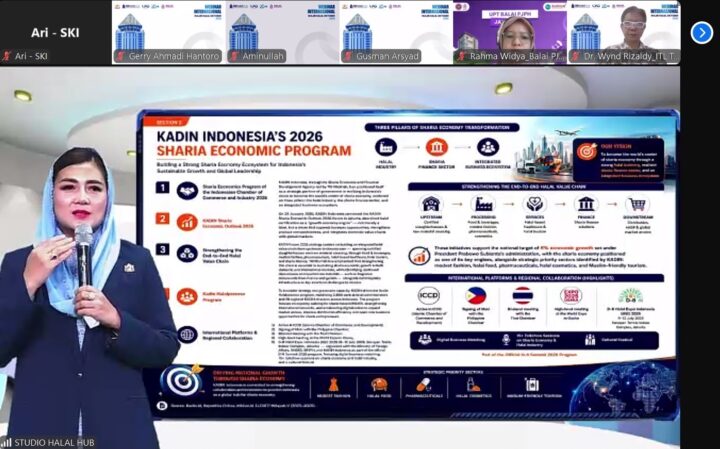
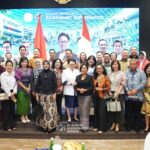
Jakarta – The Indonesian Chamber of Commerce and Industry (Kadin Indonesia), together with ESQ Halal Hub, held the International Webinar on Mandatory Halal Certification October 2026, themed “Strategies for Businesses to Build Competitive Advantage through Halal Certification,” online via Zoom on Tuesday (September 1, 2026).
Head of Kadin Indonesia’s Sharia Economic and Financial Development Agency, Titi Khoiriah, said the mandatory halal certification requirement, which will take effect in October 2026, should not be viewed merely as a regulatory obligation, but as a strategic opportunity for businesses to enhance competitiveness and expand access to global markets.
“With the October 18, 2026 deadline fast approaching, how can businesses, both MSMEs and industries, turn this mandatory halal requirement into a strength within the ecosystem?” Titi said.
Titi said Indonesia has significant potential to become one of the leading players in the global halal industry ecosystem. This is supported by Indonesia’s Muslim population of around 240 million people, or approximately 87% of the total population.
However, this substantial domestic market potential needs to be accompanied by stronger industrial capacity and halal supply chains so that Indonesia does not merely become a consumer, but is able to become a major producer and supplier within the global halal ecosystem.
“Indonesia is the country with the world’s largest Muslim population. The challenge is how we can leverage this significant potential to enable Indonesia to lead the global halal industry,” Titi said.
Titi said Indonesia currently ranks fourth in the global halal economy ecosystem. This presents both a challenge and an opportunity for Indonesia to strengthen its positioning internationally. She said halal certification can serve as one of the growth engines of the national economy, particularly by strengthening the halal supply chain from upstream to downstream.
Globally, the halal economy has currently reached approximately US$2.5 trillion in potential and is projected to continue growing. Therefore, Titi emphasized that Indonesia should not view halal certification merely as a regulatory requirement, but instead leverage it as a competitive advantage to improve quality, consumer trust, traceability, and product competitiveness.
“If Indonesia only relies on the mandatory requirement, it would be a shame if this opportunity becomes a market for other countries. We therefore need to look at this together as an opportunity,” she stressed.
Furthermore, Titi explained that Kadin Indonesia continues to promote the strengthening of the sharia economic ecosystem through various programs, including the development of halal supply chains and an end-to-end halal value chain.
One of these efforts is strengthening collaboration between Kadin Indonesia and regional Kadin organizations. There are currently 38 Provincial Kadin organizations that can play an important role in building a national halal ecosystem.
“We will strengthen the supply chain and establish halal hubs across Sumatra, Java, Kalimantan, and Eastern Indonesia. With halal hubs involving regional Kadin organizations and businesses, this will strengthen the supply chain and Indonesia’s positioning in the global sharia economy,” Titi explained.
In addition to developing halal hubs, Kadin Indonesia also runs the Kadin Halal Trainer program to enhance human resource capacity in the halal sector.
The program is not only aimed at helping businesses obtain halal certification, but also at developing talent with an understanding of the halal ecosystem, enabling businesses to scale up and expand their markets from domestic to international.
“How can we strengthen businesses that previously only served the domestic market so that we can also encourage them to expand into global markets?” she said.
Titi added that Kadin Indonesia also continues to strengthen international cooperation through various bilateral agendas, business matching activities, and business diplomacy to enhance Indonesia’s position in the global halal supply chain.
According to her, Indonesia has several advantages that could enable it to become a global halal economic hub, ranging from its abundant natural resources and large Muslim population to its broad industrial potential and domestic market.
Furthermore, Titi emphasized that the concept of halal has now evolved beyond product certification. Halal is increasingly associated with quality, health, hygiene, sustainability, integrity, and consumer trust.
“Halal is lifestyle, halal is healthy, halal is hygiene, halal is sustainability. With the halal-first concept, God willing, we can work together to make Indonesia a center of the sharia economy,” Titi said.
Titi cited Brazil as an example of one of the world’s largest chicken exporters. Although Brazil is not a Muslim-majority country, it is able to meet halal standards to serve the needs of the global Muslim market. This demonstrates that the halal economy is not only an opportunity for Muslim-majority countries, but has developed into a global market that can be tapped by countries around the world.
Therefore, Titi said Indonesia needs to strengthen several strategic sectors within the halal ecosystem, ranging from food and beverages, cosmetics, and pharmaceuticals to export-import activities and Islamic finance.
“We are not only talking about products that obtain certification, but also about their sustainability, traceability, governance, and building trust,” she said.
Titi also highlighted the importance of strengthening Indonesia’s halal economic governance. Based on the mapping she presented, Indonesia still faces challenges in halal governance, where it ranks 16th globally.
According to her, governance needs to be strengthened collectively by the government, regulators, Kadin, and businesses so that halal certification can generate greater added value for the national economy.
“Halal compliance processes also need to be supported by traceability, governance, and building trust,” she said.
Titi added that the Asia-Pacific region accounts for the largest share of the global halal economy market, at approximately 58%, followed by the Middle East at 20%, Europe at 15%, and the United States at 5%. The size of this potential indicates that there remains significant room for Indonesian halal products to access the market.
Therefore, Kadin Indonesia is encouraging businesses to use the implementation of mandatory halal certification in October 2026 as a starting point to scale up their businesses.
Titi encouraged businesses, particularly MSMEs, not to wait until the requirement takes effect. According to her, preparations for halal certification should begin early so businesses have sufficient time to improve their production processes, governance, product quality, and marketing strategies.
“Do not view halal merely as a burden or obligation. Make halal part of your business strategy to move up to a higher level, expand your market, and build consumer trust,” she said.
Titi emphasized that Indonesia’s success in developing a global halal industry requires collaboration among all stakeholders. The government, regulators, business community, financial institutions, associations, and regional Kadin organizations need to work together to build an integrated halal ecosystem.
“With strong collaboration and synergy, we hope Indonesia will not only become a market, but also become a major player and a global center of the halal economy,” Titi concluded.
Also serving as speakers at the webinar were Head of the Halal Product Assurance Organizing Agency (BPJPH) of the Republic of Indonesia Haikal Hassan, Global Halal Supply Chain Expert Marco Tieman, and ESQ Board of Director Rinaldi Agusyana.