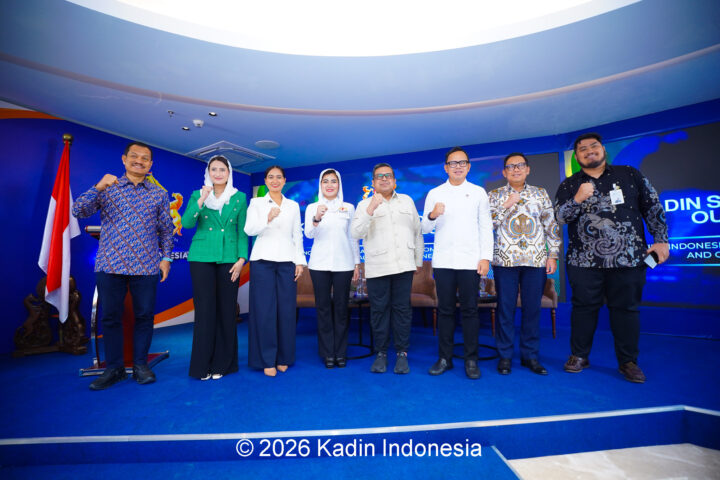
Jakarta – The Indonesian Chamber of Commerce and Industry (Kadin Indonesia) held the Kadin Sharia Economic Outlook 2026 under the theme “Driving Indonesia’s Halal Industry Competitiveness and Global Export Readiness” at the RGE Lounge, 29th Floor of the Kadin Indonesia Tower, Jakarta, on Wednesday (28 January 2026).
In her opening remarks, Titi Khoiriah, Head of Kadin Indonesia’s Sharia Economy and Finance Development Agency, said the forum discussed the future direction and prospects of the sharia economy, as well as Kadin’s role as an accelerator for the development of Indonesia’s sharia economy and halal industry.
Titi emphasized that, in line with the direction of Kadin Indonesia Chairman Anindya Novyan Bakrie, Kadin— as a strategic partner to both the government and the business community—continues to push Indonesia to become a global hub for the sharia economy and halal industry.
“Our target is to dominate the domestic market, become a key player in the sharia economy, and at the same time build strong competitiveness in the global market,” Titi said.
She added that Kadin hopes Indonesia’s sharia economy will continue to deliver tangible benefits and contribute to achieving national economic growth targets.
One of the initiatives currently being developed, Titi explained, is the Indonesia Sharia Economic Center, a platform designed to bring together halal industry players.
“Through this platform, Kadin Indonesia is also promoting and strengthening the Kadin Halal Hub as a center for collaboration, facilitation, and the development of the national halal industry,” she concluded.
Meanwhile, Deputy Minister of Tourism Ni Luh Puspa highlighted the vast potential of Muslim-friendly tourism. She acknowledged that discussions around halal tourism are often considered sensitive, but when properly understood, they represent a strategic opportunity.
With more than 86 percent of Indonesia’s population being Muslim, Indonesia is seen as having a strong comparative advantage in developing Muslim-friendly tourism, in line with shifting market structures and global traveler preferences.
“Muslim-friendly tourism is an added-value service that includes amenities, attractions, and accessibility to meet the needs and experiences of Muslim travelers, in line with the trend toward experience-based tourism,” she explained.
Furthermore, Deputy Minister of Trade Dyah Roro Esti Widya Putri underscored the export potential of halal products in boosting foreign exchange earnings. Based on Ministry of Trade data for 2024, Indonesia’s total halal product exports reached USD 41.4 billion, with the largest contribution coming from the food and beverage sector at USD 33.6 billion, followed by halal fashion at USD 6.83 billion, and halal cosmetics at USD 363 million.
“This potential continues to grow, supported by strengthened exports through Mutual Recognition Agreements (MRAs) for Indonesia’s halal certification, which are now recognized in 16 countries, as well as bilateral halal cooperation with five partner countries,” Roro said.
Deputy Minister of Home Affairs Bima Arya Sugiarto noted that Indonesia’s halal industry has very promising prospects, provided that the halal ecosystem is strengthened comprehensively from upstream to downstream.
“We need to build a culture of understanding around the halal industry while strengthening its supporting infrastructure. The Ministry of Home Affairs continues to work in synergy to ensure that regional leaders not only understand this agenda, but also become key drivers in strengthening the halal ecosystem— including through regional budget support for halal certification, education, and the development of regional competitive advantages,” he explained.
At the same event, Head of the Halal Product Assurance Organizing Agency (BPJPH) Ahmad Haikal Hasan confirmed that BPJPH has entered into a Mutual Recognition Agreement with the United States Government regarding the implementation of halal certification.
The agreement, concluded with the United States Trade Representative (USTR) and the United States Defense Representative (USDR), provides the basis for mutual recognition of halal certification for products traded between Indonesia and the United States.
“There is now an agreement between the United States and BPJPH on halal implementation—both for U.S. products entering Indonesia and Indonesian products entering the United States,” he explained.
Targeting Indonesia as a Global Sharia Economy Hub
The event continued with a panel discussion session. During the discussion, Primus Dorimulu, CEO of investortrust.id and Head of Kadin Indonesia’s Communications Office, said Indonesia possesses nearly perfect fundamental assets to become a global sharia economy hub—ranging from the world’s largest Muslim population and a mature regulatory framework to strong institutional support.
However, he noted that these strengths have not yet been fully integrated into a mutually reinforcing economic force.
“The most visible progress has been in the halal industry, particularly in food and beverages, cosmetics, pharmaceuticals, and Muslim fashion. These industries are growing rapidly, driven by domestic consumption and MSMEs, supported by halal certification, supply chain digitalization, and connectivity to export markets,” he said.
The two-session panel discussion also featured speakers including Inspector General Sony Sonjaya, Deputy Head of Operations for Nutrition Fulfillment at the National Nutrition Agency; Cecep Rukendi, Deputy for Strategic Development of the Creative Economy at the Ministry of Creative Economy/Creative Economy Agency; Donny Pramono, Founder of Sour Sally Group; Muhammad Ismail, CEO of Zahir International; and Banjaran Surya Indrastomo, Chief Economist of PT Bank Syariah Indonesia (Persero) Tbk.
As part of the event, Kadin Indonesia also signed a Memorandum of Understanding (MoU) with PT Bank Syariah Indonesia (Persero) Tbk.
The scope of cooperation includes accelerating the development of the halal industry and halal certification along with its supporting ecosystem; optimizing sharia financial products; developing digitally based halal MSMEs; enhancing human resource quality and national halal export value; strengthening the digital ecosystem and data center for the sharia economy and finance; as well as education and public outreach through the implementation of an inclusive and collaborative Sharia Economy and Finance brand.
Also in attendance were Devi Erna Rachmawati, Vice Chair for Agriculture at Kadin Indonesia; Mufti Mubarok, Vice Chair for MSME and Cooperative Business Protection and Legal Affairs; Tatyana Sentani Sutara, Vice Chair for Women and Children Empowerment; Rifda Ammarina, Vice Chair for Marketing, Promotion, Innovation, and MSME Product Development; Nofel Saleh Hilabi, Vice Chair for Migrant Worker Protection; and Muhammad Iqbal Piyeung, Chairman of Kadin Aceh Province.