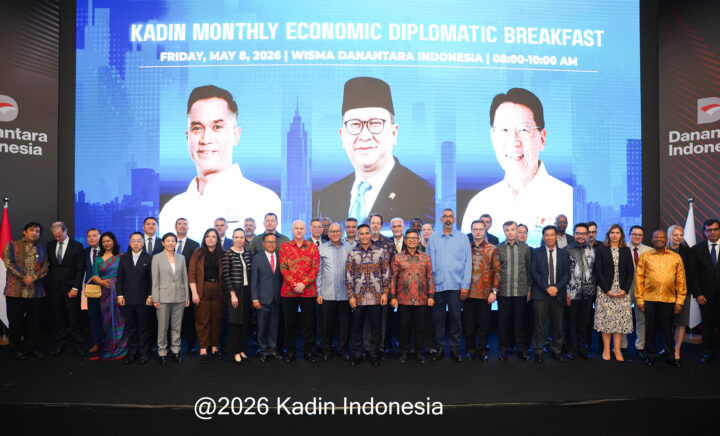
Jakarta – The Indonesian Chamber of Commerce and Industry (Kadin Indonesia) once again held its Kadin Monthly Economic Diplomatic Breakfast at Wisma Danantara on Friday (08/05/2026).
Chairman of Kadin Indonesia, Anindya Novyan Bakrie, said the meeting was held amid positive news regarding Indonesia’s economic growth, which reached 5.61% in the first quarter of 2026.
According to Anindya, commonly known as Anin, the achievement signals that the national economy continues to grow consistently despite mounting global pressures and uncertainties.
“Indonesia’s economy grew by 5.61% in the first quarter of 2026. At a time when economic growth has become increasingly rare in many countries, Indonesia continues to demonstrate consistent growth,” said Anin.
Anin noted that several domestic economic indicators still show solid performance, ranging from strong household consumption and sustained investment activity to continued expansion in the manufacturing sector.
“In other words, our economic engine is not only running, but is beginning to gain stronger momentum,” Anin stated.
Nevertheless, Anin acknowledged that current global conditions remain challenging. Geopolitical tensions, supply chain disruptions, energy volatility, and currency fluctuations continue to pose challenges for many countries, including Indonesia.
In addition, Anin said findings from the Kadin Business Pulse survey also indicate rising production costs, uneven demand recovery, and persistent business uncertainty.
“Let us be honest, this is not an easy situation. But Indonesia is not a country that can only grow under comfortable conditions,” Anin remarked.
Furthermore, Anin identified three main factors that could drive Indonesia’s economy going forward. First is the shift in global trade patterns, where companies are now seeking not only efficiency, but also certainty.
According to Anin, Indonesia possesses a rare combination of strengths, namely a large economic scale, stability, abundant natural resources, and an open foreign policy.
Second, Anin highlighted the growing importance of strategic global commodities such as nickel, palm oil, and critical minerals, which place Indonesia in a key position within the next global industrial supply chain.
“Indonesia stands right at the center of the world’s next industrial chapter,” Anin said.
Meanwhile, the third factor, according to Anin, is industrial downstreaming, which he described as a crucial step toward increasing national economic value-added.
“It is about shifting from exporting what we extract from the earth to exporting what we create. This is where value is built, resilience is built, and the future is built,” Anin stated.
Anin also expressed appreciation for the government’s swift response following the release of Indonesia’s first-quarter 2026 economic growth data. According to him, President Prabowo Subianto immediately gathered the country’s top economic policymakers, including ministers, regulators, Bank Indonesia, financial authorities, and senior advisors to ensure strong coordination.
“The message was clear: remain vigilant, remain aligned, and stay ahead of change,” he said.
Anin stressed that cross-institutional coordination is no longer merely a bureaucratic exercise, but has become part of national competitiveness. Kadin, he added, refers to this approach as “Indonesia Incorporated.”
“One nation, one direction, with many partners. Because no country can build its future alone, and the countries that move the fastest are those that move together,” Anin remarked.
He expressed hope that the Kadin Monthly Economic Diplomatic Breakfast would continue to serve as a platform where ideas, policies, investments, and collaborations converge to support stronger and more sustainable economic growth in Indonesia.
“The world today is full of noise. But Indonesia does not need to be the loudest voice in the room. We only need to be more consistent — consistent in growth, openness, and ambition. We are optimistic not because we ignore the challenges, but because we know how to work through them,” Anin concluded.
Meanwhile, Indonesia’s Minister of Investment and Downstreaming/Head of BKPM and CEO of Danantara Indonesia, Rosan P. Roeslani, stated that the world continues to face major challenges due to geopolitical conflicts and global economic uncertainty. However, Indonesia has managed to maintain economic resilience and sustain its growth momentum.
“Amid external challenges, with wars still ongoing, this provides understanding and confidence in how Indonesia can navigate the current circumstances,” he said.
Rosan also emphasized that open communication between the government, investors, and business players remains essential in maintaining a conducive investment climate. The government, he added, continues refining policies to improve business certainty.
“They (investors and business players) understand that amid these challenges, Indonesia remains resilient, both economically and in terms of continuously improving policies,” Rosan said.
Furthermore, Coordinating Vice Chairman for Foreign Affairs of Kadin Indonesia, James T. Riady, said Indonesia’s position is becoming increasingly strategic as the world competes once again for access to important commodities such as nickel, palm oil, and critical minerals. According to him, this momentum must be utilized to accelerate national industrial downstreaming.
“The question is no longer whether Indonesia is important or not. The question is how quickly Indonesia can move up the value chain,” James stated.
James added that downstreaming is the key to Indonesia’s economic transformation because it shifts the country away from exporting raw materials toward exporting higher value-added products. Such a transformation, he said, is essential for building long-term economic resilience.
“Downstreaming is the shift that changes the story — from exporting what we extract to exporting what we create. This is where value is built, resilience is built, and the future is built,” James concluded.
Also attending the event were members of Kadin Indonesia’s leadership, including Coordinating Vice Chairwoman for Infrastructure and Regional Development Carmelita Hartoto, Coordinating Vice Chairman for Investment, Downstream Industry, Energy, and Environment Bobby Gafur Umar, Coordinating Vice Chairwoman for Social Affairs Nita Yudi, Coordinating Vice Chairman for Law, Human Rights, and Infrastructure M. Azis Syamsuddin, and Coordinating Vice Chairman for Export Development Juan Permata Adoe.
Several regional Kadin chairpersons were also present, including Chairman of Kadin Aceh Province Muhammad Iqbal Piyeung, Chairman of Kadin West Sumatra Province Buchari Bachter, Chairman of Kadin South Sumatra Province Affandi Udji, Chairman of Kadin Bangka Belitung Province Ritchie Glen Yapranadi, Chairman of Kadin Jakarta Province Diana Dewi, Chairman of Kadin West Nusa Tenggara Province Faurani, Chairman of Kadin Central Sulawesi Province M. Nur Rahmatu, and Chairman of Kadin Papua Province Jacleana Joku.
Ambassadors and representatives from friendly countries also attended the event, including representatives from the Netherlands, Brazil, Denmark, Pakistan, New Zealand, Singapore, Thailand, Vietnam, and South Africa.