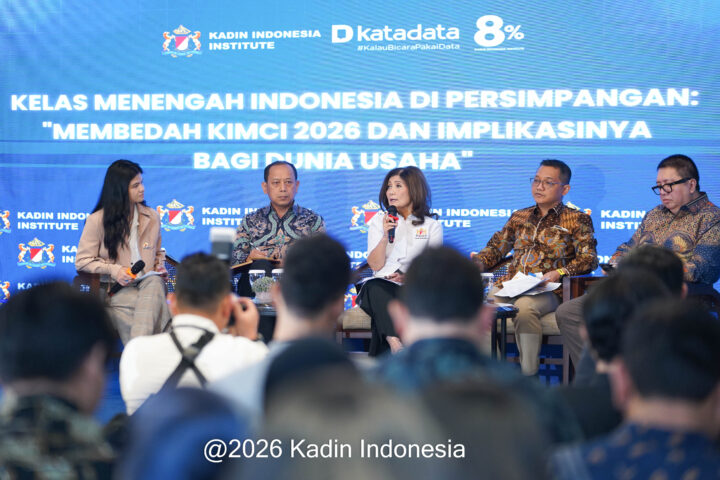
Jakarta – The Indonesia Chamber of Commerce and Industry (Kadin) Institute (KII), in collaboration with Katadata, held the forum titled “KII 8% Club: Examining the 2026 Katadata Indonesia Middle Class Insight (KIMCI) and Its Implications for the Business Sector” at Kadin Indonesia Tower, Jakarta, on Thursday (June 4, 2026).
During the forum, Kadin Indonesia Vice Chairwoman for Macro-Micro Economic Policy, Aviliani, emphasized that strengthening people's purchasing power is one of the most pressing needs for the business community today. According to her, although household consumption remains relatively strong, there are still gaps that require attention to ensure domestic demand can grow more robustly and sustainably.
“From the business perspective, we certainly want to see much stronger demand. Therefore, cooperation among the business sector, the public, and the government is needed to boost demand and strengthen economic activity,” said Aviliani.
One measure that could be pursued, she noted, is expanding the participation of micro, small, and medium enterprises (MSMEs) in the national industrial supply chain. Aviliani explained that Kadin Indonesia has conducted a study on developing collaboration models that would enable MSMEs to become part of the supply chains of Kadin member companies.
According to her, the findings of the study now need to be followed up through implementation supported by various government incentives, creating stronger incentives for both MSMEs and large corporations to establish closer partnerships.
“MSMEs are a sector that absorbs a significant amount of labor. If they can be connected to larger industrial supply chains, the economic benefits will be substantial and far-reaching. However, this process requires mentoring, capacity building, and sufficient time to improve the quality and competitiveness of MSMEs,” she said.
Aviliani added that the successful upgrading of MSMEs and their integration into the global value chain would not only strengthen the competitiveness of Indonesian businesses but also contribute to improving the quality of Indonesia’s middle class.
“When MSMEs move up the value chain and become integrated into global value chains, people's incomes will increase. Ultimately, this will strengthen the middle class and create higher-quality economic growth,” she stated.
Meanwhile, KII Executive Director Mulya Amri highlighted research findings indicating increasing pressure on Indonesia’s middle class. According to him, this phenomenon should not be viewed merely as a statistical shift but rather as an important indicator reflecting the condition of national consumption.
“The decline of the middle class is not merely a statistical issue; it is a signal that the nation’s consumption engine is under serious pressure. Therefore, a deeper understanding is needed so that research findings can be translated into concrete actions,” said Mulya.
He explained that the KII 8% Club was established as a data-driven dialogue platform aimed at bridging research findings with the needs of the business community and the public policymaking process.
“We want to ensure that data and research findings can be transformed into insights that are relevant for businesses while also serving as a foundation for effective policy advocacy,” he said.
On the same occasion, Ferry Irawan, Deputy for Coordination of State-Owned Enterprise Management and Development at the Coordinating Ministry for Economic Affairs of the Republic of Indonesia, stated that middle-class development remains one of the government’s key priorities due to its substantial contribution to the national economy.
According to Ferry, the middle class makes a significant contribution to household consumption, the productive workforce, and Indonesia’s overall economic growth. Therefore, the government continues to formulate policies aimed at improving the welfare of this segment of society.
“How to encourage and further develop the middle class has become one of the government’s important programs. In terms of consumption, population size, and contribution to economic growth, the middle class plays a highly significant role,” he said.
Ferry also expressed his appreciation for Kadin Indonesia’s initiative through the KII 8% Club, which provides a research-based discussion forum to address national economic challenges and formulate collaborative solutions.
“We highly welcome this initiative by Kadin. Moreover, the spirit behind it is to drive economic growth to 8 percent. For that reason, we are ready to collaborate,” he concluded.