Jakarta – Chairman of the Indonesian Chamber of Commerce and Industry (Kadin Indonesia), Anindya Novyan Bakrie, said the Comprehensive Strategic Partnership between Indonesia and China continues to grow stronger, as reflected in expanding trade, investment, and collaboration across strategic sectors that support the economic growth of both countries.
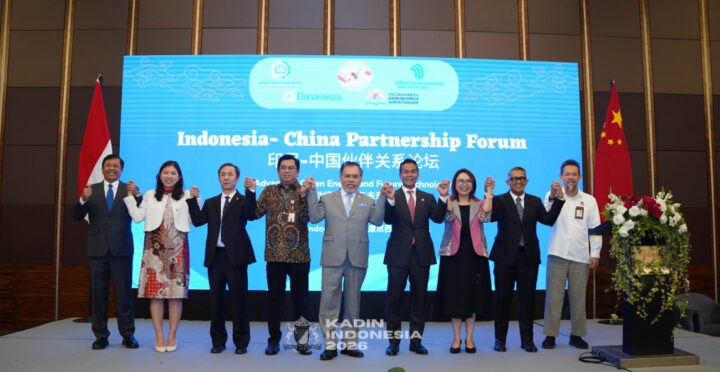
Anindya, popularly known as Anin, made the remarks during the Indonesia–China Partnership Forum: "Advancing Green Energy and Future Technology", held at Hotel Indonesia Kempinski in Central Jakarta on Thursday (July 23, 2026).
Anin said economic relations between Indonesia and China continue to demonstrate positive momentum. Bilateral trade reached approximately US$168 billion in 2025, while total trade in the first half of 2026 had already surpassed US$100 billion.
"This represents extraordinary growth," Anin said.
In addition to expanding trade, Indonesia recorded a trade surplus of approximately US$5.8 billion with China during the first half of 2026. According to Anin, the achievement was driven by growing exports of higher value-added products resulting from Indonesia's downstream industrialization strategy.
"We would like to thank our Chinese partners for their investments in Indonesia. This time, we have successfully exported more value-added products, enabling us to achieve a trade surplus of US$5.8 billion over the past six months," Anin said.
On the investment front, Anin noted that combined investment from China and Hong Kong into Indonesia reached approximately US$20 billion in 2025, making them Indonesia's largest source of foreign investment.
"China has made a tremendous contribution to both Indonesia's trade and investment," he said.
Anin also highlighted the implementation of the Local Currency Transaction (LCT) framework between Bank Indonesia and China's monetary authorities, describing it as another milestone in strengthening bilateral economic relations.
"The target for direct transactions between the rupiah and the yuan has been increased from US$30 billion to US$60 billion. About a month ago, during our visit to Bank Indonesia, we were informed that direct rupiah-yuan transactions had already increased by 300 percent," Anin said.
According to Anin, Indonesia and China also have significant opportunities to build a more integrated global supply chain. He pointed to his participation in the China International Supply Chain Expo (CISCE) in Beijing, held from June 22 to 26, 2026, as evidence of the growing potential for cooperation.
He expressed hope that this synergy would continue to deepen, including through the upcoming Trade Expo Indonesia scheduled for October, which aims to surpass last year's transaction value of US$20.8 billion.
Anin added that the Comprehensive Strategic Partnership established by both governments must continue to be translated into concrete collaboration among governments, businesses, and other stakeholders.
"I believe the Indonesia–China Comprehensive Strategic Partnership, which has been so well established at the government-to-government level, needs to be realized through meaningful events like today's forum. It is an honor for Kadin to be part of this effort," he said.
He further noted that the forum's theme closely aligns with the future direction of bilateral cooperation, particularly in green energy, healthcare, and future technologies.
"If we look at today's theme, it is exactly on point—green energy, health, and future technology. China is truly a global leader in all three of these sectors," Anin said.
According to Anin, Indonesia has tremendous potential to deepen cooperation with China through the development of critical minerals such as nickel, copper, and bauxite, as well as renewable energy resources including hydropower, geothermal, solar, and wind energy. He emphasized that Chinese technological expertise will play a vital role in unlocking these opportunities while accelerating Indonesia's transition toward a green economy.
In addition, Anin underscored the importance of human capital development as the foundation for long-term cooperation. Indonesia's demographic dividend, he said, must be fully utilized to achieve the country's Golden Indonesia 2045 vision.
"Indonesia has a population of 287 million people, and around 60 percent are under the age of 40. However, we have only about 20 years to realize Golden Indonesia, and this demographic bonus will not come again. That is why we need to work together to ensure that this growth benefits not only a small group of people but also the broader communities of Indonesia and China," Anin said.
Meanwhile, Indonesian Ambassador to the People's Republic of China Djauhari Oratmangun said the Indonesian government continues to actively promote investment opportunities to Chinese businesses. As of June 2026, investment from China and Hong Kong into Indonesia had exceeded US$9 billion, following total investment of more than US$20 billion in 2025.
"Today we presented Indonesia's investment opportunities because we believe the potential is extremely strong. As of June alone, investment from China and Hong Kong has already exceeded US$9 billion. Last year, investment from China and Hong Kong surpassed US$20 billion. Trade performance has also been remarkable," he said.
Djauhari explained that the forum specifically focused on two sectors expected to shape the future of Indonesia–China economic relations. In the field of green energy, he said Indonesia continues to accelerate its energy transition through the development of various strategic industries.
According to him, these efforts provide broader opportunities for collaboration with China, which has become one of the world's leading players in clean energy and advanced manufacturing technologies.
"We continue to expand renewable energy, develop the electric vehicle ecosystem, strengthen the battery industry, improve energy efficiency, and build green industrial zones," he said.
Beyond green energy, Indonesia also views future technologies as a strategic priority for enhancing national competitiveness. Djauhari noted that innovations such as artificial intelligence (AI), smart manufacturing, digital industry, green technology, industrial automation, and research-driven innovation will shape the global economy for decades to come.
"The future economy will be driven by technologies such as artificial intelligence, smart manufacturing, digital industry, green technology, automation, and research-based innovation. Indonesia intends to become an active participant in this transformation," he concluded.
Also attending the forum were Vice Chairman of the Kadin Indonesia China Committee (KIKT) Jona Widhagdo Putri; Deputy for Investment Services at the Ministry of Investment and Downstream Industry/Indonesia Investment Coordinating Board (BKPM), Andi Maulana; Senior Advisor for Economic Diplomacy at the Ministry of Foreign Affairs, Zelda Wulan Kartika; and Economic and Commercial Counselor of the Embassy of the People's Republic of China in Indonesia, Li Hongwei.