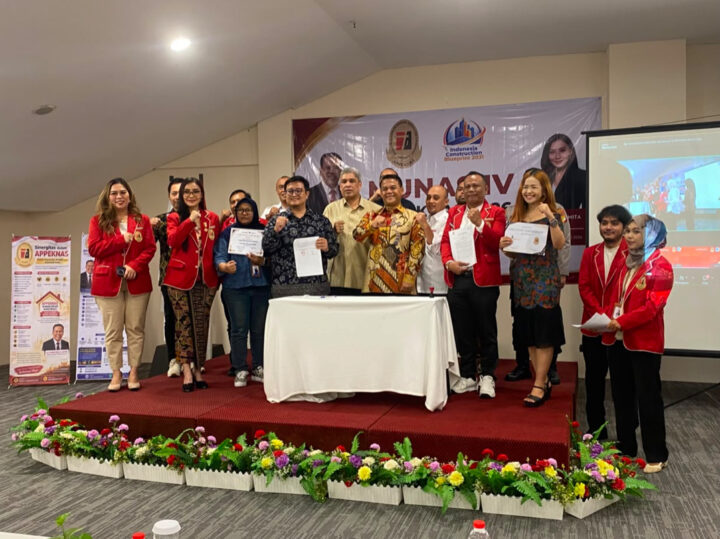
Jakarta – The Indonesian Chamber of Commerce and Industry (Kadin Indonesia) is encouraging stronger synergy with the Association of National Contractors and Construction Business Operators (APPEKNAS) to address the challenges and opportunities facing the national construction industry. The statement was made at the opening of the 4th APPEKNAS National Conference (Munas) 2026, held at ShanKee Sudirman Hotel, Jakarta, on Friday (August 14, 2026).
On the occasion, Kadin Indonesia Deputy Chairman for Membership Widiyanto Saputro, representing Kadin Indonesia Chairman Anindya Novyan Bakrie, expressed Kadin Indonesia’s appreciation for the 4th APPEKNAS National Conference as a strategic forum to determine the organization’s direction while formulating the business community’s contribution to advancing Indonesia’s construction industry.
The 4th APPEKNAS National Conference carries the theme “Transforming Adaptive, Professional, and Integrity-Driven Contractor Businesses as the Main Pillar of Indonesia’s Construction Industry Advancement.”
According to Kadin Indonesia, the theme is aligned with the government’s policy direction and the needs of the business community, given the construction sector’s strategic role in the national economy.
Data presented in the speech showed that the construction sector contributed 9.83 percent to Indonesia’s Gross Domestic Product (GDP) in 2025, making it the country’s fourth-largest economic sector. The sector also employed more than 8.7 million workers, or around 6 percent of Indonesia’s total labor force. These figures demonstrate the significant contribution of the construction industry to economic activity and national development.
In 2026, the Ministry of Public Works’ budget was reported to reach Rp118.5 trillion to support the development of quality infrastructure. The government has also announced an economic policy package with a total outlook of approximately Rp16.23 trillion targeting the national construction and property sectors. Kadin Indonesia views these developments as a positive signal and an opportunity that construction service providers should capitalize on.
In his remarks, Widiyanto also presented the results of Kadin Indonesia’s Strategic Response Meeting (SRM), which has been conducted since April 2026. The forum serves as an internal cross-sector platform to gather input from the business community and formulate it into policy recommendations for the government. To date, around 10 SRM sessions have been held, involving eight Coordinating Deputy Chairmen and four Heads of Departments, resulting in a total of 326 cross-sector policy recommendations.
Several issues discussed during the SRM and considered particularly relevant to APPEKNAS members include contractor liquidity challenges, the Government-to-Business Cooperation (KPBU) scheme, and the acceleration of regulations in the housing sector.
On liquidity issues, the SRM recorded contractor margin pressures of up to a 5–12 percent deficit, along with increases in industrial diesel and asphalt prices of as much as 20–30 percent. These conditions have prompted proposals for the implementation of price adjustment clauses in contracts, accelerated disbursement of government project payments, as well as credit restructuring and project guarantee schemes for affected contractors.
Meanwhile, under the KPBU scheme, infrastructure financed through the mechanism currently accounts for only around 10 percent. At the same time, the 2025–2029 National Medium-Term Development Plan (RPJMN) sets a target of Rp544.48 trillion, with a funding gap of Rp753 trillion. Kadin is therefore advocating the establishment of a KPBU working team and a review of regulations to make the financing scheme more attractive to investors and national contractors.
The housing sector is also a key area of concern, including the acceleration of the Housing Bill or Housing and Settlement Areas (PKP) Omnibus Law, the designation of special zones for subsidized housing, and a program to regularize existing housing projects that continue to face overlapping licensing regulations.
Kadin Indonesia considers these issues directly relevant to the agenda of the 4th APPEKNAS National Conference, particularly in strengthening business certainty, improving contractor competitiveness, and promoting construction policies that are more responsive to conditions on the ground. Kadin also hopes APPEKNAS will continue to provide data-driven input to strengthen the organization’s policy advocacy efforts with the government.
In addition, the national housing development program presents further opportunities for construction businesses. The speech noted that, as of mid-2026, the 3 Million Houses Program had delivered more than 324,000 housing units nationwide, supported by a 2026 state budget allocation of Rp58 trillion. Housing Program Credit disbursements had also reached Rp22.11 trillion by the end of July 2026, equivalent to 57.81 percent of the target, benefiting nearly 100,000 borrowers.
Amid these opportunities, Kadin also highlighted the challenge of improving the efficiency of national investment. The Rp753 trillion KPBU funding gap was cited as one indication of the issues requiring collective attention. Kadin believes these challenges must be addressed through collaboration between the government, the business community, and the entire construction industry ecosystem, including improvements to financing mechanisms.
As part of its commitment to the national construction ecosystem, Kadin Indonesia outlined three key priorities: overseeing the acceleration of government project payment disbursements and credit restructuring schemes for contractors; promoting the implementation of price adjustment clauses and clarity on force majeure regulations; and accelerating reforms to the KPBU scheme and non-state budget financing to help close the infrastructure funding gap.
Kadin Indonesia also views APPEKNAS as a strategic partner in strengthening the national construction services ecosystem. The synergy between the two organizations is expected to continue expanding, including through discussions on APPEKNAS joining Kadin Indonesia as an Extraordinary Member (Anggota Luar Biasa/ALB). This step is expected to broaden opportunities for national contractors to convey their aspirations in the economic policymaking process.
The 4th APPEKNAS National Conference is expected to produce stronger leadership and organizational direction, while also delivering the APPEKNAS Blueprint 2031, which can address the challenges of technological transformation, regulatory developments, and global competition.
Kadin Indonesia reaffirmed its commitment to continuing to work hand in hand with APPEKNAS to build an adaptive, professional, and integrity-driven national construction industry toward achieving Golden Indonesia 2045.