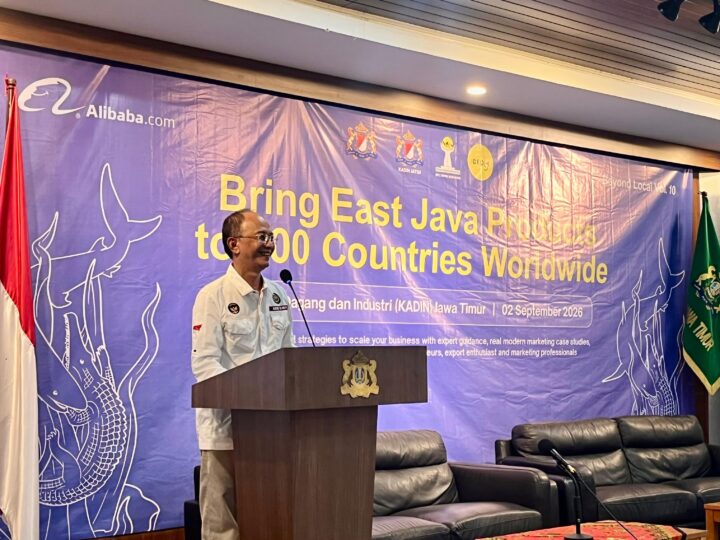
Surabaya – The East Java Provincial Chamber of Commerce and Industry (Kadin East Java) and Kadin Surabaya, in collaboration with e-commerce platform Alibaba, held a workshop aimed at providing export education and helping businesses introduce their products to global markets through digital platforms. The workshop, themed “Bring East Java Products to 200 Countries Worldwide,” was held at Graha Kadin East Java, Surabaya, on Wednesday evening (September 2, 2026).
Chairman of Kadin East Java Adik Dwi Putranto emphasized that the initiative provides an opportunity for MSMEs to learn how to enter global markets.
“This is about going global. Of course, MSMEs need to learn what global quality standards look like. Alibaba provides education on quality requirements as well as certainty regarding order quantities,” Adik said.
All MSME products participating in the program will first undergo a selection process by Kadin before being further curated by Alibaba.
“Kadin’s target is to onboard around 100 MSMEs onto the Alibaba platform within one year, or approximately 8–10 MSMEs per month,” he said.
Head of the East Java Office of Cooperatives and SMEs Endy Alim Abdi Nusa also welcomed Alibaba’s presence. He encouraged East Java MSMEs to leverage digital platforms to expand their markets rather than relying solely on local consumers.
According to Endy, many MSMEs from East Java have successfully expanded their businesses into a number of overseas markets. This success demonstrates that local products have the potential to compete globally when businesses take advantage of available market access and assistance.
“If possible, don’t limit yourselves to being players only in the Surabaya or East Java markets. Make use of this platform, just as other businesses have successfully done in entering overseas markets,” Endy said.
Endy added that MSMEs are an important pillar of East Java’s economy, contributing approximately 60 percent of the province’s Gross Regional Domestic Product (GRDP). Therefore, the regional government continues to encourage greater market access, including through various interregional trade missions and partnerships with global trading platforms.
He expressed hope that the collaboration with Alibaba would provide East Java MSMEs with an additional avenue to expand their network of buyers. With increasingly open access to digital markets, local products are expected not to remain confined to the domestic market but to become part of international trade.
Indonesia Country Manager of Alibaba Ryan Liu said Alibaba’s presence in Surabaya was not merely aimed at introducing its digital trading platform, but also at understanding the potential of local products and preparing businesses to enter international markets.
According to Ryan, Surabaya has an attractive business ecosystem. In addition to its dynamic economic growth, the city offers a diverse range of potential products, including food and beverages, coffee beans, wood products, and furniture.
“When we came to Surabaya, our first impression was that it is a very dynamic and energetic city with strong economic growth. We also saw many excellent products, including food and beverages, coffee beans, wood products, and furniture,” Ryan said.
He said some businesses in Surabaya had already successfully entered markets in the United States and Europe. However, many other promising businesses still lack sufficient access or knowledge to reach international buyers.
Therefore, Alibaba brought two main agendas during its visit. First, to provide an understanding of global markets through the Alibaba platform. Second, to launch an initiative with local partners to develop international export education in Surabaya.
“We are here to do two things. First, to understand the global market through Alibaba. Second, we will launch a new initiative with our partners to develop international export education in Surabaya and introduce Surabaya products to the global market,” he said.
Ryan explained that Alibaba has grown into one of the leading business-to-business (B2B) platforms with an extensive global market network. The platform connects suppliers with buyers from various countries and regions.
“Alibaba actually started as an export business. Since its establishment in 1999, Alibaba has grown into a leading B2B platform. Today, we reach more than 200 countries and regions, with around 50 million buyers and more than 200,000 suppliers worldwide,” he explained.
According to Ryan, cooperation with local partners is important because MSMEs need closer assistance tailored to their specific circumstances. With such support, businesses are expected not merely to list their products on digital platforms, but to genuinely develop the capabilities needed to manage their businesses for export markets.
Meanwhile, Deputy Chairman of Kadin Surabaya Medy Prakoso said Kadin Surabaya supports Alibaba’s program as it could create greater opportunities for businesses, particularly MSMEs, to enter export markets.
He said the program is aligned with efforts to increase exports of leading products from Surabaya. Following discussions with Alibaba, Kadin identified several facilities that could help businesses develop their international markets.
“Alibaba offers several valuable services, including payment guarantees, product curation for export markets, and market access. All of these can serve as triggers to encourage Surabaya’s trade to expand overseas,” Medy said.
According to Medy, several MSME products from Surabaya have strong potential for development in global markets. These include horticultural products, handicrafts, and furniture, which has long been one of Surabaya’s key industrial strengths.
“Some of the Surabaya MSME products with export potential include horticultural products, handicrafts, and furniture. All of these products can be developed for export as long as their permits and legal requirements have been fully completed,” he explained.
However, before entering export markets, Medy said businesses need to ensure that all legal and licensing requirements have been fulfilled. This is an important prerequisite for ensuring that MSME products can be marketed sustainably in international markets.