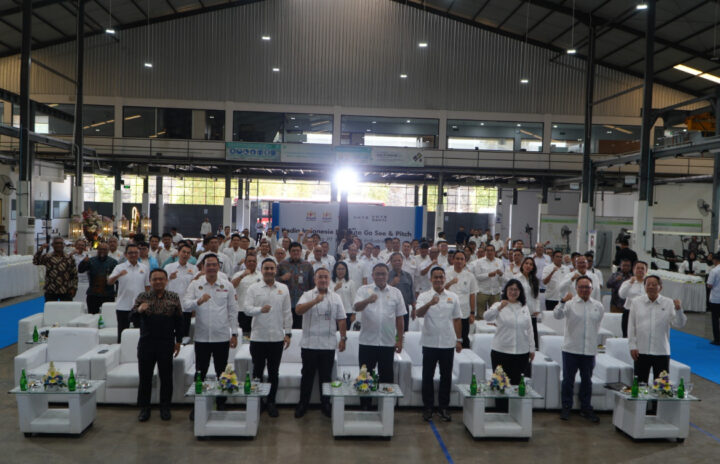
Magelang – The Indonesian Chamber of Commerce and Industry (Kadin Indonesia), together with the Kadin Indonesia Institute (KII), held a Go-See and Pitch Trip to PT VKTR Sakti Industries under the theme “Green Industry, Sovereign Economy: Kadin Indonesia Promotes 8% Economic Growth through Green Industry” in Magelang, Central Java, on Friday (August 28, 2026).
The event was part of the Go-See and Pitch program initiated by KII to connect prospective suppliers with prospective buyers from the business community.
Chairman of Kadin Indonesia, Anindya Novyan Bakrie, expressed his appreciation to Minister of Environment/Head of the Environmental Control Agency Moh Jumhur Hidayat, who attended the event. According to Anin, as he is affectionately known, the government’s presence demonstrates that the transition toward a green economy requires close collaboration between the government and the business sector.
“Our theme today, ‘Green Industry, Sovereign Economy,’ represents two things that, in my view, cannot be separated. We want to promote high economic growth, create jobs, strengthen national industries, while at the same time ensuring that such growth becomes increasingly sustainable,” said Anin.
Anin said Indonesia is currently in the midst of major changes in global supply chains, the energy transition, technological developments, and global investment patterns. According to him, these conditions present an opportunity for Indonesia to strengthen its economy through investment and downstreaming, the energy transition, strengthening value chains and MSMEs, infrastructure and logistics development, as well as optimizing international trade cooperation.
“Indonesia has the potential to become not only a market, but also a production, innovation, and value-creation hub in the region,” Anin said.
In this context, Anin reaffirmed Kadin Indonesia’s commitment to continuously promoting the spirit of Indonesia Incorporated, in line with the approach frequently advocated by President Prabowo Subianto. According to him, the concept positions the government, business community, academia, and society as an integrated force in building national economic strength.
“The government provides firm regulations, market certainty, and long-term commitment. The business sector brings investment, innovation, and a willingness to take productive risks. Meanwhile, academia provides applied research that can be commercialized and integrated into industry, while also preparing talent,” Anin explained.
According to Anin, the activity at PT VKTR Sakti Industries represents a tangible implementation of the Indonesia Incorporated concept. Through the Kadin Indonesia Institute, Kadin continues to promote research, discussions, and dialogue on various strategic issues, including the energy transition, electric vehicles, sustainability, and industrial development.
The selection of PT VKTR Sakti Industries as the venue for the event is also aligned with Kadin Indonesia’s focus on promoting the development of green industries and strengthening the national electric vehicle ecosystem. PT VKTR Sakti Industries is a company developing locally based assembly facilities for non-commercial electric vehicles in Indonesia.
“Through the Kadin Net Zero Hub, we are also encouraging businesses to strengthen their capacity and preparedness to face the transition toward a low-carbon economy. Meanwhile, through the Kadin Global Engagement Office, we are bringing Indonesia’s electrification narrative to the international stage to continue opening opportunities for investment, technology, and global collaboration that can strengthen Indonesia’s industrial capacity,” Anin said.
Anin emphasized that field visits such as the Go-See and Pitch Trip are important because they provide stakeholders with an opportunity not only to discuss concepts but also to directly observe the application of technology and industrial development on the ground.
Furthermore, Anin highlighted waste management as one of the major challenges facing Indonesia. According to him, the policy of converting waste into electricity, or waste-to-energy, should not focus solely on end-of-pipe processing facilities, but must also take into account waste collection and transportation processes.
“This is where we see a critical link, namely low-emission waste transportation fleets. If we look at this ecosystem as a whole, there are three national agendas that can move forward together,” Anin said.
First, in terms of job creation and increasing the Domestic Component Level (TKDN). Anin said the development of green industries could create new value chains within the country.
“When the electric vehicle industry grows, it is not only vehicle assembly companies that will benefit, but also body manufacturers, component producers, technology providers, after-sales services, technical workers, and various suppliers from the MSME sector,” Anin said.
Therefore, according to Anin, the development of commercial electric vehicles needs to be positioned as part of efforts to strengthen national industry while increasing the Domestic Component Level (TKDN).
Second, in terms of environmental protection and the energy transition. The electrification of commercial vehicles is considered part of Indonesia’s efforts to reduce emissions while improving environmental quality.
Anin also sees economic opportunities arising from emissions reductions through the Carbon Unit Registry System (SRUK). Thus, the electrification of waste management fleets could deliver three benefits simultaneously: improving the operational efficiency of local governments, creating potential additional revenue from carbon units, and helping accelerate the achievement of Indonesia’s national climate targets.
Third, in terms of economic growth. Anin acknowledged that one of the challenges in electrification is the high upfront cost or initial investment requirement. However, the development of business models such as mobility-as-a-service provides an opportunity for local governments to use electric vehicles as a service without having to bear the entire initial investment burden or capital expenditure (CAPEX).
“Therefore, the focus should not only be on the initial vehicle price, but on the total efficiency that can be achieved throughout the vehicle’s operational lifetime,” Anin said.
On the occasion, Kadin Indonesia also proposed that the draft Regulation of the Minister of Environment concerning battery-based electric motor vehicles (KBLBB) for waste management services include an obligation for all operators of national waste-to-energy (PSEL) facilities to use electric compactor trucks.
“This obligation will turn Presidential Regulation No. 109/2025 from a direction into a reality. This regulation will also strengthen Indonesia’s green readiness to maximize the benefits of Indonesia’s trade agreements with other countries, while supporting Indonesia’s competitiveness against Vietnam, Thailand, and China in the global market,” Anin said.
From the business sector, Anin outlined three commitments from Kadin Indonesia. First, to promote investment, downstreaming, and industrial capacity building through the development of domestic commercial electric vehicle manufacturing.
“Second, with regard to universities, we will deepen the downstreaming of research into industry. Talent and technology are two sides of the same coin,” Anin said.
Third, Kadin Indonesia is calling on all stakeholders to turn Indonesia Incorporated into concrete action.
“If this ecosystem is implemented comprehensively, within the next four years Indonesia will have 100 percent electric waste management fleets among PSEL operators, 80 percent TKDN across the entire commercial EV value chain, approximately 10,000 new green jobs from the commercial EV ecosystem, and around 3 million tons of CO₂ equivalent per year in carbon units that can be traded through SRUK, with potential additional revenue of Rp300–700 billion per year for the ecosystem,” Anin explained.
Anin added that Indonesia already has various building blocks needed to establish a green industrial ecosystem. The next challenge, he said, is to connect all these elements so that they can operate in an integrated manner.
“We already have all the building blocks. Our challenge now is to connect these building blocks into a single ecosystem that works together. If we succeed, what we are seeing today in Magelang can become a model that can be replicated across various regions in Indonesia,” Anin said.
Meanwhile, Minister of Environment/Head of the Environmental Control Agency Moh Jumhur Hidayat praised PT VKTR Sakti Industries as a pioneer of Indonesia’s first Completely Knocked Down (CKD)-based electric commercial vehicle assembly plant, which was inaugurated by President Prabowo Subianto.
The presence of the assembly facility is considered strategic for strengthening domestic manufacturing capacity, promoting energy efficiency, accelerating technology transfer, and increasing the Domestic Component Level (TKDN).
“Of the approximately 172.9 million motor vehicles currently in Indonesia, the electric vehicle population has only reached around 274,800 units, or 0.16 percent. This figure demonstrates that there remains enormous room for transformation within the national industry,” Jumhur said.
However, he cautioned that the transition to electric vehicles is not simply about replacing fossil-fuel-powered engines, but about building an industrial ecosystem encompassing research, supply chains, batteries, and recycling based on a circular economy.
In addition to technological readiness, Jumhur underscored the importance of social preparation and social integration, as well as occupational safety through the Zero Accident principle.
“Industrial development must proceed in harmony with the interests of society and the environment in order to obtain a social license to operate and prevent social conflict,” he said.
Furthermore, Jumhur highlighted the implementation of Minister of Environment/Environmental Control Agency Regulation No. 7 of 2025 concerning the Corporate Performance Rating Assessment Program (PROPER), which encourages businesses to adopt the Beyond Compliance concept. Through this regulation and the implementation of Environmental, Social, and Governance (ESG) principles, environmental protection is being transformed from a cost center into a value creator that enhances industrial competitiveness in the global market.
“Let us embrace an ‘ecological repentance’ by shifting our development paradigm from exploitation toward sustainability as we work toward the vision of a Golden Indonesia 2045,” Jumhur concluded.