Beijing – Chairman of the Indonesian Chamber of Commerce and Industry (Kadin Indonesia), Anindya Novyan Bakrie, reaffirmed the organization’s commitment to strengthening the long-standing relationship between Indonesia and China, both at the government and business levels.
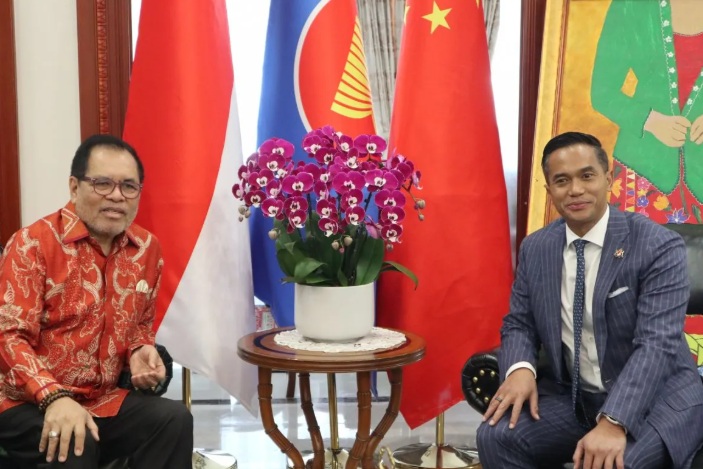
“China is Indonesia’s largest trading partner. Therefore, we must be present here. Trade between Indonesia and China reached approximately US$168 billion last year, and I believe that figure will continue to grow. Before long, Indonesia could become China’s second-largest trading partner, or even its largest,” Anindya said at the Indonesian Embassy in Beijing on Sunday (June 21).
Anindya, widely known as Anin, visited China to attend several major events, including the China International Supply Chain Expo and the APEC CEO Forum in Beijing, the Summer Davos 2026 in Dalian, as well as meetings with various business partners.
“Indonesia exports roughly one-quarter of its total exports to China and imports about one-third of its imported goods from China. My mission here, together with several Kadin members, is to convey that we are not only seeking to increase trade but also to create shared value,” Anin said.
He emphasized Kadin Indonesia’s intention to encourage greater collaboration and innovation with Chinese partners.
“I believe everything begins with dialogue. Through continued engagement, we can build greater trust, especially amid ongoing geopolitical tensions. Our hope is to foster even more collaboration in the future,” he added.
According to Anin, the first key area of focus for discussions with Chinese counterparts is the electric vehicle (EV) industry.
“However, we do not want to focus solely on electric vehicle trade. We want to participate across the entire supply chain—not only to serve the Indonesian and Chinese markets, but also the global market,” he explained.
He added that Kadin’s initiatives could support Indonesia’s mineral downstreaming agenda, including the development of electric vehicle battery manufacturing facilities.
“Ultimately, we aspire to develop our own electric vehicles and EV brands in partnership with China, supported by technology, capital, and experience. This is one of the strategic sectors we intend to prioritize,” Anin said.
The second priority area, he continued, is renewable energy, with the goal of accelerating domestic industrialization through partnerships with Chinese companies.
“The third area is data centers, digital infrastructure, and artificial intelligence. In my view, China is one of the world’s two leading powers in artificial intelligence, and AI will become the super infrastructure underpinning numerous industries,” Anin stated.
In the field of artificial intelligence, he stressed that Indonesia must strengthen capabilities across the entire value chain to remain competitive.
“It is not only about building data centers, but also about developing computing power, especially considering Indonesia’s massive internet user base,” he added.
The fourth focus area is Micro, Small, and Medium Enterprises (MSMEs), which Anin noted provide employment for around 60 million Indonesians and contribute approximately 60 percent of the country’s Gross Domestic Product (GDP).
“Therefore, we must continue to support them. We need to involve and integrate MSMEs into the broader economy to ensure sustained growth—from 5.1 percent to 5.6 percent, and eventually reaching the 8 percent growth target envisioned by the President,” he said.
During the meeting, Indonesian Ambassador to China and Mongolia, Djauhari Oratmangun, reported that bilateral trade between Indonesia and China reached US$167.48 billion in 2025, with Indonesian exports growing by 16.7 percent.
Meanwhile, Indonesia’s trade with Hong Kong amounted to approximately US$6 billion, bringing the combined trade value with China and Hong Kong to around US$173 billion.
“If Indonesia-China relations remain strong and we maintain economic momentum, that figure could double within six years,” Ambassador Djauhari said.
Nevertheless, the combined trade volume remains below Malaysia’s trade with China, which reached US$191.66 billion, while Vietnam ranked as China’s largest trading partner in ASEAN with a trade value of US$296.14 billion.
On the investment front, Chinese investment in Indonesia reached approximately US$7.58 billion in 2025, while investment from Hong Kong totaled US$10.1 billion. Combined, investment from China and Hong Kong amounted to around US$18 billion, making them Indonesia’s largest source of foreign direct investment.
Regarding people-to-people relations, Ambassador Djauhari noted that approximately 20,000 Indonesian students are currently studying in China. Although this figure remains below the pre-COVID-19 level of around 60,000 students, it represents a significant recovery from the pandemic period, when the number fell sharply to just 2,000 students.
“As investment continues to grow, it will create more employment opportunities for graduates returning from China,” Ambassador Djauhari concluded.