Jakarta – The Indonesian Chamber of Commerce and Industry (Kadin Indonesia) is strengthening its strategic cooperation with the Singapore Business Federation (SBF) to accelerate micro, small, and medium enterprise (MSME) exports through the utilization of Artificial Intelligence (AI). This step is expected to help MSMEs penetrate more international markets by leveraging various Free Trade Agreements (FTAs) and Comprehensive Economic Partnership Agreements (CEPAs) that have not yet been optimally utilized.
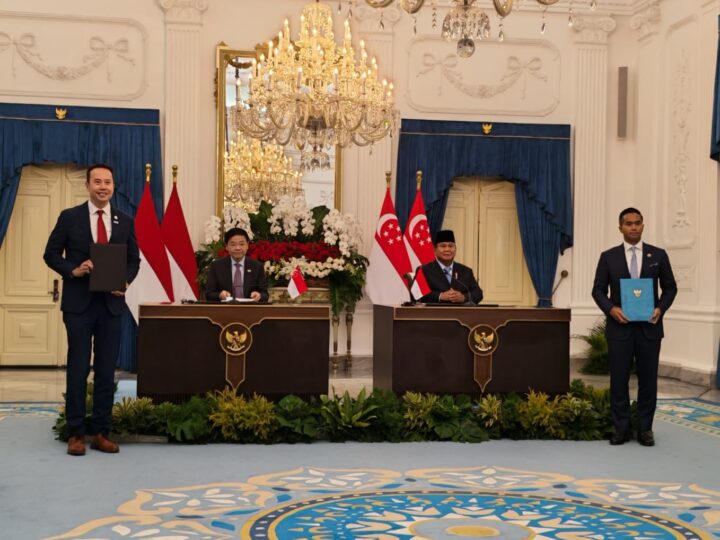
This commitment was marked by the signing of a Memorandum of Understanding (MoU) between the Executive Chairman of Kadin Indonesia, Anindya Novyan Bakrie, and the Chairman of SBF, Mark Lee. The signing was witnessed directly by President Prabowo Subianto and Singapore Prime Minister Lawrence Wong at the Merdeka Palace, Jakarta, on Monday (06/07/2026). The MoU was one of the key outcomes of the 2026 Singapore-Indonesia Leaders’ Retreat, reinforcing the economic partnership between the two nations amid global economic uncertainty.
The Executive Chairman of Kadin Indonesia, Anindya Novyan Bakrie, stated that this cooperation is not merely about building a digital platform, but rather about introducing AI technology as a "trade advisor" capable of helping MSMEs identify export opportunities faster, more accurately, and more efficiently.
"What was signed between Kadin and the Singapore Business Federation is a cooperation to develop AI-supported trade. The goal is to assist MSMEs so they can export more by utilizing AI facilities, allowing them to understand how to use various free trade agreements and comprehensive economic partnership agreements that Indonesia has established with various countries," Anindya, affectionately known as Anin, told reporters after the signing.
According to Anin, Indonesia’s current export value has reached approximately USD 300 billion per year. Of this amount, the vast majority is still dominated by major commodities such as coal, palm oil, and resource-based products. However, outside these sectors, the contribution of MSMEs to exports continues to rise and possesses a much larger room for growth.
Therefore, Anin continued, AI technology will be utilized to map potential markets, provide recommendations for export destinations, explain tariff structures, rules of origin, and navigate the export procedures that business players must fulfill.
"That is where we need Artificial Intelligence technology to identify which market potentials should be penetrated. By leveraging existing free trade agreements and comprehensive economic partnership agreements, our MSMEs can level up and expand their export markets," Anin said.
Anin added that this cooperation also supports the We Buy From Indonesia campaign, which aims to strengthen Indonesia’s position in the global supply chain. According to him, many Indonesian industrial components have already become integral parts of products manufactured by world-class companies.
"Many components of well-known products, such as those from Boeing, Tesla, and Dettol, are produced in Indonesia. The question now is how this cooperation can use technology to accelerate exports in specific sectors. That is where the collaboration between Indonesia and Singapore becomes vital," Anin stated.
Through the MoU, Kadin Indonesia and SBF have agreed to cooperate in three main areas: trade digitalization, policy dialogue, and MSME capacity building. Both business organizations will also organize roundtable discussions, workshops, training, mentoring, and knowledge-sharing forums involving business players, trade experts, and policymakers.
One of the flagship programs in this cooperation is the development of the Trade AI Advisor (TAIA), a Generative Artificial Intelligence-based platform developed by SBF through the Centre for the Future of Trade and Investment (CFOTI). This platform is designed as an on-demand digital consultant to provide practical guidance on cross-border trade.
Through TAIA, MSMEs will obtain information regarding export requirements, international market entry strategies, tariff regulations, rules of origin, and opportunities to utilize various free trade agreements held by both Indonesia and Singapore. The platform will also be developed in an Indonesian language version to make it more accessible for domestic business players.
In addition to serving as a digital consultation tool, TAIA is expected to complement various training programs and policy dialogues run by Kadin and SBF. The AI-based approach enables self-service delivery, can scale to reach more business entities, and helps MSMEs make data-driven, faster export decisions.
This collaboration also reflects a new direction in Indonesia-Singapore economic relations, which increasingly focuses on digital transformation, artificial intelligence development, and boosting business competitiveness. Amid a global trade slowdown, both nations have chosen to strengthen technological collaboration so that MSMEs can become the engine of export growth and expand ASEAN economic integration.
Indonesia’s Fundamentals Remain Strong
On the same occasion, SBF Chairman Mark Lee emphasized that the fluctuations in the rupiah, the stock market, and rising investor caution do not alter Indonesia's long-term outlook as an investment destination. According to him, volatility is a global phenomenon that has occurred over the past 18 months and actually unlocks new opportunities for the business world.
"Volatility is not unique to Indonesia. In every volatility, there is always opportunity," Lee told The Business Times on the sidelines of the Singapore–Indonesia Leaders’ Retreat in Jakarta on Monday (6/7/2026). He assessed that Indonesia’s fundamentals remain very strong, backed by a population of over 280 million, rapid urbanization, a growing middle class, and development programs for various new economic centers. These factors will continue to drive demand for housing, infrastructure, education, healthcare, and consumer products.
He also noted that Indonesia possesses competitive advantages, such as the availability of land, natural resources, energy, industrial estates, and solar energy potential that are difficult for other countries in the region to match. Furthermore, a weaker rupiah can boost the competitiveness of export-oriented companies because production costs in rupiah become lower, while export revenues are generally received in US dollars.
"I always say, if you have a long-term view, don't try to time the market. Just ride the cycle," Lee said.
Echoing this sentiment, SBF Chief Executive Officer Kok Ping Soon said that the interest of Singaporean companies to expand into Indonesia remains high. Based on an SBF internationalization survey conducted in April 2026, as many as 65% of Singaporean companies planning to expand chose ASEAN, with Indonesia being one of the top destinations alongside Malaysia and Thailand.
Kok added that Indonesia remains attractive thanks to its economic growth potential, improving digital infrastructure, and competitive operational costs. However, he cautioned that Indonesia is a highly diverse market, meaning companies need to understand the characteristics of each region and secure the right local partners.
This optimism formed the foundation for the signing of the MoU between SBF and Kadin Indonesia on July 6, 2026. Through this partnership, both organizations will develop trade digitalization, policy dialogue, MSME capacity building, and the Trade AI Advisor (TAIA) platform based on generative artificial intelligence to help businesses understand international trade rules, utilize free trade agreements, and expand access to global markets.