Jakarta – Two of Indonesia’s largest shopping mall owners, James Riady of Lippo Group and Alexander Tedja of Pakuwon Group, have affirmed that national security conditions remain conducive, eliminating any need to install perimeter fencing around shopping centers. They clarified that the installation of fences at several malls was an initiative by local management rather than a corporate strategy.
James T. Riady, Vice General Chair for Foreign Affairs of the Indonesian Chamber of Commerce and Industry (Kadin) and Chairman of Lippo Group, stated that all Lippo-owned malls previously had fences installed during past periods of civil unrest in Indonesia. However, those structures have long been removed as the security situation improved.
“In the past, all malls installed fences when riots broke out. Today, it is no longer necessary because the situation is calm,” James told Investortrust on Friday (31/07/2026).
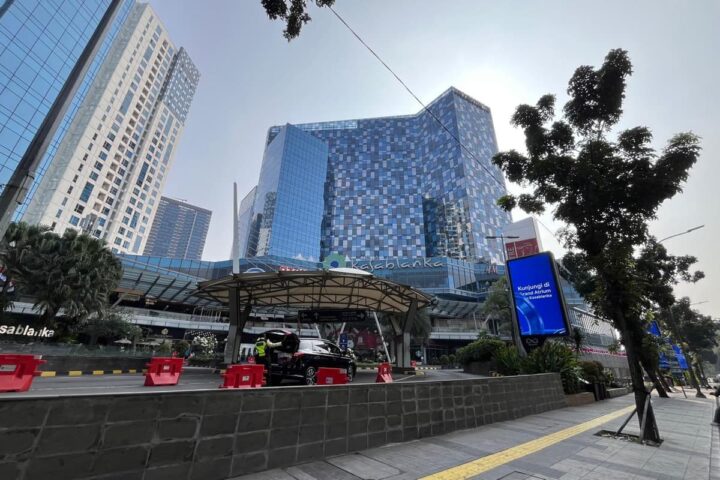
Echoing these remarks, the founder of Pakuwon Group, Alexander Tedja, confirmed that the fence recently erected at Kota Kasablanka (Kokas) Mall in South Jakarta will be dismantled immediately. According to Alex, the fence was installed following a local management decision made without direction from shareholders or head office.
“That was a local management policy, and it will be taken down shortly,” Alex told Investortrust.
Minister of Housing and Residential Areas (PKP) Maruarar Sirait stated he communicated directly with Alexander Tedja after the mall fence issue gained public attention. According to Maruarar, Alex reassured him that the fence at Kokas would be removed, while spatial arrangements at other Pakuwon properties would align with applicable regulations to avoid creating false public perceptions.
“I spoke directly with Mr. Alex Tedja. He emphasized that it was merely a local management initiative and will be resolved promptly,” Maruarar said.
Maruarar commended James Riady and Alexander Tedja for publicly reassuring the community that Indonesia's security conditions remain strong. “They are major mall and hotel owners in Indonesia. The stance taken by these two owners deserves appreciation, as our security environment is indeed stable,” he added.
James noted there is no reason for the public to feel anxious about social or economic conditions. He emphasized that the government has successfully safeguarded public purchasing power through strategic policies, such as maintaining prices for subsidized fuel (BBM), subsidized household electricity tariffs, and 3-kilogram LPG cylinders amid global energy price spikes driven by geopolitical conflicts.
“As long as subsidized fuel, 3-kilogram LPG, and subsidized household electricity rates remain stable, there is no reason for public anxiety,” James remarked.
He added that this stability is reflected in the shopping mall industry, which is currently experiencing very strong growth. Demand for retail space from tenants currently exceeds available space in many malls.
“Right now, there is actually a shortage of space. Demand to open new retail stores exceeds the supply of space in modern shopping centers. This is a golden era for the mall business,” James said.
Driven by these positive industry prospects, Lippo Group continues to expand. The group currently manages 71 malls and 35 shopping centers—totaling 106 retail properties—spread across more than 29 cities in Indonesia. According to James, Lippo’s mall portfolio accounts for approximately 25% of the total modern retail space market in Indonesia.
The Lippo Malls network spans across Indonesia, covering Jakarta, Bekasi, Bogor, Depok, Bandung, Tangerang, Yogyakarta, Surabaya, Malang, as well as Medan, Palembang, Bali, Manado, Kendari, and various other cities. Iconic properties under its management include Lippo Mall Kemang, Lippo Mall Puri, Plaza Semanggi, Lippo Mall Nusantara, Senayan Park (SPARK), Bandung Indah Plaza, Sun Plaza Medan, Palembang Icon, and Lippo Mall Kuta.
“We continue to open new shopping centers because demand is exceptionally high. If the situation were unsafe, tenants would certainly not be competing to open stores,” James added.
He highlighted that ongoing developer expansions and sustained high demand for commercial space demonstrate strong business confidence in Indonesia’s economic outlook. Had security conditions deteriorated, mall operators would not be actively expanding.
James stressed that the installation of fences at a few locations represented isolated cases and did not reflect broader industry trends. The measures were strictly operational decisions by local management rather than mandates from corporate leadership.
“It was strictly a local management initiative, not a policy from the owners or corporate headquarters. Upon verification, such fencing is indeed unnecessary,” he asserted.
Alex Tedja noted that the mall fence issue had gained significant traction on social media. However, he agreed that current security conditions remain stable, rendering perimeter fences unnecessary. Pakuwon Group is one of Indonesia’s premier property developers and shopping center operators, with a portfolio spanning major cities such as Surabaya, Jakarta, Bekasi, Yogyakarta, and Solo. In Surabaya, Pakuwon operates Pakuwon Mall Surabaya, Tunjungan Plaza, Pakuwon City Mall, Royal Plaza, and Food Junction. In Jakarta, Pakuwon manages Kota Kasablanka, Gandaria City, and Blok M Plaza.
Minister Maruarar expressed hope that the clarifications provided by the two business leaders would put public speculation to rest. He noted that the proactive approach taken by Lippo Group and Pakuwon Group sends a positive signal of business optimism regarding national security and economic prospects.
“What we must build is optimism. In reality, security conditions are conducive, economic activities are running normally, shopping centers are bustling with visitors, and demand for commercial space continues to rise. There is no justification for creating a perception that security is deteriorating,” Maruarar stated.
Ultimately, both Lippo Group and Pakuwon Group reaffirmed that the installation of perimeter fences at select malls was an isolated operational decision that does not reflect Indonesia’s overall security climate. On the contrary, stable security conditions, resilient consumer purchasing power, and robust demand for commercial space signal that the nation’s investment climate and modern retail sector remain on a highly positive trajectory.