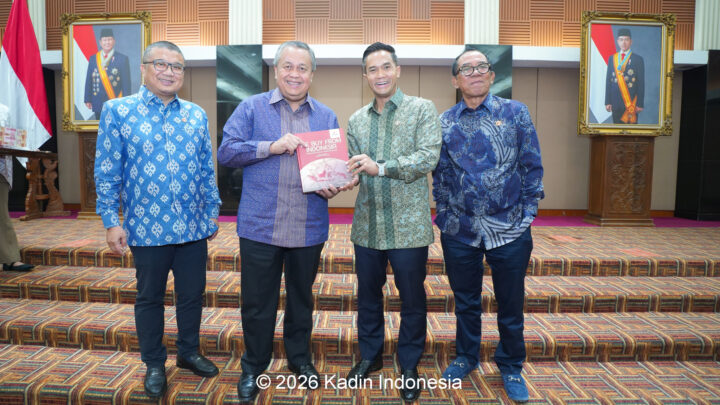
Jakarta – Bank Indonesia (BI) has reaffirmed its commitment to working tirelessly to maintain economic stability while supporting national growth amid persistently high global uncertainty. Together with the government and all relevant stakeholders, BI is ensuring that its policy instruments are directed toward stabilizing the rupiah exchange rate, controlling inflation, strengthening the financial system, and supporting business expansion.
“We want everyone to leave this room after today’s meeting with optimism that Indonesia’s economy will continue to grow, the rupiah will strengthen, inflation will remain under control, and credit growth will continue to increase,” said Bank Indonesia Governor Perry Warjiyo during a discussion with leaders of the Indonesian Chamber of Commerce and Industry (Kadin Indonesia), led by Chairman Anindya Novyan Bakrie, at the BI Headquarters in Jakarta on Thursday (June 18, 2026).
The meeting was attended by BI Senior Deputy Governor Destry Damayanti, BI Deputy Governors, and members of Kadin Indonesia’s leadership. Perry emphasized that BI would deploy all available policy measures to safeguard national economic stability and support the growth agenda and various programs of President Prabowo Subianto.
“Our message is simple. First, remain optimistic. Second, BI will go all out to maintain stability and promote economic growth. Third, we will continue strengthening coordination with the government, the Ministry of Finance, and the Financial System Stability Committee (KSSK),” Perry said.
According to him, BI has consistently adopted a pro-business approach, not only toward the financial and banking sectors but also toward the real sector. Supported by 46 regional representative offices across Indonesia, BI is ready to strengthen its collaboration with Kadin throughout the country to stimulate investment, exports, manufacturing industries, and micro, small, and medium-sized enterprises (MSMEs).
Perry stated that BI fully supports the government’s priority programs, including industrial downstreaming, investment promotion, MSME development, and people-centered economic initiatives. At the same time, BI must ensure that macroeconomic stability is maintained so that development achievements are not undermined by global turbulence.
“We fully support the President’s policy direction. When external pressures and financial market volatility arise, BI’s responsibility is to ensure stability so that the economic progress already achieved is not eroded,” he stressed.
Global Uncertainty Remains High
Firman Mochtar, Executive Director and Head of BI’s Economic and Monetary Policy Department, explained that the global economy continues to face significant uncertainty despite a temporary ceasefire agreement reached between the United States and Iran on June 14, 2026.
Disruptions in global logistics, geopolitical tensions, and persistently high prices of several strategic commodities are expected to weigh on global economic growth. BI projects global economic growth to slow to around 3.0% in 2026 from 3.4% in the previous year, while global inflation is forecast to rise to 4.4%.
These conditions have prompted major central banks to maintain tight monetary policies. The hawkish stance of key central banks, particularly the U.S. Federal Reserve, has strengthened the U.S. dollar and encouraged capital flows from emerging markets to developed economies.
“Such external pressures present challenges for all emerging markets, including Indonesia,” Firman said.
Nevertheless, Firman noted that Indonesia’s economic fundamentals remain strong. Household consumption remains resilient, government fiscal stimulus continues to provide support, business confidence remains in expansion territory, and investment continues to grow. BI projects Indonesia’s economic growth to range between 4.9% and 5.7% this year.
Foreign Capital Begins Returning
To mitigate external pressures, BI has strengthened its monetary policy mix since May 2026. After raising the BI Rate by 50 basis points in May and by another 25 basis points in an unscheduled move on June 9, BI increased the benchmark interest rate by an additional 25 basis points during its June Board of Governors Meeting, bringing the BI Rate to 5.75%.
In addition, BI has intensified interventions in the foreign exchange market, raised yields on Bank Indonesia Rupiah Securities (SRBI), expanded monetary operations, and introduced various incentives to attract foreign capital inflows into domestic financial markets.
“The policies we have implemented are beginning to show positive results. Foreign capital inflows into SRBI and government securities have started to increase, the rupiah has strengthened, and foreign exchange reserves remain robust,” Firman said.
Inflation also remains under control. In May 2026, annual inflation stood at 3.08%, still within BI’s target range of 2.5% ±1%.
Double-Digit Credit Growth
On the growth front, BI continues to implement accommodative macroprudential policies. Bank lending grew by approximately 11.5% year-on-year as of May 2026, supported by investment financing and productive government programs.
To accelerate banking intermediation, BI has continued expanding incentives under its Macroprudential Liquidity Incentive Policy (KLM), which had reached approximately Rp418 trillion by June 2026. These incentives are provided to banks that channel financing to priority sectors such as downstream industries, MSMEs, food security, housing, and the green economy.
BI has also enhanced flexibility in banking liquidity management and increased the limit on the Foreign Funding Ratio to broaden financing sources for productive sectors.
Remaining Optimistic
Kadin Indonesia Chairman Anindya Novyan Bakrie welcomed BI’s measures to maintain national economic stability. According to him, close communication between regulators and the business community is crucial in navigating global economic challenges.
“We are optimistic that we can get through this situation. Signs of improvement are already beginning to emerge. The interest rate hikes implemented by BI are aimed at maintaining stability, and we appreciate those measures,” said Anindya, who is widely known as Anin.
He emphasized that Kadin is ready to strengthen its collaboration with BI down to the regional level. As the umbrella organization representing Indonesia’s business community through its network in 514 regencies and municipalities, as well as numerous business associations, Kadin is prepared to support the government’s agenda of boosting investment, exports, industrial downstreaming, and MSME development.
According to Anindya, the business sector is continuing efforts to increase exports in order to expand Indonesia’s trade surplus and strengthen foreign exchange earnings. At the same time, Kadin is encouraging greater inflows of foreign direct investment (FDI) to enhance national industrial capacity.
“We believe optimism remains strong. The challenges are significant, but the opportunities are equally substantial. With strong synergy among the government, Bank Indonesia, the banking sector, and the business community, Indonesia has sufficient capital to maintain stability while accelerating economic growth,” he concluded.