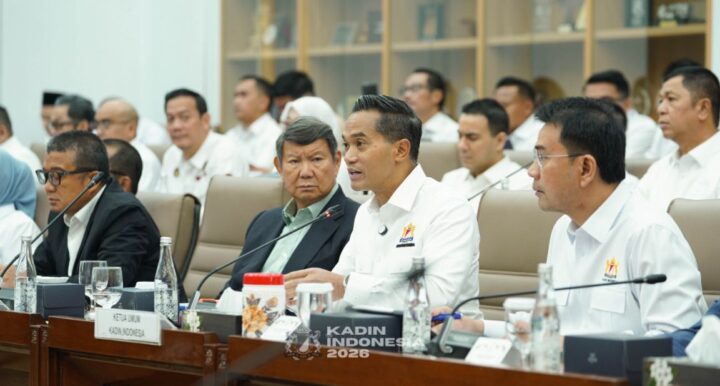
Jakarta – Chairman of the Indonesian Chamber of Commerce and Industry (Kadin Indonesia) Anindya Novyan Bakrie, together with Kadin Indonesia’s board members and business community representatives, presented Kadin Indonesia’s views and recommendations on the Draft Law on Amendments to Law No. 1 of 1987 on the Chamber of Commerce and Industry during a Public Hearing Meeting (RDPU) held by the Working Committee (Panja) for the Draft Law on Amendments to Law No. 1 of 1987 together with Commission VI of the House of Representatives of the Republic of Indonesia (DPR RI) at Nusantara I Building, the DPR RI Complex, Central Jakarta, on Wednesday (September 2, 2026).
On the occasion, Anin, as he is commonly known, said that the current Kadin Law is 39 years old and was enacted in an era that preceded the development of the digital economy, global supply chains, and the economic fragmentation being faced today.
“This is a historic momentum to update and improve the law in order to achieve Golden Indonesia 2045,” Anin said.
During the public hearing, Kadin Indonesia delivered four key messages in the discussion of the Kadin Bill. First, enabling MSMEs to move up to a higher level through a single ecosystem encompassing 63 million MSMEs. All business actors holding a Business Identification Number (NIB) are proposed to automatically become part of the Kadin ecosystem, enabling them to gain access to training, business assistance, networks, and markets.
Second, creating quality employment. Kadin has proposed greater involvement in the formulation of economic policies, as well as strengthening vocational education and certification programs coordinated jointly with the business community, so that quality job creation can be carried out systematically and measurably.
“Third, enabling Indonesian businesses to go global by strengthening the export ecosystem, trade documentation, and economic diplomacy, from MSMEs to corporations,” Anin said.
Fourth, positioning Kadin as the umbrella organization for the business community—one legally recognized umbrella organization that serves as a strategic partner to the government in economic policymaking to provide greater certainty and ease of doing business.
Furthermore, Anin emphasized that these four messages are not merely plans. Kadin Indonesia has already implemented various programs related to strengthening MSMEs, creating employment, expanding global market access, and strengthening Kadin’s role as the umbrella organization for the business community.
In terms of MSME development, Kadin said that 38 Provincial Kadin offices and 225 Extraordinary Members had conducted more than 400 MSME assistance and training programs during the first half of 2026. These programs were reported to have reached more than 5,000 MSMEs across Indonesia.
Anin added that Kadin Indonesia has also implemented various initiatives through the Gotong Royong Protein Task Force, the Gotong Royong Free Nutritious Meals Task Force, the Creative Economy Forum, Islamic economy initiatives, the People’s Festival (Festival Rakyat) in 35 provinces, as well as the Kadin Indonesia Institute, which provides training, data, and research on MSMEs.
To support quality job creation, Kadin has developed employment-generation platforms through PT LPK Kadin Indonesia Training Center and the Kadin AI Academy, as well as vocational training and certification programs in collaboration with Kadin Institute East Java.
“Through the Kadin Work Abroad program, more than 207,000 Indonesian migrant workers were facilitated through the Kadin ecosystem in 2025. Of the total national remittances from Indonesian migrant workers, amounting to Rp288 trillion last year, around 70 percent was reportedly generated through the Kadin ecosystem,” Anin said.
Meanwhile, to help Indonesian businesses go global, Kadin issues ATA Carnets and facilitates export trade documentation, established the Kadin Global Engagement Office to strengthen economic diplomacy, and has participated in more than 50 trade missions, exhibitions, and business matching activities since 2025.
As the umbrella organization for the business community, Kadin also channels business community aspirations through Kadin Presidential Briefings, the Debottlenecking Task Force, and meetings with the government. Kadin has held 14 Strategic Response Meetings with its board members and business associations to respond to various current developments, including the Strait of Hormuz crisis and the weakening rupiah.
However, Anin said Kadin still faces limitations under the current legal framework.
“With the 1987 Law as our legal framework, there are limits that we cannot overcome. This is where the urgency of this Bill lies,” Anin said.
12 Key Inputs from Kadin Indonesia on the Kadin Bill
During the public hearing, Kadin Indonesia presented 12 key recommendations regarding the Kadin Bill:
- Kadin is proposed to become an independent, sui generis strategic partner institution of the government.
- Kadin would serve as the sole umbrella organization for the business community at the national, provincial, and regency/city levels.
- Kadin would serve as the government’s consultation partner in formulating policies affecting the economy and business community, including the Regional Development Planning Forum (Musrenbang), the National Medium-Term Development Plan (RPJMN), the Regional Medium-Term Development Plan (RPJMD), as well as draft laws and government regulations related to the business community.
- Kadin would serve as a consultation partner in formulating provisions of the State Budget (APBN) and Regional Budgets (APBD) relating to the economy and business community.
- Strengthening sustainable funding through membership dues and contributions eligible for deductible or super-deduction treatment, corporate income tax exemptions for organizational functions, as well as government grants and CSR channels managed transparently and subject to audit.
- Strengthening reciprocal access to and exchange of economic data between the government and Kadin.
- Kadin would be granted functions related to the development, accreditation, and formal recognition of business associations and organizations.
- Standardization of business and trade documents, including the issuance of Certificates of Origin in accordance with international chamber-of-commerce practices, standards for certification bodies, training, and enforcement of codes of ethics.
- A membership system under which all business actors holding an NIB would automatically become Kadin members, opening access to business development, assistance, and supply-chain partnership ecosystems to help MSMEs move up to a higher level.
- Establishment of a business dispute resolution institution through arbitration and/or mediation.
- Development of national and global workforce talent through internship registration and vocational competency examinations, as well as training, certification, and assistance for prospective Indonesian migrant workers.
- Strengthening economic diplomacy and global networks through the joint utilization of Indonesia Trade Promotion Centers (ITPC) and trade attachés, as well as strengthening diaspora-based Indonesian Chambers (IndCham) in partner countries.
In addition, Anin said Kadin Indonesia had socialized and discussed the Bill with all components of the organization, ranging from the Business Council, Advisory Board, Board of Trustees, and Provincial Kadin offices across Indonesia to associations and organizations representing Extraordinary Members. All of these aspirations had been consolidated as inputs for discussions with the board.
The process also continued a series of discussions with the legislative body, including a public hearing with the DPR RI’s Legislative Body (Baleg) on June 17, 2026.
“We are grateful for the continuity of this constructive legislative process, which has now continued in Commission VI of the DPR RI,” Anin said.
Anin also expressed his appreciation to Commission VI of the DPR RI, chaired by Anggia Erma Rini, particularly the Working Committee for the Draft Kadin Law, chaired by Adisatrya Sulisto, for its support for the Bill.
Kadin Indonesia, Anin said, also seeks support for the Bill to become a law that advances the interests of the entire Indonesian business community.
“Kadin is ready to be present and work together as an active partner at every stage of the discussion process to ensure the success of this Bill for the benefit of Indonesia’s business community,” he said.
Also attending from Kadin Indonesia’s leadership were Chairman of the Advisory Board Hashim S. Djojohadikusumo; Coordinating Deputy Chairman for Organization, Communication and Regional Empowerment (OKP) Erwin Aksa; Coordinating Deputy Chairman for Food Affairs Mulyadi Jayabaya; Coordinating Deputy Chairman for Political and Security Affairs Bambang Soesatyo; and Coordinating Deputy Chairman for Law and Human Rights and Infrastructure M. Azis Syamsuddin.
Also present were several Provincial Kadin Chairpersons, including Chairman of Kadin South Sumatra Affandi Udji, Chairman of Kadin Bangka Belitung Ritchie Glen Yapranadi, Chairman of Kadin DKI Jakarta Diana Dewi, Chairman of Kadin West Nusa Tenggara Faurani, Chairman of Kadin East Nusa Tenggara Bobby Lianto, and Chairman of Kadin Maluku Muhammad Armyn Syarif Latuconsina.