Makassar – Titi Khoiriah, Head of the Indonesian Chamber of Commerce and Industry (Kadin Indonesia)’s Agency for Islamic Economic and Financial Development, has called for stronger synergy between the halal industry, the Islamic finance sector, and the business community as a strategic measure to enhance Indonesia’s competitiveness and expand the global market reach of Indonesian halal products.
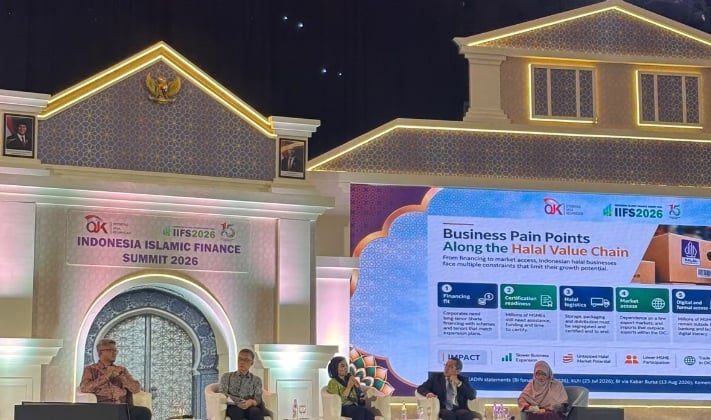
She delivered the remarks during a panel session at the Indonesia Islamic Finance Summit (IIFS) 2026 – International Islamic Finance Conference, held at Four Points Hotel in Makassar, South Sulawesi, on Monday (November 2). Representing the perspective of the Indonesian business community, Titi presented on the theme “Driving Demand for the Halal Economy through Islamic Finance.”
According to Titi, Indonesia has enormous potential to become one of the world's leading halal economy powerhouses. With its vast domestic consumer base, sustained economic growth, and expanding Islamic finance industry, Indonesia has a strong foundation for strengthening its halal ecosystem across the entire value chain, from upstream production to downstream distribution.
However, realizing this potential requires concrete measures to increase production capacity, broaden access to financing, strengthen halal certification, and expand market access for domestic businesses.
“Our challenge is not merely to generate demand, but also to transform that potential demand into sustainable production, financing, and exports. To achieve this, the halal industry and Islamic finance must be integrated with the actual needs of the business community.” This was the key message conveyed in Kadin Indonesia’s presentation at IIFS 2026.
Bridging the Gap Between Islamic Financial Literacy and Inclusion
In her presentation, Titi highlighted the importance of narrowing the gap between Islamic financial literacy and inclusion in Indonesia. According to the 2025 National Survey on Financial Literacy and Inclusion (SNLIK), as cited in the presentation, Indonesia’s Islamic financial literacy index stood at 43.42%, while its Islamic financial inclusion rate remained at just 13.41%.
These figures underscore the need for a more integrated approach to ensure that public understanding of Islamic finance translates into the actual and productive use of financial services.
From a business perspective, Islamic financing schemes must be tailored to business cycles, working capital requirements, expansion plans, and the specific characteristics of halal industry supply chains. In this way, financing can serve not merely as a financial instrument but also as a catalyst for business growth and greater economic value creation.
Titi emphasized the importance of expanding financing access for micro, small, and medium enterprises (MSMEs), including through supply chain financing, long-term investment financing, and Islamic trade finance facilities to support export activities.
Halal Certification and Market Access as Key Drivers of MSME Growth
Beyond financing, halal certification is another critical factor in building consumer confidence and expanding market opportunities for businesses. Products that meet halal requirements have greater opportunities to enter modern retail channels, meet the procurement requirements of institutional buyers, and access international export markets.
Therefore, support for halal certification must go hand in hand with access to financing, increased production capacity, strengthened halal logistics, and business digitalization.
Kadin Indonesia believes that developing a robust halal ecosystem requires collaboration among the government, regulators, financial institutions, business associations, and industry players. Such synergy is essential to ensuring that MSMEs are not only able to meet certification requirements but also have the capacity to grow, improve product quality, and compete in broader markets.
Five Strategic Recommendations from Kadin Indonesia
To accelerate the development of Indonesia’s halal economy, Kadin Indonesia presented five strategic recommendations at the forum.
First, strengthen regulations that support MSMEs, providing businesses with greater opportunities and room to grow.
Second, accelerate integration between the halal industry, Islamic finance, and business support services.
Third, increase infrastructure investment and reform business licensing procedures to ensure more efficient business operations.
Fourth, accelerate industrial downstreaming, renewable energy development, carbon trading, and sustainable financing.
Fifth, expand digital literacy and access to formal financing for MSMEs that remain underserved by the banking system.
These recommendations are expected to provide a foundation for stronger collaboration among stakeholders in building a productive, inclusive, and competitive halal economy ecosystem.
Positioning Indonesia as a Global Halal Economy Hub
Kadin Indonesia is also advocating for a 2026–2029 halal economy development roadmap focused on three key phases: achieving halal compliance and strengthening connectivity; expanding financing access and business scale; and strengthening exports while positioning Indonesia as a leader in the global market.
The roadmap includes the development of halal hubs across four regions of Indonesia: Sumatra, Java, Kalimantan, and Eastern Indonesia; strengthening halal certification assistance programs in collaboration with the Halal Product Assurance Agency (BPJPH); and developing Islamic financing schemes aligned with the needs of the halal industry.
Through stronger collaboration with the Financial Services Authority (OJK), the government, financial institutions, and business players, Kadin Indonesia is committed to fostering an integrated ecosystem that connects market demand, production capacity, financing, certification, and international trade.
Kadin Indonesia’s participation in IIFS 2026 forms part of its broader efforts to strengthen the role of the business community in advancing Indonesia’s Islamic economy and finance sectors. Through focused and sustainable collaboration, Indonesia is expected to increase the added value of halal products, expand export markets, strengthen MSMEs, and maximize opportunities in the halal economy as one of the key drivers of national economic growth.