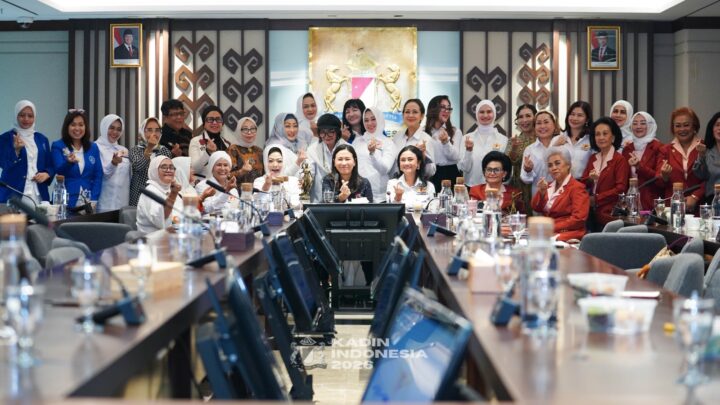
Jakarta – The Indonesian Chamber of Commerce and Industry (Kadin Indonesia) held a Focus Group Discussion (FGD) titled "Stop the Criminalization of Women Entrepreneurs: Advancing Gender-Responsive Policy Implementation and Ensuring Legal Protection for Women in Conflict with the Law, Particularly Women Entrepreneurs, Towards Planet 50:50 and Golden Indonesia 2045" at Kadin Indonesia Tower in South Jakarta on Wednesday (July 22, 2026).
Kadin Indonesia Coordinating Vice Chairwoman for Social Affairs, Nita Yudi, emphasized the importance of ending the criminalization of women entrepreneurs, citing their substantial contribution to Indonesia's economy, particularly through the micro, small, and medium-sized enterprise (MSME) sector.
"Women entrepreneurs should never be underestimated or criminalized. On the contrary, women entrepreneurs—especially those in the MSME sector—contribute approximately 62 percent of Indonesia's GDP. Of the country's 65 million MSMEs, around 60 percent are owned by women," Nita said.
Nita explained that if Indonesia is to achieve the 8 percent economic growth target envisioned by President Prabowo Subianto, the country must continue to encourage more women to become entrepreneurs rather than allowing them to face criminalization.
"When women entrepreneurs encounter legal issues, they should be supported—not criminalized. We must also ensure they have access to legal assistance because legal language often differs significantly from everyday language, creating potential pitfalls," she said.
Meanwhile, Deputy Minister of Women's Empowerment and Child Protection, Veronica Tan, expressed hope that the forum would produce concrete solutions to strengthen legal protection for women, particularly women entrepreneurs.
She explained that Indonesia already has an adequate legal framework, including Supreme Court Regulation (PERMA) No. 3 of 2017 on Guidelines for Adjudicating Cases Involving Women in Conflict with the Law, as well as provisions under the Law on Sexual Violence Crimes (TPKS Law). However, she stressed that the greatest challenge lies in effective implementation and legal assistance.
"The regulations are already in place. What needs to be strengthened is their implementation—ensuring that judges and prosecutors examine cases through a gender perspective while guaranteeing that legal services and assistance are properly provided," Veronica said.
She also expressed hope that the discussion would serve as the foundation for a long-term roadmap, including the establishment of a community of legal advocates who share the same gender-sensitive perspective in protecting women facing legal proceedings.
"Our hope is not only to produce solutions for this year but also to build a community of legal advocates with a shared perspective. Women are not asking for special treatment—they simply seek justice. The state has a responsibility to protect everyone, and no one should be left behind," she said.
Echoing this view, Chairwoman of the Indonesian Women's Congress (KOWANI), Nannie Hadi Tjahjanto, expressed hope that the FGD would generate practical solutions to address the various forms of violence and legal challenges faced by women entrepreneurs. She emphasized that women play a strategic role in safeguarding the economic resilience of both families and the nation, particularly during difficult periods such as the COVID-19 pandemic.
"Women play a vital role in uniting families, strengthening the nation, and safeguarding national resilience. Therefore, let us encourage all women's organizations and communities to work together in supporting and empowering women," Nannie concluded.
Also attending the event were Kadin Indonesia Vice Chairwoman for Women's and Children's Empowerment Tatyana Sentani Sutara and Chairwoman of Kadin Indonesia's Standing Committee on Women's Empowerment and Child Protection, Jurika Fratiwi.